%20(1).png)

Virtual Assistant for Event Vendors: The Complete Guide


Event vendors, florists, DJs, caterers, photographers, AV crews, rental companies, venues, planners, coordinators, and sound engineers share a problem almost nobody outside the industry understands. It isn't that the work stops coming in. It's that the operational layer around the work can't stretch any further without someone burning out.
You can only quote so many inquiries between events. You can only chase so many deposits between load-ins. You can only follow up on so many reviews between the next booking cycle. And the moment you try to grow, add a second team, book a second weekend, expand into a second market, the admin that was already stretched thin snaps.
This is the problem a virtual assistant for event vendors exists to solve. Not by replacing the creative or the on-site execution, but by absorbing the operational and administrative layer that sits underneath it. This guide is the complete overview: which vendor categories benefit most, which operational workflows delegate best, when to hire, how to sequence the handoff, what mistakes to avoid, and where the real case-study evidence lives. Each section links to a deeper piece if you want to go further on a specific angle.
Key Takeaways
Event vendors across every category planners, venues, florists, DJs, caterers, AV, sound, rentals hit the same operational ceiling: their admin capacity, not their creative capacity, is what caps growth.
The five workflows almost every event vendor benefits from delegating are: inquiry response and lead qualification, booking and contract management, event-week logistics, vendor and partner coordination, and post-event follow-up.
Response time is the highest-leverage lever for most event vendors; every hour of delayed reply measurably reduces booking rates.
The right time to onboard a VA is Q4 or Q1, before peak season. Trying to hire in June or July is the single most common event-industry mistake.
Structured delegation typically produces measurable capacity gains within 60 days, and YSO's published case studies document this pattern across floral, DJ, product/inventory, and multi-brand event businesses.
Why Event Vendors Are a Distinct Category
The event industry isn't one business. It's a chain of specialist businesses that coordinate around a single date, and each specialist has an operational profile that doesn't quite fit standard small business advice.
The Events Industry Council's Global Economic Significance of Business Events study documents that business events alone generate more than a trillion dollars in direct spending globally each year, and that number doesn't include weddings, private social events, or festivals. The U.S. Bureau of Labor Statistics describes event planning as a role dominated by administrative and coordination work, and for vendors specifically, that admin layer sits on top of a physical service that has to be delivered on a specific date at a specific location.
Three things make event vendors operationally distinct:
Extreme time compression. Every wedding, festival, corporate offsite, or private event has a hard deadline. There's no rescheduling. That compresses admin quote turnaround, contract signing, vendor coordination, and timeline distribution into windows that don't forgive delay.
High-touch client relationships. Most event vendors sell high-consideration purchases. Weddings alone average a 12–15-month planning cycle. Every client interaction over that period shapes the review, the referral, and the repeat booking.
Network-dependent operations. No event vendor works alone. Florists talk to venues. Caterers talk to rental companies. DJs talk to photographers about ceremony timing. That cross-vendor communication is a full operational layer on top of client work.
Those three characteristics are why generalist "virtual assistant" advice tends to miss for event vendors. The delegation sequencing, the operational systems, and the seasonal timing all work differently.
The Event Vendor Categories
The rest of this guide covers the workflows that apply across all event vendors. This section breaks down what's specific about each vendor category, with links to the deeper articles for each.
Event Coordinators and Planners
Coordinators are usually the clients of every other vendor on this list. Their operational challenge is different; instead of running one specialty, they run the coordination across every other specialty. Inbox management, vendor sourcing, timeline drafting, RSVP tracking, and client planning cadence dominate the workload.
Deeper reading: what to delegate first to an event coordinator VA and the five costly mistakes event coordinators make when delegating.
Wedding Venues
Venues sit at the center of the vendor network. Every florist, caterer, DJ, and planner working a given weekend routes information through the venue team, on top of the venue's own client planning cycle. Tour scheduling, contract and payment tracking, preferred vendor and COI collection, and event-week logistics dominate venue operations.
Related reading: managing clients, quotes, and event logistics with a VA.
Florists
Event florists, especially at the wedding and luxury event level, balance intensive creative work (design meetings, sourcing, arranging) with a heavy client communication load. The creative work is what pays; the admin is what caps how many events they can take.
Deeper reading: YSO's florist virtual assistant service page and the piece on how a virtual assistant for florists helps the business grow.
DJs, Hosts, and Emcees
Event DJs run on inquiries, playlist coordination, ceremony-timeline alignment, and on-the-day performance. The admin layer quote turnaround, playlist collection from clients, ceremony timing coordination with photographers and coordinators, contract and deposit tracking is where DJs consistently leak revenue.
Deeper reading: YSO's VA support page for DJs, hosts, and emcees.
Catering Businesses
Catering has some of the most complex operational profiles in the event industry: menu customization, guest count changes, staffing per event, kitchen logistics, dietary tracking, and rental coordination for service pieces. It's also one of the fastest-scaling categories when operations get systematized.
Deeper reading: what catering businesses should delegate first and why going solo is stalling catering business growth.
Photographers and Videographers
Event photographers and videographers run on inquiries, engagement session scheduling, timeline coordination with the coordinator or venue, and, critically, post-event editing and delivery timelines. The bottleneck is almost always the client communication layer around editing.
Deeper reading: YSO's VA support page for photographers and videographers.
Rental Companies
Rental companies' linens, tables, chairs, tents, dishware, and décor run inventory operations with delivery logistics layered on top. The quote-to-order workflow is where they leak revenue fastest, and damage waiver and deposit reconciliation are where cash sits unrecovered.
AV and Sound Companies
Audio-visual and sound companies serve the technical infrastructure layer of events. Their operational profile blends rental-style logistics (equipment moving in and out) with service-style scheduling (technicians on-site).
Deeper reading: why AV companies need better event operations and why hiring a VA improves operational efficiency for sound companies.
Corporate Event Planners
Corporate event planners operate in a distinct market from social event planners. B2B sales cycles, sponsor relationships, RFP responses, and stakeholder management look nothing like wedding planning. Generalist event VAs often struggle with this vertical.
Deeper reading: why generalists struggle with corporate B2B events.
The 5 Operational Workflows Most Event Vendors Delegate
Across every vendor category above, the same five workflows recur as the highest-value delegation targets. The specific tasks inside each workflow vary by category, but the pattern holds.
1. Inquiry Response and Lead Qualification
Response speed is the single highest-leverage lever for event vendors. Research widely referenced across sales operations, including the Harvard Business Review analysis by James Oldroyd on the short life of online sales leads, found that firms contacting potential customers within an hour of a query were nearly seven times more likely to qualify the lead than firms that responded even an hour later, with a steep drop-off from there.
A trained event VA can monitor inquiry forms, DMs, marketplace messages (The Knot, WeddingWire, Zola, industry directories), and inbox in real time; send a qualified first response; ask defined qualification questions; and book the discovery call or tour directly. This is almost always the fastest ROI in an event vendor delegation.
2. Booking, Contracts, and Payment Management
Once a lead is qualified, the paperwork loop is where event vendors leak revenue. Contracts sent late. Deposits were chased weeks after the verbal yes. Payment schedules are missed because nobody's tracking them.
A VA can draft contracts from your templates (you approve before sending), issue invoices, track payment status across all bookings, send reminders on defined cadences, and reconcile deposits against your calendar. This workflow is covered in more operational depth in YSO's post on managing clients, quotes, and event logistics with a VA.
3. Event-Week Logistics
The week before every event is when vendor operations get loudest. Timelines get finalized. Vendor arrivals get confirmed. Day-of contact sheets get distributed. Weather contingencies are communicated for outdoor events.
Delegate the entire event-week package: timeline distribution, vendor confirmation calls, day-of contact sheets, load-in coordination, and weather contingency communications. This is templatable work that eats hours in the week before every single event.
4. Vendor and Partner Coordination
Event vendors don't work alone; they work in a network of specialists coordinating around the same date. That network communication (introductions, timeline reconciliation, referral tracking, preferred vendor list maintenance) is a full operational layer.
A VA can own the entire cross-vendor communication layer. The compounding effect is significant: the vendor who consistently shows up prepared becomes the vendor other specialists refer to, which drives inbound pipeline without ad spend.
5. Post-Event Follow-Up
The post-event window is where most vendors leave revenue and reputation gains on the table. Reviews don't get requested. Referral thank-yous don't get sent. Testimonials don't get captured. Repeat-client outreach doesn't happen.
Delegate the full post-event sequence: structured review requests (Google, The Knot, WeddingWire, category-specific platforms), thank-you notes, photo request follow-up with the photographer, testimonial capture, and repeat-booking outreach on anniversaries. Small, consistent, and largely absent from most event vendor operations, which is why turning it on tends to move the needle.
When Event Vendors Should Actually Hire
The timing question matters more than most event vendors realize. Peak event season in most U.S. markets runs May through October, with a secondary peak in December for corporate holiday events and winter weddings.
Q4 (October–December). Best onboarding window. Traffic from newly engaged couples spikes after Thanksgiving. Onboarding lands before peak-season inquiry volume.
Q1 (January–March). Second-best window. Contract and payment workflows peak as clients book for the coming season. A VA onboarded in January is fully ramped by April.
Q2 and Q3. Worst hiring windows. By the time you're drowning in May, you don't have training bandwidth. This is the single most common event-industry hiring mistake.
More detail: the best time of year to hire an event virtual assistant.
How to Delegate Well: The First 90 Days
Three things separate a VA who saves you time from one who creates more work. Research consistently backs up the same pattern. A widely cited McKinsey analysis on knowledge work found that office workers spend significant portions of their week searching for information they should already have access to. Clear documentation and access management cut that overhead.
Write the SOP before the first task. A short Loom video plus a one-page checklist outperforms hour-long calls. For a deeper look at why process mapping matters, see YSO's post on why process mapping and SOPs come first.
Share access deliberately. Use a password manager (1Password, Bitwarden, LastPass) and grant scoped access per task. Full inbox and payment access on day one is a control problem waiting to happen.
Schedule a 15-minute end-of-day check-in for the first two weeks. This isn't micromanagement; it's how context gets transferred. After two weeks, drop it to twice weekly.
Measure outcomes, not hours. The right metric depends on the workflow: response time, booking conversion, deposit collection speed, review count, planning-meeting no-show rate. Not hours logged.
Watch for the growth signal. After 60–90 days, most event vendors identify a second wave of delegation to expand into marketing, bookkeeping, or a specialty coordinator. YSO's post on why most event businesses outgrow their first virtual assistant covers what that transition looks like, and how many event assistants your business actually needs covers when to add the second.
Marketing and Growth Work an Event VA Can Also Own
Beyond core operations, event vendors often expand VA scope into marketing tasks as trust builds. Social media management, blog scheduling, email marketing, portfolio maintenance, and review-collection systems all fit inside the VA scope with defined SOPs.
More detail: marketing your event business tasks your VA should own and productivity hacks for event planners working with a VA.
Case Studies: What This Looks Like in Practice
YSO has documented 14 client engagements in its published case studies library. A few that speak most directly to event vendor operational scaling:
b.box for Kids USA. Product-inventory business (analogous operationally to rental companies). The engagement is documented in the full case study on how YSO helped b.box free up 30+ hours per week, build scalable systems, and deliver 2–3x expected output. The scaling pattern of SOP-driven delegation, defined approval loops, and outcome-based measurement is the same template event vendors need.
Naunet Floral. Luxury floral design studio serving weddings and events. Structured delegation across inbox triage, lead follow-up, and event timeline management freed 30+ hours per week for the founder, allowing focus on design work and high-touch client meetings.
DJ Will Gill. Corporate and event DJ, recognized on the Forbes Next 1000 list of top small business entrepreneurs. Operational handoff supported 57% year-over-year growth by removing the inquiry response and booking coordination bottleneck.
The Think Mill. Multi-brand events portfolio. Operational scaling across multiple brand units under one operator through structured VA delegation.
These are documented on YSO's case studies page, and the pattern across all of them is consistent: operational handoff first, capacity growth after.
Common Mistakes Across Every Vendor Category
Hiring creative staff before operational staff. Bringing on a second florist, DJ, shooter, or coordinator when the admin is what's capping you doubles creative capacity but not booking capacity. The bottleneck moves; it doesn't disappear.
Delegating without SOPs. A VA without documented processes will make judgment calls that don't match how you'd handle it, and you'll spend the time you saved undoing them.
Measuring in hours instead of outcomes. Wrong metric. Track results, not activity.
Skipping a shared password manager. Sharing raw credentials is a control problem. Use 1Password, Bitwarden, or LastPass with scoped access per task.
Ignoring red flags during hiring. Not every VA candidate is a fit for event work. YSO's post on red flags to watch for when hiring an event VA covers what to filter out.
When a Virtual Assistant Isn't the Right Answer
To keep this honest: a VA doesn't fix every operational problem. If your issue is pricing (rates too low to support any hire), positioning (competing on the wrong criteria), or fulfillment quality (the creative or on-site execution itself isn't landing), a VA will make the underlying problem louder, not smaller. Fix those first. A VA scales what's working; it doesn't rescue what isn't.
How YSO Places VAs With Event Vendors
YSO is a Women-Owned Small Business that places trained virtual assistants specifically with event vendors and event-adjacent businesses, including planners, venues, florists, DJs, caterers, photographers, AV/sound, and rental companies. Every VA we place comes in with event-industry context, meaning your team doesn't spend the first month explaining ceremony timelines, load-in windows, or vendor network etiquette.
If you want to walk through your specific operation and where a VA would land first, book a free consultation.
Frequently Asked Questions
What does a virtual assistant for event vendors actually do?
Event vendor VAs handle the administrative, coordination, and communication layer around your creative or on-site work. Common workflows include inquiry response, quote and booking management, contract and payment tracking, vendor and partner coordination, event-week logistics, and post-event follow-up, including reviews and repeat outreach. They don't typically run events on-site or handle physical work; they run the operational infrastructure.
How much does a virtual assistant for event vendors cost?
Pricing varies with hours, experience, and scope. Most event-focused VA engagements in the U.S. run depending on the arrangement, with agency placements typically falling in the middle of that range. Direct hires are cheaper hourly but include hiring, training, and replacement risk absorbed by the owner.
Is it better to hire a VA or a full-time employee?
A VA makes sense when your need is variable (peak seasons, specific projects) or when you want to test workflows before committing to a full hire. Full-time hires make sense once you've identified a stable 40+ hour-per-week need and want someone long-term in your culture and pipeline.
Should I hire a generalist VA or one with event experience?
Strongly recommended: event experience. A generalist can learn, but the ramp is meaningfully longer. Event-industry context, knowing what a run-of-show is, understanding vendor relationships, recognizing seasonal urgency, and being comfortable in wedding platforms like The Knot and WeddingWire cuts onboarding time roughly in half.
How long until I see ROI?
Operational lift (response time, hours reclaimed) is measurable within 30 days. Revenue impact of higher booking conversion, tighter deposit collection, more reviews, and referrals typically shows up between days 60 and 90.
Can a VA work with my existing tools?
Yes. Trained event VAs work fluently across Honeybook, Dubsado, 17Hats, Aisle Planner, Planning Pod, Point of Rental, Booqable, Slack, Notion, Google Workspace, Microsoft 365, and most event-industry platforms.
Do I need one VA or a team?
Start with one. A single well-trained generalist covers the core operational workflows for most event vendors doing under 60 events a year. Add specialists (bookkeeping, marketing, on-site coordination) once the first VA hits capacity, not before.
What's the biggest mistake event vendors make when delegating?
Delegating without SOPs. Every documented failure of an event VA engagement traces back to inadequate process documentation upfront. The one-hour investment in a clear SOP saves 20+ hours of correction downstream.
About YSO
Your Startup Operations (YSO) is a Women-Owned Small Business (WOSB)-certified virtual assistant and operations agency founded by Jenna Henao and Alexis Schomer. The company has been featured in Forbes, Authority Maximizer, and Voyage LA, and has published 14 client case studies highlighting measurable operational results. Learn more by exploring our case studies.
About the Author

Alexis Schomer is Co-Founder and Marketing and Operations Expert at Your Startup Operations. She helps business owners transform complex operations into organized systems, efficient workflows, and teams equipped to execute with clarity. With experience spanning HR, finance, operations, recruitment, management, sales, and marketing, she has helped multiple startups establish the foundation needed to scale from six figures to seven figures.
About the Reviewer

Jenna Henao is Co-Founder and Operations Expert at Your Startup Operations. She helps business owners reduce operational overwhelm by improving efficiency, creating stronger delegation systems, and building the right support structure to help their businesses grow.
Free Resources
Discover practical tools, templates, and SOPs to help you streamline operations, delegate effectively, and scale your business with confidence.
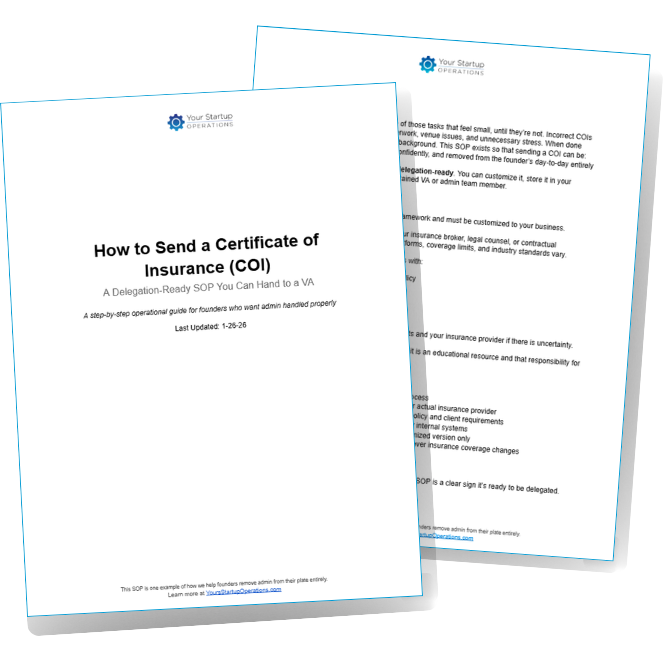
How to Send a Certificate of Insurance (COI)
Submitting a COI can quickly become complicated if details are missing or incorrect.
This SOP provides a clear, step-by-step process to help you send certificates accurately, avoid delays, and
reduce last-minute revisions.
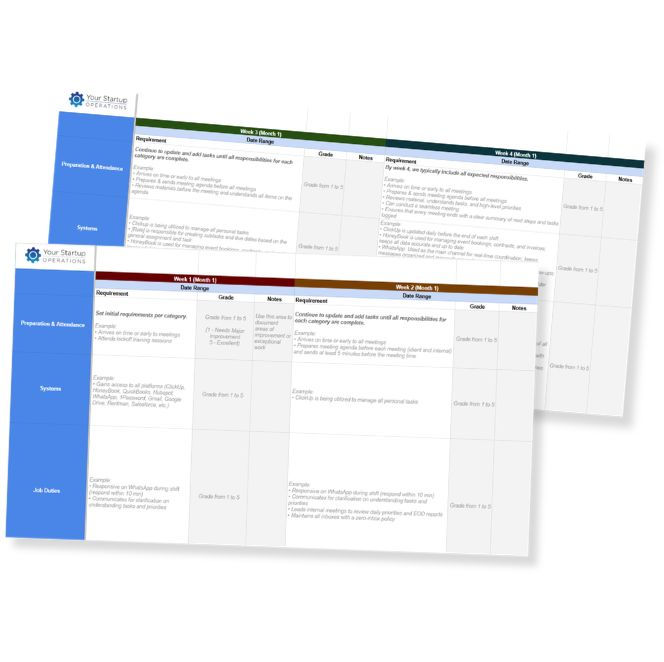
90-Day
Onboarding
Template
Set new hires up for success with a structured onboarding plan.
This template
helps you establish clear expectations, assign responsibilities, and track progress so every new
team member
starts with
confidence.

VA
Interview
Questions
Finding the right virtual assistant starts with asking the right questions. This interview guide helps you evaluate experience, communication skills, problem-solving ability, and ownership to identify a VA who aligns with your business needs.


