%20(1).png)
Event Operations in 2026: Trends, Tools, and Workflow Shifts Worth Watching
- Alexis Schomer

- Jul 17
- 10 min read

The event industry has always changed slowly until suddenly, it hasn't. The shift from pen-and-paper planning to spreadsheets took a decade. The shift from spreadsheets to platforms like Aisle Planner, Honeybook, and Dubsado took another turn. But the shift happening right now, driven by AI, remote-first operations, and platform consolidation, is compressing five years of change into eighteen months.
Most event vendors we talk to know something is changing. They see planners using new tools. They notice their own inbox filling up with AI-drafted vendor pitches. They read about consolidation in the wedding platform space. But turning that vague sense of "things are moving fast" into actual decisions about what to adopt, what to ignore, what to watch is harder than it sounds.
This guide walks through the event operations trends 2026 worth paying attention to, the tools that matter, and the workflow shifts that are quietly becoming standard practice. It's written for event vendors and coordinators who don't want to chase every shiny thing but do want to stay current on what actually matters.
Key Takeaways
AI-assisted operations moved from experimental to expected between 2024 and 2026. Vendors who aren't using AI for at least inquiry response, quote drafting, or content generation are increasingly at a competitive disadvantage.
Remote and hybrid vendor teams are now standard, not exceptional. The events industry followed the broader workforce shift, and the "you have to be in the office" mindset is largely gone from operational roles.
Data-driven decision-making has moved from the corporate event world into the SMB event vendor space. Small vendors are tracking KPIs their peers weren't measuring five years ago.
Wedding platform consolidation reshaped where couples find vendors. The Knot Worldwide's ownership of both The Knot and WeddingWire, combined with Zola's growth, means fewer marketplaces matter more.
Sustainability entered vendor operations as a real consideration, not a marketing checkbox, with vendor and venue partners increasingly asking about it.
What's Changed and What Hasn't
Before getting into the trends, some honest context: not everything about event operations has changed. The fundamentals of client relationships, vendor networks, timeline management, and on-site execution look almost exactly like they did five years ago. Anyone telling you "everything is different now" is selling something.
What has changed is the tools and workflow layer underneath those fundamentals. The client meeting still matters. The tools you use to prepare for that meeting have changed. Vendor coordination still matters. The way you actually run that coordination looks different from how it did in 2020.
The U.S. Bureau of Labor Statistics' description of event planning still classifies the role by the same core skills: coordination, communication, administrative work, and project management. What's shifted is what those skills look like in daily practice.
The 7 Trends Actually Worth Watching
1. AI Moved From Experimental to Expected
The single biggest operational shift heading into 2026 is that AI-assisted work moved from "some vendors are trying it" to "most vendors are using it for at least a few workflows." Inquiry response drafting, quote generation, timeline drafting, email polishing, and content creation are the most common use cases.
McKinsey's research on generative AI adoption across knowledge work has documented how quickly professional workflows adopted AI tools between 2023 and 2025. Event operations followed the same curve, just a year or two behind other service industries.
What this actually means for event vendors: if you're still drafting every inquiry response from scratch, you're spending time your competitors aren't. AI doesn't replace the operational judgment; it removes the time cost of the mechanical drafting.
For more on the delegation logic that lets AI-assisted work actually save time, see YSO's post on why process mapping and SOPs come first.
2. Remote and Hybrid Vendor Teams Are Now Default
The debate about whether operational roles in event businesses could be remote basically ended between 2022 and 2024. By 2026, virtual assistants, remote coordinators, and hybrid teams will be the default operational structure for event vendors, not the exception.
Harvard Business Review has extensively documented how remote and hybrid work reshaped knowledge work across service industries, enabling organizations to rethink where and how administrative, operational, and coordination work gets done. Those same shifts have expanded opportunities for event businesses to build remote operations teams.
What this means for event vendors: your talent pool is national (or international), not local. The best coordinator or operations person for your business probably doesn't live in your city. Businesses that still restrict hiring to a 30-mile radius are competing for a much smaller candidate pool.
3. Data-Driven Decision Making Moved Into SMB Events
Corporate event teams have measured everything for years. What's new is small and medium event vendors, florists doing 40 weddings a year, DJs doing 60, rental companies doing 80, building actual dashboards and running their operations on measurable KPIs.
Response time. Booking conversion. Deposit lag. Vendor referral rate. Repeat-client rate. Five years ago, most SMB event vendors weren't tracking any of these numbers. In 2026, more of them are.
For more on which numbers actually matter, see YSO's post on managing clients, quotes, and event logistics with a VA, which touches on the operational metrics vendors are increasingly tracking.
4. Wedding Platform Consolidation Reshaped Lead Sources
The Knot and WeddingWire operating under The Knot Worldwide have been a reality for years now, but the practical effect on vendor operations continued to compound through 2024 and 2025. Zola grew. TikTok became a real discovery channel for younger couples. Google Business Profile mattered more, not less, despite predictions of its decline.
According to The Knot's Real Weddings Study, which surveys tens of thousands of couples annually, discovery patterns continued shifting through the mid-2020s toward a more concentrated but more visual set of channels. What this means practically: your presence on fewer platforms, but done well, matters more than being on many platforms half-heartedly.
5. Sustainability Stopped Being a Marketing Checkbox
Sustainability in events used to be a nice-to-have that some couples asked about. By 2026, it will become an active procurement question for planners and venues asking vendors about waste practices, sourcing, and carbon footprint as part of vetting decisions.
The Events Industry Council's Sustainable Event Standards demonstrate that sustainability has become a core part of professional event planning rather than an optional initiative.
6. Client Experience Personalization at Scale
The paradox of 2026 event operations: clients expect a more personal experience than ever, and vendors need to deliver that personal experience across more clients than ever. The way this actually works is through better systems, not more hours.
Client questionnaires that adapt based on prior answers. Automated but timely follow-ups that feel human. Portfolio galleries curated to each client's style. This kind of personalization at scale used to require a marketing team. In 2026, it's increasingly running through the operational layer of the business.
For more on how event vendors are approaching this shift, see YSO's post on what to delegate first to an event coordinator virtual assistant. The same operational infrastructure that supports scale also enables personalization.
7. Financial Infrastructure Evolution
The payment layer of event operations has shifted meaningfully. Stripe, Square, and dedicated event-industry platforms have made split payments, payment plans, and even wedding-specific financing more standard. The U.S. Small Business Administration's guidance on managing cash flow still applies; the fundamentals of cash flow haven't changed, but the tools available to smooth it have.
What this means practically: deposit structures, payment schedules, and refund policies that reflect current infrastructure produce dramatically better cash flow than terms designed around 2018-era payment processing.
Tools Worth Watching
The tool landscape in event operations changes fast, but a few categories are worth tracking regardless of the specific vendor:
AI writing and communication tools. ChatGPT, Claude, and category-specific integrations in event platforms. Use case: drafting inquiries, quotes, timelines, and client communications.
Event management platforms. Honeybook, Dubsado, 17Hats, Aisle Planner, Planning Pod, and category-specific tools have all added significant functionality between 2023 and 2026. The right choice depends on your business model.
CRM tools optimized for events. Pipeline management, lead scoring, and booking workflow automation.
Marketplace and discovery platforms. The Knot, WeddingWire, Zola, Google Business Profile, category directories.
Financial and payment tools. Stripe, Square, dedicated event billing platforms, deposit and payment schedule automation.
Team collaboration. Notion, ClickUp, Asana, and Slack, all of which are increasingly used as the "operational spine" of event businesses.
The mistake most vendors make with tools is chasing new ones instead of using the ones they already have well. If your current CRM has features you've never used, adopting a new tool won't fix that; it'll just move the underutilization.
Workflow Shifts You Should Actually Adopt
Not every trend is worth adopting. But a few workflow shifts are genuinely worth adopting because they compound quickly:
AI-drafted first responses reviewed by a human. The workflow that saves the most time in 2026 event operations. AI drafts, human polishes, and sends. Cuts response time by more than half without losing voice.
Async status updates instead of standing meetings. Weekly written summaries instead of hour-long team meetings. Reads faster, documents better, respects everyone's time.
Automated review requests at a set trigger. The single highest-ROI post-event workflow. Requests fire automatically at your defined interval; response rate roughly doubles.
Templated but customized client questionnaires. Base template plus 3–5 client-specific questions. Feels personal, saves preparation time.
Vendor referral tracking as a real number. Not just gratitude, but actual measurement. Referrals compound only if you know who's sending them.
Case Studies: Modern Operations in Practice
Across YSO's published case studies, the pattern for well-scaled operations in the 2024–2026 window is consistent: the businesses growing weren't the ones with the most creative talent; they were the ones with the best operational infrastructure.
DJ Will Gill, a corporate and event DJ recognized on the Forbes Next 1000 list of top small business entrepreneurs, scaled 57% year-over-year through structured operational delegation, the kind of measurable growth that's characteristic of modern event operations.
Naunet Floral, a luxury floral studio, freed 30+ hours per week for the founder through operational restructuring around inbox triage, lead follow-up, and event timeline management.
Simply Branded, another YSO engagement, produced 12x ROI in under four months once the operational infrastructure was built.
Different businesses, different verticals, same pattern: infrastructure first, growth second. That's the story of event operations heading into 2026.
What to Focus On If You're Behind
Not every event vendor is where they want to be operationally. If you're reading this feeling three years behind, that's actually a common position, and it's fixable. Priority order:
Fix response time first. Get your inquiry response within an hour during business hours. This has the highest ROI and the shortest time-to-visible-impact.
Add AI to your existing workflow. Not by replacing your CRM or overhauling your tools. Just by using AI to draft the mechanical writing you're currently doing manually.
Start tracking three or four KPIs. Not a dashboard. A spreadsheet. Response time, booking rate, deposit lag, review count. Monthly.
Formalize one workflow into an SOP. Just one. Whichever is broken most often. Written down, testable, delegable.
Then consider your hire. After the above are in place. Not before.
For a deeper look at the hiring side, see YSO's post on why most event businesses outgrow their first virtual assistant and how many event assistants your business actually needs.
How YSO Helps Event Businesses Stay Current
YSO places trained virtual assistants specifically with event vendors and event-adjacent businesses, including on the operational workflow shifts described in this article. Every VA we place has current context on the tools, platforms, and workflow patterns discussed above.
If you want to talk through where your operation sits relative to the 2026 baseline and where to focus first, book a free consultation.
Frequently Asked Questions
What are the biggest event operations trends in 2026?
AI-assisted operations, remote and hybrid vendor teams as default, data-driven decision making in SMB event businesses, platform consolidation reshaping lead sources, sustainability entering procurement decisions, personalization at scale through better systems, and evolved financial and payment infrastructure. Not all seven matter equally to every business; pick the two or three most relevant to your operation.
Should I be worried about AI replacing my event business?
No. AI replaces mechanical writing and drafting; it doesn't replace client relationships, creative work, or on-site execution, which is where event vendors actually deliver value. The vendors at risk aren't the ones with strong client relationships. They're the ones whose value proposition is mostly administrative work that AI can now do.
Do I really need to be on TikTok?
Only if your audience is there. TikTok became a real wedding discovery channel for younger couples through 2024–2025, but for corporate event vendors, it's marginal. Look at where your best clients actually find vendors and prioritize accordingly.
Which AI tools should event vendors actually use?
Start with general-purpose AI assistants (ChatGPT, Claude) for drafting communications, quotes, and content. Then layer in event-specific integrations as your primary platforms release them. Chasing the shiniest new AI event tool usually costs more time than it saves.
How do I know if my operations are behind the 2026 baseline?
A rough check: response time under an hour, at least a few KPIs tracked monthly, some form of AI in your workflow (even if just drafting emails), remote team members if you have staff, and a CRM you actually use. If you're missing three or more of these, you're likely a year or two behind.
Are wedding marketplace listings still worth it in 2026?
Yes, but selectively. The Knot Worldwide (which owns both The Knot and WeddingWire) still drives significant lead volume for wedding vendors. Zola grew meaningfully through the mid-2020s. Category-specific directories vary widely; some are still valuable, some are effectively dead. Audit yours annually.
What operational shift is most worth adopting first?
AI-drafted communications reviewed by a human. It cuts inquiry response time by more than half, integrates into your existing tools, and doesn't require any structural change to your business. Highest ROI, lowest effort.
About YSO
Your Startup Operations (YSO) is a Women-Owned Small Business (WOSB) certified virtual assistant and operations agency founded by Jenna Henao and Alexis Schomer. The company connects event vendors, home service businesses, and bookkeeping firms with trained virtual assistants who help streamline daily operations. YSO has been featured in Forbes, Authority Maximizer, and Voyage LA, with 14 published client case studies highlighting measurable improvements and real-world business outcomes.
About the Author

Alexis Schomer is the Co-Founder and Marketing & Operations Expert at Your Startup Operations. She works with business owners to streamline processes, improve delegation, and create scalable systems that support long-term growth. With a background in marketing, entrepreneurship, and operations, Alexis believes successful delegation goes beyond simply bringing on a virtual assistant. It starts with identifying the right fit, building clear workflows, setting expectations, and providing the guidance and training needed for teams to succeed. This practical, people-first approach shapes every client partnership at YSO. Connect with Alexis on LinkedIn.
Reviewed by

Jenna Henao is the Co-Founder and Operations Expert at Your Startup Operations. She helps business owners improve efficiency, strengthen workflows, and develop dependable teams that support scalable growth. With years of experience in entrepreneurship and startup operations, Jenna has led initiatives across HR, finance, recruitment, operations, sales, marketing, and team management. She has helped businesses grow from six to seven figures by building streamlined systems, developing effective processes, and creating operational foundations that allow companies to scale successfully. Connect with Jenna on LinkedIn.
Free Resources
Access practical tools, templates, and SOPs designed to simplify operations, improve delegation, and help your business scale efficiently.
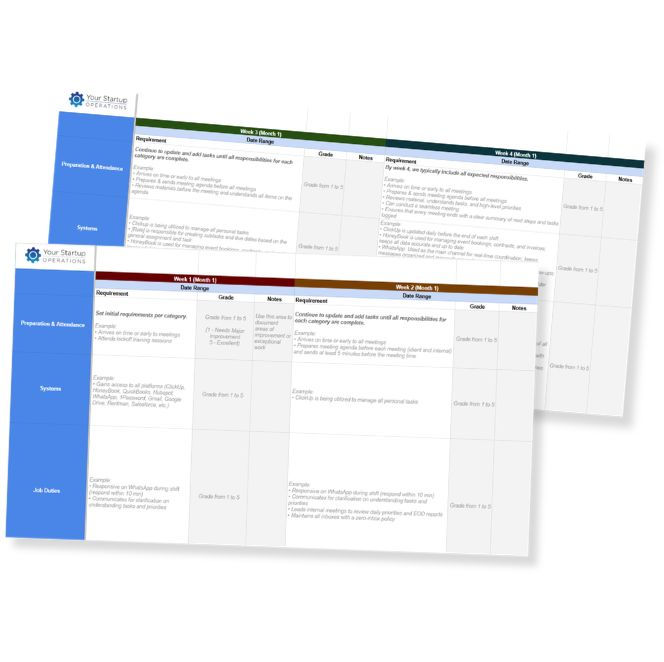
90-Day
Onboarding
Template
A strong onboarding process sets new hires up for success without adding more work to your plate. This template
helps you
establish clear expectations, define responsibilities, and track progress
From day one.

Hire Your
First VA
Guide
Bringing on your first virtual assistant is a big step, but it doesn’t have to feel overwhelming. This free guide walks you through the process so you can confidently
find the right
Support for your business.
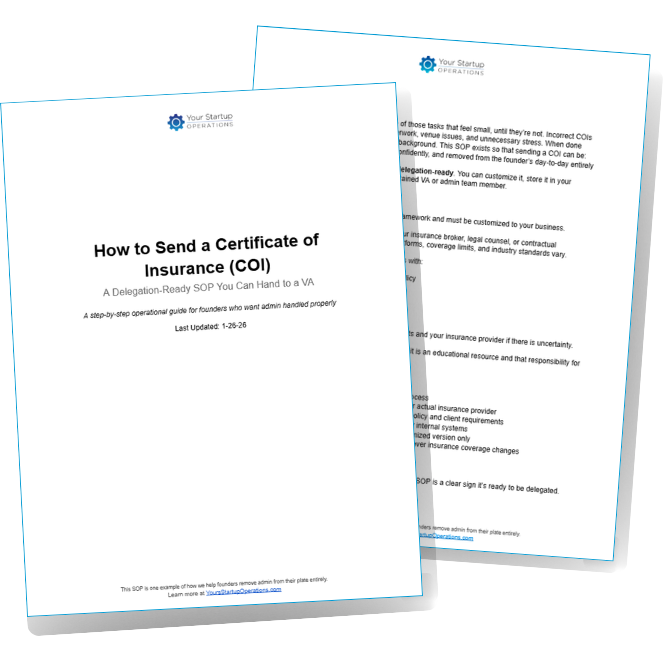
How to Send a Certificate of Insurance (COI)
Submitting a COI can become complicated when details are missed or documents are rejected. This SOP provides a step-by-step process to help you send accurate certificates, avoid delays, and keep approvals moving smoothly.