%20(1).png)

Event Coordinator vs. Event Planner: Where They Overlap

Updated: Jul 31

The most confusing terminology in the event industry might not be "operations" or "production." It's "coordinator" and "planner." Ask ten people what the difference is, and you'll get ten answers. Some use them interchangeably. Some treat them as different job titles for the same work. Some are very particular about the distinction. And when you're the client trying to figure out who to hire or the vendor trying to figure out who to work with, the confusion is expensive.
Event Coordinator Vs Event Planner
distinction isn't semantic. It's about who designs the event and who executes it, whether both jobs happen inside one person or across two people. Whether the engagement lasts 12 months or 6 weeks. Whether the fee is $8,000 or $2,500. Getting the terminology wrong when hiring means you either overpay for work you didn't need or underpay for scope you actually needed.
This guide walks through what each role actually does, where the overlap sits, which one clients should hire, and how the roles usually evolve inside an event business. It's written for event industry professionals figuring out their own positioning, and for clients trying to hire the right role for their event.
Understanding the differences between an event coordinator vs event planner is essential for building efficient event teams. While the roles often overlap, each has distinct responsibilities that contribute to a successful event.
Key Takeaways
Event planners design and manage full-service events from concept to execution, typically engaged 6–12+ months out.
Event coordinators execute the logistics and day-of management, typically engaged 1–3 months out.
Fee ranges differ significantly; planners typically charge multi-thousand-dollar packages; coordinators often charge day-of or month-of rates.
The two roles overlap in day-of execution, which is where terminology gets confused most often.
Career progression in the industry usually moves coordinator → senior coordinator → lead planner, with the shift from "executing someone else's vision" to "creating and executing your own" being the key transition.
Quick Definitions
Event Planner designs and manages events from the concept phase through execution. Full-service planners handle the creative vision, budget planning, vendor selection, timeline creation, client meetings, and typically the day-of coordination as well. Engagement often begins 6–12 months (or more) before the event. Planners tend to charge higher fees; a full-service wedding planner might quote $6,000–$15,000+ in most U.S. markets, with corporate event planning fees varying widely by scope.
An event coordinator executes what someone else either the client or a planner has already designed. Coordinators handle the logistics: timeline execution, vendor coordination, day-of management, RSVP tracking, and the mechanical work of making an event actually happen. Engagement typically begins 1–3 months before the event, sometimes just weeks out. Fees are generally lower; a wedding "day-of" or "month-of" coordinator might charge $1,500–$4,000, depending on market and scope.
Both roles fall under the U.S. Bureau of Labor Statistics classification of Meeting, Convention, and Event Planners, but the industry treats them as meaningfully different jobs despite the shared occupational category. That's an important distinction: the government classification puts them together, but the market reality separates them.
The Core Differences
Same industry. Same broad occupational classification. Very different day-to-day work.
Scope of Involvement
Planners are involved in every part of the event lifecycle: concept, design, vendor curation, budget management, contract review, timeline building, client meetings, and execution. If the event needed it, the planner touched it.
Coordinators are involved in a defined slice of the lifecycle, usually the execution phase. They may join the process 60–90 days before the event to run logistics, or they may only appear the week of the event as day-of managers. The design decisions have typically already been made by the client (with or without a planner) before the coordinator arrives.
Timeline of Engagement
Planners are usually the first vendor booked. Weddings especially, according to The Knot's Real Weddings Study, which surveys tens of thousands of couples each year, wedding planning typically spans 12–15 months, and planners are usually engaged in the first few weeks of that timeline.
Coordinators are booked much later. Day-of coordinators are sometimes booked 4–8 weeks out. Month-of coordinators come in around 30 days before the event. Even "full-service" coordinators rarely enter the picture more than 3–4 months out.
Creative vs Executional
This is the deepest distinction. Planners are creative directors. They shape the vision of what the event will be: the aesthetic, the guest experience, the atmosphere, the storytelling of the day. Coordinators are execution specialists. They take a vision that's already defined and make it real through logistics management.
A planner might spend three hours creating a mood board with the client. A coordinator might spend three hours confirming with each vendor that they know their arrival window. Both are essential work; they're different work.
Fees and Business Models
Planner fees reflect creative and management work over long engagements. Wedding planner packages commonly run $6,000–$15,000+ for full-service, with high-end and luxury markets going significantly higher. Corporate event planners often work on percentage-of-budget or flat-fee retainers.
Coordinator fees reflect execution over shorter engagements. Wedding day-of and month-of coordination commonly runs $1,500–$4,000, again with high-end markets going higher. Corporate event coordinators often work hourly or per-event.
Both ranges vary significantly by region and specialty; this is where researching your specific market matters more than any general guide.
Who Reports to Whom
In organizations that have both roles, coordinators often report to planners or work as part of a planner's team. Solo coordinators typically work independently on smaller events or as subcontractors for larger planning firms. Career progression usually moves from coordinator → senior coordinator → lead planner over 3–7 years for those who want the full-service path.
Where the Roles Overlap
The overlap is where the terminology confusion lives.
Day-of execution. Both planners and coordinators often manage the event day. This is where a full-service planner and a day-of coordinator can look very similar: the same person on-site, the same clipboard, the same headset. The difference is what happened before that day.
Vendor coordination. Planners select vendors; coordinators confirm and manage them on-site. Both interact with the vendor network, just at different points.
Timeline management. Planners build the initial timeline; coordinators execute it. Same document, different phase of work.
Client communication. Both talk to the client, but about different things. Planners have design conversations, budget conversations, and strategic conversations. Coordinators have logistics conversations, confirmation conversations, and day-of conversations.
The overlap is why so many people think the roles are interchangeable. From the client's angle, if you see the same person managing your event on the day, it can feel like the same job regardless of how much work was or wasn't done in the months prior.
For a related look at how these roles fit into broader event operations, see YSO's post on managing clients, quotes, and event logistics with a VA.
Which One Should Clients Hire?
Depends entirely on what the client actually needs. Here's the honest breakdown.
Hire a full-service planner if:
You have limited time to design and manage the event yourself
You want strategic guidance on vision, budget, and vendor selection
You want the same person from concept through execution
The event is high-stakes (large budget, professional reputation involved, high emotional weight)
You don't have relationships with the vendor network already
Hire a coordinator if:
You've already done most of the design work
You have the budget and vendor relationships figured out
You mainly need logistics and execution support
The event is smaller, simpler, or less design-heavy
You're partway through planning and running out of bandwidth
Hire both if:
The event is complex enough to warrant a planner and large enough to need coordinator support on the day
You're doing corporate events with staffing requirements
You want the planner focused on strategy while the coordinator focuses on execution
The Society for Human Resource Management's guidance on writing accurate job descriptions reinforces the principle that role clarity matters; the same principle applies when hiring event professionals. If a client can't tell whether they need a planner or a coordinator, they usually need to figure that out before shopping fees.
Which One Should You Be (If You're the Professional)?
If you're an event professional deciding which direction to grow, the honest tradeoffs:
Coordinator strengths: Lower entry barrier. Faster path to income. Less capital and less client acquisition needed. Individual events are shorter engagements, which can mean more variety and less relationship management. Strong operational skills translate directly.
Planner strengths: Higher fees per engagement. Longer client relationships. More creative expression. Higher ceiling on business scale. But requires stronger design instincts, better client management, and more sustained financial capacity between larger engagements.
Some professionals move coordinator → planner naturally as they build design instincts and relationships. Some stay coordinators intentionally because they prefer the execution work. Neither is a lesser choice; they're different careers.
Case Study: What Operational Support Looks Like for a Planning Organization
One of YSO's clearest documented examples of what structured operational infrastructure produces at scale is Saphineia, an engagement where the team grew from 13 to 34 members through operational systems that supported that expansion.
The engagement, documented in YSO's case studies library, demonstrates the pattern that shows up whenever a service organization scales its human capacity: the operational infrastructure has to be built first, then the team can grow into it. That principle applies equally to planning organizations adding coordinators to their team and to coordinator-focused businesses adding planning capacity. Growth follows systems, not the reverse.
Across YSO's published case studies, including event industry engagements with Naunet Floral, DJ Will Gill, and The Think Mill, the same pattern repeats: the businesses that scaled cleanly built operational scaffolding before adding people, whether those people were planners, coordinators, or a mix.
Common Confusions Between Coordinator and Planner Roles
Calling day-of management "planning." The most common misuse of terminology. Day-of management is coordination. Planning implies design, budget, and vendor curation work done over months. A "day-of planner" isn't really a thing; it's a day-of coordinator.
Treating month-of coordinators as light-service planners. Month-of coordinators do meaningful work in the last four weeks: timeline finalization, vendor confirmation, logistics locking. But they aren't doing full-service planning. Clients expecting design input from a month-of coordinator will be disappointed.
Using "planner" as an aspirational job title. Some coordinators list themselves as "event planners" because it sounds more senior. This creates client confusion when the actual service offered is coordination-only. Better to lead with the accurate title and let the fee reflect the scope.
Assuming planners are always more expensive. Not always. A junior full-service planner might charge less than an experienced senior coordinator. Fees track experience, market, and scope, not just job title.
Treating the terms as regional or generational. Some industries and regions use the terms differently. UK wedding industry often uses "wedding planner" more broadly than the U.S. industry does. Older event professionals sometimes use different terminology than younger ones. Context matters.
For a broader look at role definition mistakes, see YSO's post on what to delegate first to an event coordinator virtual assistant.
The Operational Work Behind Both Roles
Whichever role a business is built around, the underlying operational needs are similar: client management, quote and contract workflow, calendar and meeting coordination, vendor communication, timeline management, and post-event follow-up. What differs is the strategic layer: planners spend more time on design and vendor curation; coordinators spend more time on execution logistics.
For more on structuring that operational layer, see YSO's posts on why process mapping and SOPs come first and why most event businesses outgrow their first virtual assistant.
The Harvard Business Review article on delegation by Jesse Sostrin frames the underlying dynamic: whether the business is coordinator-focused or planner-focused, the owner can't scale without building the operational scaffolding that lets others run parts of the work.
How YSO Supports Planners and Coordinators
YSO places trained virtual assistants specifically with event vendors and event-adjacent businesses, including both planning firms and coordinator-focused businesses. The operational support looks similar across both: client intake, quote and contract workflows, calendar management, vendor coordination, timeline drafting, and post-event follow-up. The strategic and creative work stays with the owner regardless of role type.
If you want to talk through what operational support could look like in your specific practice, book a free consultation.
Frequently Asked Questions
What's the main difference between an event coordinator and an event planner?
Planners design and manage events from concept to execution, typically engaged 6–12+ months out. Coordinators execute what someone else has already designed, typically engaged 1–3 months out. The core difference: planners create the vision; coordinators make the vision happen.
Are the terms "event coordinator" and "event planner" interchangeable?
No, though they're used that way frequently. The confusion is common in job listings, industry conversations, and client-facing communication. Being specific about which role is which, especially when hiring or pricing, prevents mismatched expectations.
Who is more expensive, a planner or a coordinator?
Planners generally are, because their scope is broader and their engagement is longer. Full-service wedding planners commonly run $6,000–$15,000+; day-of or month-of coordinators commonly run $1,500–$4,000. Corporate event pricing varies more widely by scope. Fees within each category also vary significantly by market and experience.
Do I need a planner if I already have a venue coordinator?
Usually yes. Venue coordinators work for the venue, not for you; their job is to make sure your event runs smoothly at their venue, not to manage your vendors, timeline, or overall experience. A venue coordinator plus a planner (or coordinator working for you) is a common setup.
Can I hire a coordinator instead of a planner to save money?
Sometimes if you've already done the planning work yourself. If you haven't, hiring only a coordinator means design decisions get made under time pressure or default to the coordinator's judgment, which may or may not match what you wanted. Coordinators aren't cheap planners; they're specialists in a different phase of the work.
Do event planners always attend the event day?
Full-service planners almost always do, either personally or through a team member. Some planners hand off to an in-house coordinator or an outsourced day-of team for execution, but the planning firm is still on-site. Coordinator-only engagements always include day-of presence.
Can one person do both planning and coordination?
Yes, and many independent event professionals do both. The question is scope per event. Full-service planning plus day-of coordination for a single event is one person's job. Trying to do full-service planning for six concurrent events plus coordination on all of them isn't; that's when firms hire coordinators to expand execution capacity.
How does career progression work between the two roles?
Most event professionals start as coordinators and either stay there intentionally (executing well, growing income per engagement) or grow into planners over 3–7 years (developing design instincts, building client relationships, growing fees). Neither path is universally better they suit different personalities and career goals.
About YSO
Your Startup Operations (YSO) is a Women-Owned Small Business (WOSB) certified virtual assistant and operations agency founded by Jenna Henao and Alexis Schomer. YSO partners with event vendors, home service businesses, and bookkeeping firms by providing trained virtual assistants who help simplify operations and improve day-to-day efficiency. The company has been featured in Forbes, Authority Maximizer, and Voyage LA, and has published 14 client case studies highlighting measurable operational improvements and sustainable business growth.
About the Author

Jenna Henao is the Co-Founder and Operations Expert at Your Startup Operations. She helps business owners build stronger operational systems, improve workflows, and create dependable teams that support sustainable growth. With experience in entrepreneurship and business operations, Jenna has worked across HR, finance, recruitment, operations, sales, marketing, and leadership. She has helped businesses scale from six figures to seven figures by building efficient processes, hiring exceptional talent, and creating the operational foundation needed for long-term success. Connect with Jenna on LinkedIn.
Reviewed by

Alexis Schomer is the Co-Founder and Marketing & Operations Expert at Your Startup Operations. She helps business owners streamline their operations, strengthen delegation, and build scalable systems that support long-term growth. With a background in marketing, entrepreneurship, and business operations, Alexis understands that successful delegation goes beyond hiring a virtual assistant.
It requires finding the right fit, developing efficient processes, setting clear expectations, and providing the guidance and support teams need to thrive. This practical, systems-driven approach is at the heart of every client partnership at YSO.
Free Resources
Explore free tools, templates, and SOPs designed to help you simplify operations, delegate more effectively, and build a business that can grow with confidence.
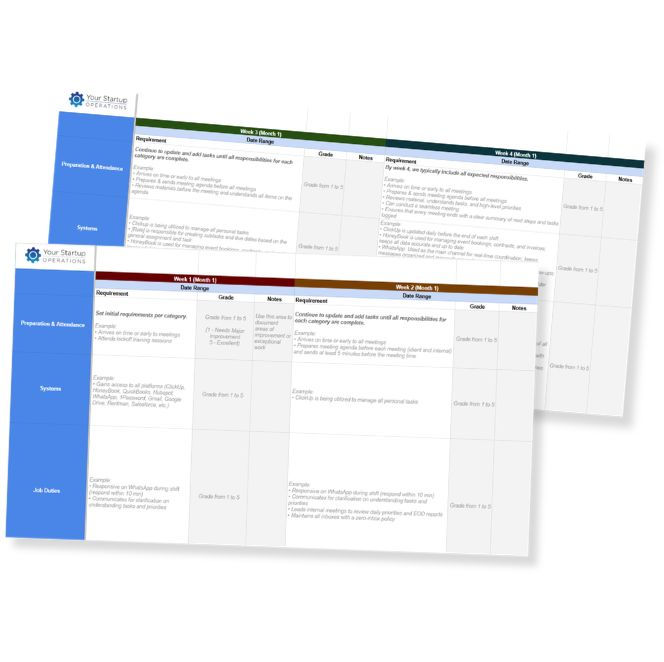
90-Day Onboarding
Template
A great onboarding process should make your life easier, not add more to your workload. Use this template to set clear expectations, assign responsibilities, and measure progress from day one so every new hire is set up for success.

25 Tasks You Can Offload to Your VA Today
From managing your inbox to scheduling meetings and following up with clients, small tasks can quickly take over your day. This guide highlights 25 responsibilities you can confidently delegate to a virtual assistant so you can spend less time on admin and more time growing your business.

The Ultimate
Productivity Toolkit for Event Professionals
Managing an event business means balancing clients, vendors, schedules, and endless follow-ups. This toolkit shares five practical ways a virtual assistant can lighten your workload, reduce administrative tasks, and give you more time to focus on growing your business.


