%20(1).png)

Event Operations Reset: A Quarterly Cleanup Process for Vendor Businesses

Updated: Jul 24

Operations don't stay clean by accident. Even the best-run event business drifts between quarters; SOPs get out of date, vendor lists go stale, tools accumulate that nobody uses anymore, small workflow issues quietly turn into big ones. If you only look at your operations once a year, either during an annual audit or right before peak season, you're catching problems six to nine months after they started.
That's what an event operations reset is for. It's a lighter, quarterly cleanup process not a full audit, not a system rebuild, just a structured pass through your operation every ninety days to catch drift before it becomes damage. Done consistently, it's the single highest-leverage operational habit an event business can build.
This guide walks through what a quarterly operations reset actually includes, how to time it against your event vendors, and how to run it without carving out days you don't have. It's written for event vendors and coordinators who've got the basics in place and now want the discipline to keep those basics working over time.
Key Takeaways
A quarterly operations reset is a lighter process than an annual audit or pre-peak checklist, designed to catch operational drift every ninety days rather than every twelve months.
The reset covers six categories: numbers review, vendor and partner refresh, tool and subscription audit, SOP freshness check, client experience spot-check, and team and financial health.
Total time investment is 8–12 hours across a week or two — not a multi-day project.
The right cadence is quarterly (four times a year), tied to the natural rhythm of your event calendar rather than the standard calendar quarters.
Skipping the reset doesn't cause immediate breakage. It causes gradual drift that shows up months later as bigger, more expensive problems.
Why Quarterly Is the Right Cadence
The wrong cadences are common:
Monthly. Too often. Operational patterns don't shift meaningfully in 30 days. Monthly reviews turn into performative meetings that produce noise instead of insight.
Annually. Too infrequent. A lot happens in twelve months. Problems that show up in month three go unaddressed until month twelve, by which point they've compounded or caused visible damage.
Never. By far the most common. Operations just drift year over year, and the drift shows up as slow declines in metrics that owners then blame on "the market" or "the season."
Quarterly is the right cadence because it matches how business changes actually happen — enough time for real trends to emerge, but short enough to catch problems before they compound. The Harvard Business Review's foundational work on measurement by Robert Kaplan and David Norton established this principle in the context of the balanced scorecard: measurement without an operating rhythm attached to it doesn't produce action, and the right rhythm depends on how fast the underlying business changes. For event vendors, that's quarterly.
The U.S. Bureau of Labor Statistics description of event planning captures why events specifically need this: the role is dominated by administrative and coordination work, most of which decays quietly if nobody's actively maintaining it.
When to Actually Schedule the Reset
Standard calendar quarters (January, April, July, October) work fine for some businesses. Others benefit from tying the reset to event-industry rhythms instead.
For most U.S. event vendors, the four natural reset points are:
Early Q1 (January). Post-holiday recovery. Fresh start of the year. This reset sets up the coming peak season.
Late Q1 / early Q2 (March–April). Just before peak wedding/social season starts in most markets. This reset catches anything that needs to be tight before volume hits.
Mid-Peak (July–August). The lightest of the four. Not a full reset, but a sanity check during the busy stretch to catch anything actively breaking. Skip most categories; focus on numbers and client experience.
Post-Peak (October–November). The most valuable of the four. Fresh memory of what worked and what didn't during peak season. This reset compounds directly into next year's planning.
For corporate event vendors with different seasonality (Q1 conferences, Q4 holiday events), shift the timing to match your peak. The principle stays the same: a lighter reset before peak, a deeper reset after.
For related timing context, see YSO's post on the best time of year to hire an event virtual assistant.
The 6-Category Quarterly Reset
Each category takes roughly 1–2 hours. Total reset runs 8–12 hours spread across a week or two.
1. Numbers Review (90-Day KPI Check)
Pull the same 5–7 numbers you track monthly, but look at the 90-day trend rather than a single month. What to check:
Average inquiry response time trending up or down?
Inquiry-to-booking conversion rate steady, improving, or declining?
Days from contract to deposit received creeping longer?
Reviews received (Google, The Knot, WeddingWire): Is the request-to-review ratio holding?
Vendor referral rate: Is the network still feeding you leads?
Owner hours per event trending in the right direction?
Trend beats snapshot. A single bad month is noise. Three months of drift in the same direction is a signal.
Write down anything that's moved 20% or more from the previous quarter. Those are your reset priorities.
2. Vendor and Partner Refresh
The category most vendors let rot fastest.
Go through your preferred vendor list: the planners, venues, florists, DJs, photographers, and category-adjacent vendors you actively work with. For each:
Are they still active in the business?
Have you worked together in the last 6 months?
Are their COIs current (if applicable to your business)?
Do their referrals still convert well?
Has anything changed about the relationship that should be noted?
Drop vendors who've left the industry or who haven't been active in over a year. Add vendors you've started working with informally but haven't formalized. Send one round of "checking in" emails to any partner who's been quiet for 90+ days.
The Events Industry Council's research on the events ecosystem documents how much of the industry runs on inter-vendor relationships, which means vendor network hygiene isn't optional maintenance; it's core operational work.
For related workflow context, see YSO's post on managing clients, quotes, and event logistics with a VA.
3. Tool and Subscription Audit
The one that saves the most money the fastest.
Pull up your credit card statements and list every recurring software subscription. For each, answer honestly:
Am I actively using this tool?
Is anyone on my team actively using it?
If I canceled it tomorrow, would anything actually break?
Have I explored whether one of my other tools does this same job?
Kill anything you can't justify. Most event businesses have $200–$600 per month of tool sprawl by year 3 subscriptions that got added for a specific project, a specific trial, or a specific person who's since left, and just kept billing.
Also review permissions on active tools:
Are ex-employees or ex-contractors still on any tool logins?
Is your password manager reflecting current team access?
Are shared drives cleaned of files no longer relevant?
4. SOP Freshness Check
The category that determines whether your playbook is living or decorative.
Pick 3–5 SOPs to spot-check each quarter. Rotate through the full library over the course of the year; you don't need to review every SOP every quarter. For each spot-check:
Does the SOP still match how the work actually happens?
Are the tools referenced still current?
Are the templates or forms embedded still the right versions?
Has anything changed about the workflow that isn't captured?
Update anything that's drifted. Flag anything that's fundamentally broken and needs a rebuild; those become quarterly project items, not fixed inside the reset itself.
For deeper context on SOP maintenance, see YSO's post on why process mapping and SOPs come first.
5. Client Experience Spot-Check
The one owners are usually most reluctant to do honestly.
Pick 5 recent client interactions from the last quarter: a mix of inquiry threads, planning meetings, and post-event communications. Read them as a customer would. Not defensively. Honestly.
Was the response tone right?
Was the response time appropriate?
Was the client experience consistent across touchpoints?
Were there missed opportunities to add value, clarify, or personalize?
Did the emails or messages sound like the business you want to be?
Note patterns. If three out of five interactions felt rushed, that's not a coincidence; it's a workflow signal. If the tone shifted meaningfully between the discovery call and the post-event follow-up, that's a signal too.
For related reading on how VAs impact client experience, see YSO's post on what to delegate first to an event coordinator virtual assistant.
6. Team and Financial Health
The final category that stitches together whether the operation is healthy overall.
Team health check:
Is anyone consistently overloaded or under-loaded?
Have role boundaries drifted since last quarter?
Are check-in cadences still happening on schedule?
Any signals of burnout: missed deadlines, defensive responses, quiet withdrawal?
Financial health check:
Is bookkeeping current through end of previous month?
Are outstanding invoices being collected on schedule?
Are there any expense categories that grew unexpectedly?
Is cash flow projected out for the next 60–90 days?
The Harvard Business Review article on delegation by Jesse Sostrin frames why the team check-in matters as much as the financials: teams don't tell owners they're overwhelmed until it's a crisis; owners have to actively check for the signals earlier. Financial checks are similar; the U.S. Small Business Administration's guidance on managing cash flow reinforces the principle that cash flow problems become visible late unless you're actively monitoring for them.
How Long the Reset Actually Takes
For most event vendors, the numbers land like this:
Solo owner running the reset alone. 10–12 hours total, spread across a week or two. Roughly 2 hours per category, plus a synthesis pass at the end.
Owner + VA running it together. 6–8 hours of owner time, with the VA handling data pulls and mechanical work. This is the more common approach.
Established teams with clear role ownership. 4–6 hours of owner time, with team members owning most category work and reporting back at the end.
The reset shouldn't feel like a project. If it does, either you're doing more than a reset (that's a full audit; see YSO's 30-day audit process for that scope) or the operation has drifted so far that a lighter cleanup can't handle it.
Case Study: What Sustained Operational Discipline Produces
One of YSO's clearest documented examples of what sustained operational discipline produces is EmployLaw Group. The full case study on how YSO helped EmployLaw Group onboard 30+ clients and free up 20+ hours per week documents outcomes that come from building operational infrastructure and critically maintaining it over time.
To be transparent: EmployLaw is a legal firm, not an event vendor. The industry is different, but the maintenance discipline is identical. Building operational systems produces the initial gain. Maintaining them through quarterly resets and ongoing discipline is what makes the gain last past the first year. Across YSO's published case studies, including event industry engagements with Naunet Floral, DJ Will Gill, and The Think Mill, the same principle repeats: businesses that build once and stop maintaining tend to see initial gains erode; businesses that build and maintain compound their outcomes over time.
Common Mistakes With Quarterly Resets
Turning it into a full audit. The most common way quarterly resets die. Owners try to do everything the reset covers, plus the audit-level deep work, and burn out before the second quarter. A reset is not a rebuild. If you find yourself opening major projects during the reset, close them and add them to a quarterly project list instead.
Skipping the client experience spot-check. The category that feels least urgent and matters most. Client experience drifts subtly; response tone gets rushed, personalization slips and only shows up in reviews months later. Force yourself through this one every quarter.
Reviewing alone with no accountability. Solo resets fade within two quarters. Do the reset with a partner, coach, or operations person. The accountability is what makes the habit stick.
Not writing anything down. Mental resets don't produce change. Document what you found, what you changed, and what you're carrying forward as project items for the next 90 days.
Over-indexing on numbers, under-indexing on qualitative. KPI review is easy because it's quantitative. Qualitative categories (SOPs, client experience, team health) are what actually produce the biggest wins from a reset. Don't skip the harder categories because they're less measurable.
Trying to fix everything you find during the reset. The reset is a diagnostic and light cleanup, not a repair project. Note what needs deeper work. Schedule it separately. Trying to fix everything mid-reset extends the reset from 10 hours to 40 hours and kills the sustainability.
For related content on the deeper audit process for when the reset surfaces something bigger, YSO has covered how to structure that work in adjacent articles on operational infrastructure.
Event Operations Reset
The 90 days between resets aren't dormant. They're where the fixes actually happen. A functional cadence:
Reset week (week 1): Run the reset. Document findings.
Weeks 2–4: Fix the top 2–3 items that surfaced. Small enough to close inside 30 days.
Weeks 5–8: Work on the medium project items. These usually need a defined scope and owner.
Weeks 9–12: Wrap up any lingering items. Set up next quarter's reset.
The pattern compounds. Every reset produces a shorter list of findings than the one before it, because you're catching drift before it turns into damage.
How YSO Supports Quarterly Operations Resets
YSO places trained virtual assistants specifically with event vendors and event-adjacent businesses to run the mechanical work of quarterly resets, pulling KPI data, auditing vendor lists, reviewing subscriptions, spot-checking SOPs, and compiling findings. Most owners don't need to do the data gathering themselves. They need someone to hand them a synthesized report at the end of reset week and a priority list for the next 90 days.
If you want to talk through how a quarterly reset could work in your specific operation, book a free consultation.
Frequently Asked Questions
How is a quarterly reset different from an annual audit?
The audit is a comprehensive one-time diagnostic typically 30 days, covers every category deeply, and produces a full picture of the operation. The reset is a lighter recurring maintenance process, 8–12 hours across a week or two, spot-checks each category to catch drift. Both are useful; they serve different purposes and shouldn't replace each other.
When should I run my first quarterly reset?
Whenever you can start the habit. There's no perfect starting quarter. The businesses that succeed with quarterly resets are the ones who started imperfectly rather than waiting for the "right" time. Start now, refine the process over the first few resets.
Can I run a reset while events are happening?
Yes, and most vendors do. The 8–12 hour total commitment fits inside a normal work week for most owners, even during moderately busy periods. During peak weeks, defer the deeper categories (SOP check, client experience spot-check) and focus on the fast ones (numbers review, subscription audit).
What if my operation is too small for this?
Even solo vendors doing 15–20 events a year benefit from a quarterly reset. Scale the depth to match: a solo florist might run a 4-hour version of the reset that a multi-team catering business runs at 12 hours. The categories stay the same; the depth adjusts.
Should I involve my team in the reset?
Yes, especially the client experience spot-check, SOP freshness check, and team health check. Owners see the operation from one angle; team members see it from another. Both perspectives are needed for a real reset.
How do I keep the reset from getting skipped?
Schedule it on the calendar 90 days out from the previous one, before the current one is even finished. Owners who wait to schedule the next reset "when they get around to it" reliably don't run it. Owners who schedule immediately do.
What's the single most important reset category?
Probably numbers review, because it surfaces drift you might not have noticed. But the highest ROI over time is usually the vendor and partner refresh category that decays fastest and produces the most visible impact when maintained.
Can a virtual assistant run the entire reset?
The mechanical portions, yes, pulling data, auditing subscriptions, spot-checking SOPs, compiling findings. The judgment portions (deciding what to do with what's found, prioritizing fixes, making people-related calls) stay with the owner. A well-supported reset is a partnership between the two roles.
About YSO
Your Startup Operations (YSO) is a Women-Owned Small Business (WOSB) certified virtual assistant and operations agency founded by Jenna Henao and Alexis Schomer. The agency helps event vendors, home service businesses, and bookkeeping firms improve efficiency by connecting them with trained virtual assistants who support day-to-day operations. Featured in Forbes, Authority Maximizer, and Voyage LA, YSO has also published 14 client case studies highlighting measurable operational improvements and sustainable business growth.
About the Author

Jenna Henao is the Co-Founder and Operations Expert at Your Startup Operations. She helps business owners create efficient systems, optimize workflows, and build high-performing teams that support sustainable growth. Drawing on her experience in entrepreneurship and business operations, Jenna has worked across HR, finance, recruitment, operations, sales, marketing, and leadership. She has helped companies scale from six figures to seven figures by building strong operational foundations, hiring the right people, and implementing processes that enable long-term success. Connect with Jenna on LinkedIn.
Reviewed by

Alexis Schomer is the Co-Founder and Marketing & Operations Expert at Your Startup Operations. She helps business owners streamline operations, strengthen delegation, and build systems that make growth more sustainable. With a background in marketing, entrepreneurship, and business operations, Alexis knows that successful delegation goes beyond hiring a virtual assistant. It requires the right hire, well-defined processes, clear expectations, and ongoing support to help teams perform at their best. This practical, operations-focused approach is at the core of every client partnership at YSO. Connect with Alexis on LinkedIn.
Free Resources
Explore practical guides, templates, and SOPs created to help you streamline your operations, delegate more effectively, and build a stronger foundation for business growth.

Best Practices for Creating an SOP
When your processes aren't documented, your team depends on you for every step. This guide shows you how to create clear, easy-to-follow SOPs that improve consistency, make delegation easier, and keep work moving without constant oversight.

Hire Your First VA Guide
Hiring your first virtual assistant can feel like a big step, especially when you're already stretched thin. This free guide walks you through the process, from knowing when you're ready to hire to finding the right fit, so you can delegate with confidence and set your new VA up for success.
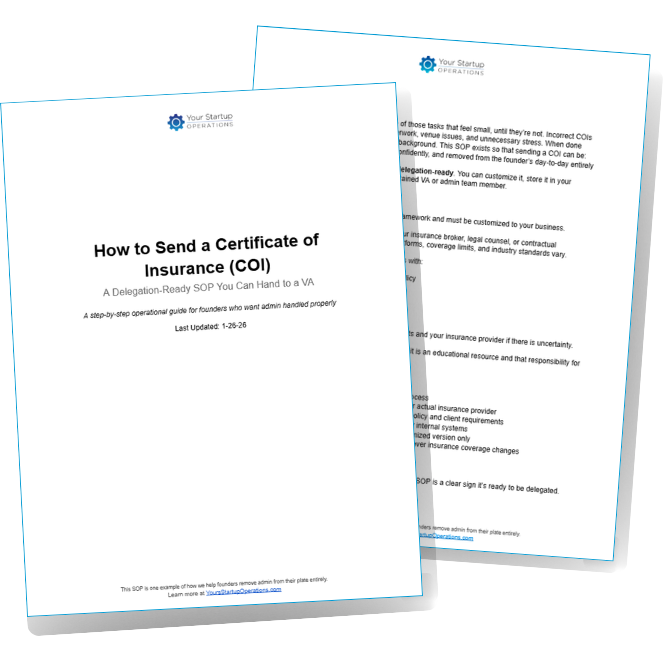
How to Send a Certificate of Insurance (COI)
Sending a Certificate of Insurance can seem straightforward until a missing detail causes delays. This step-by-step SOP shows you how to complete the process correctly, helping you avoid rejections, reduce back-and-forth, and keep your projects moving forward.
This is a placeholder paragraph. Replace this text with your own content.


