%20(1).png)

How to Scale an Event Business Without Working 14-Hour Days to Do It

Updated: Aug 20

Most event business owners try to scale the same way: take on more events, work more hours, and hold the whole thing together through sheer effort. It works, right up until it doesn't. At some point the math breaks. There are only so many hours in a day, and if growth depends on you personally working more of them, you don't have a business that scales. You have a job that's slowly eating you alive, one 14-hour day at a time.
Here's the thing nobody tells you about how to scale an event business: the constraint was never demand. It's you. Your time, your attention, your capacity to be the person every decision runs through. Real scaling isn't about you doing more. It's about building a business that does more without requiring more of you. That's a fundamentally different project, and it's the one this article is about.
Below is a practical framework for scaling an event business through systems, delegation, and leverage, so that growth stops being synonymous with exhaustion.
Key Takeaways
You can't scale an event business by working more hours. Your personal capacity is the ceiling, and effort-based growth just raises the ceiling slightly while guaranteeing burnout.
Sustainable scaling comes from four levers: systematizing your workflows, delegating the operational load, leveraging technology, and protecting your own capacity.
Systematize before you scale. Growth applied to chaos just produces more chaos, faster.
Delegate the operational spine (admin, CRM, coordination) and keep the craft that differentiates you. That distinction is the whole game.
You don't need a big payroll to scale. Much of the leverage comes from systems and flexible support, not full-time hires.
The goal isn't just a bigger business. It's a bigger business that runs without you being the bottleneck for everything.
Why "Work Harder" Stops Working
Let's be direct about why the default strategy fails, because understanding this is what makes the rest click.
When you scale by adding hours, you're treating your own labor as the growth engine. Early on, that works, because there's slack in your schedule to absorb more work. But it's linear at best (more hours in, slightly more revenue out) and it has a hard ceiling: the number of hours you can physically work. The U.S. Bureau of Labor Statistics notes that event planners already routinely work long, irregular hours to meet deadlines, so "just work more" is rarely spare capacity waiting to be tapped. Worse, as you approach that ceiling, quality drops, mistakes climb, and the exhaustion starts costing you the very clients you worked so hard to win. We covered the warning signs of that spiral in depth in our article on event planner burnout.
Businesses that scale sustainably do something different. They decouple growth from the owner's hours by building a business that produces results through systems and other people, not just through the founder's effort. That shift, from being the engine to building the engine, is the entire difference between a business that scales and a job that doesn't.
The Four Levers for How to Scale an Event Business Sustainably
Scaling an event business without burning out comes down to four levers. Pull them in roughly this order.
Lever 1: Systematize Before You Scale
The most common scaling mistake is applying growth to a business that has no systems. If your operation runs on your memory, your instincts, and a lot of "I'll just handle it," then adding more events doesn't scale the business, it multiplies the chaos, because every new event depends on you personally holding it together.
Systematizing means turning the things you do repeatedly into documented, repeatable processes. Your inquiry response, your proposal workflow, your vendor confirmation sequence, your event-day timeline, your post-event follow-up. Once these live as documented processes rather than in your head, they become things other people (and software) can execute without you.
Where to start: Pick your three most-repeated workflows and document them. A quick screen-recorded walkthrough is often more useful than a written manual. This single step is what makes every other lever possible, because you can't delegate or automate a process that only exists in your head.
Lever 2: Delegate the Operational Spine
Once workflows are documented, you can hand them off. But what you delegate matters enormously. The instinct is to cling to the operational work ("it's faster if I just do it") and to try to delegate by hiring more of yourself. Both are backwards.
Delegate the operational spine: inquiry response, CRM management, proposal formatting, scheduling, vendor confirmations, invoicing, follow-up. Keep the craft that differentiates you and the high-stakes relationships that need your personal touch. This distinction, between the business machinery and the creative or relational core, is the key to delegating well. We break down exactly which tasks fall on the delegatable side in our guide on remote support for event businesses.
The reason this lever matters so much: the operational spine is usually where most of your hours go, and it's the part that least requires you specifically. Handing it off frees the largest block of time for the smallest loss of irreplaceable input.
Lever 3: Leverage Technology
Systems and people are two of your three force multipliers. Technology is the third. A well-configured CRM (HoneyBook, Dubsado, Aisle Planner, and similar) automates the work that would otherwise consume hours: instant inquiry responses, automated follow-up sequences, payment reminders, review requests. Automation handles the repetitive, time-sensitive tasks with a consistency no human maintains at 11 PM in peak season.
The leverage here is real. An automated inquiry response that fires the instant a lead submits does something you literally cannot do manually across every inquiry, and response speed is one of the strongest drivers of booking rate. If you're still choosing tools, our CRM comparison for event planners walks through which platforms fit which businesses.
Lever 4: Protect Your Capacity
The final lever is the one owners skip, and it's the one that makes the others sustainable. As you free up time through systems, delegation, and technology, protect that reclaimed capacity instead of immediately refilling it with more work.
The trap is obvious in hindsight: you delegate enough to free ten hours a week, then fill those ten hours with ten more events, and you're right back to 14-hour days at a higher revenue number. Scaling sustainably means deliberately keeping some of the reclaimed time as genuine capacity, for strategic work, for rest, for the buffer that keeps small problems from becoming crises. Growth without protected capacity isn't scaling. It's just a bigger version of the same trap.
What Scaling Actually Looks Like in Practice
Put the four levers together and a picture emerges. A scaled event business isn't one where the owner works more. It's one where:
Inquiries get instant, automated first responses, and a delegated team member handles the personal follow-up.
Proposals go out same-day from tiered templates, customized in minutes rather than built from scratch.
Vendor confirmations, scheduling, and invoicing run on documented processes owned by support staff.
The CRM is the source of truth, kept clean by someone whose job that is.
The owner spends their time on the craft, the key relationships, and the strategic decisions, the work that actually requires them.
Notice what's happening: the business is producing more, but the owner's hours are going down, not up. That's the definition of scaling, as opposed to just grinding harder.
You also don't need to build this with a big payroll. The team layer can often be fractional or remote rather than full-time salaried hires, which is what makes sustainable scaling accessible to event businesses that aren't yet large. The U.S. Small Business Administration's guidance on growing your business frames this kind of operational infrastructure as the backbone of scaling, well before a company needs a full executive team. For where a dedicated operations function fits into that structure, see our comparison of an event operations manager vs an event coordinator.
Common Scaling Mistakes
A few patterns that quietly sabotage event businesses trying to grow:
Scaling chaos. Adding events before systematizing, so growth multiplies the disorganization instead of the profit.
Delegating the wrong things. Handing off the creative craft (the differentiator) while clinging to the admin (the delegatable part). Exactly backwards.
Refilling reclaimed time immediately. Freeing hours through delegation, then instantly booking them full again, so capacity never actually grows.
Waiting until peak season to build. Trying to set up systems and support when you're already underwater, which is the hardest possible time to do it.
Assuming scaling requires big hires. Believing you need a full salaried team before you can grow, when much of the leverage comes from systems and flexible support.
Each of these keeps the owner as the bottleneck, which is the one thing sustainable scaling has to eliminate.
Case Study: Saphineia
Saphineia is a clear illustration of scaling without the burnout, even though it's a manufacturing consultancy rather than an event business. We're including it because the principle is universal, and Saphineia's story is one of the purest examples of it in our client library.
Before working with YSO, the leadership was carrying the operational load personally, to the point of a seven-day workweek, the consultancy equivalent of the event owner's 14-hour day. That's the exact ceiling this article is about: growth constrained by the founders' personal capacity. By offloading the operational and administrative load to embedded YSO support, the leadership was freed from being the bottleneck for everything.
The result, per YSO's documented case study, was that Saphineia scaled its team from 13 to 34 members, a 161% increase, and eliminated the seven-day workweek in the process. That's the whole thesis of this article in one story: the business got substantially bigger while the founders got their time back, because growth was decoupled from their personal hours and rebuilt on systems and delegated capacity.
The lesson transfers directly to event businesses. Scale isn't a function of how hard the owner works. It's a function of how well the business runs without them in every seat. Full details are on our case studies page.
Frequently Asked Questions
How do I scale an event business without burning out?
By decoupling growth from your personal hours. Systematize your repeatable workflows, delegate the operational spine (admin, CRM, coordination) while keeping your craft, leverage technology to automate time-sensitive tasks, and deliberately protect the capacity you free up instead of immediately refilling it. Scaling through more hours has a hard ceiling and guarantees burnout. Scaling through systems and leverage doesn't.
What should I delegate first when scaling?
Start with the operational spine: inquiry response, CRM management, proposal formatting, scheduling, vendor confirmations, and follow-up. These consume the most of your time and least require you specifically. Keep the creative craft and the high-stakes client relationships, which are your differentiators.
Do I need to hire a full team to scale an event business?
No. Much of the leverage in sustainable scaling comes from systems and technology rather than headcount, and the team layer that is needed can often be fractional or remote support rather than full-time salaried hires. This is what makes scaling accessible to event businesses that aren't yet large.
When is the right time to start building systems for scaling?
Before you need them, ideally during a calmer stretch rather than mid-peak-season. Systematizing requires focused time, which is exactly what disappears once you're underwater. Building the structure in advance is what lets you absorb growth when it comes instead of drowning in it.
What's the biggest mistake event businesses make when scaling?
Scaling chaos, adding more events before building the systems to handle them, so growth multiplies the disorganization instead of the profit. The fix is always to systematize first, then scale. Growth applied to a well-run operation compounds. Growth applied to a chaotic one just breaks it faster.
About Your Startup Operations
Your Startup Operations (YSO) is a Women-Owned Small Business (WOSB) certified, white-glove operations agency co-founded by Jenna Henao and Alexis Schomer. YSO helps event business owners and other service-based companies step out of daily operations by installing a dedicated Ops Assistant trained specifically for their business, typically helping owners reclaim 30–40 hours per week.
YSO has been featured in Forbes, Voyage LA, Authority Maximizer, EIN Presswire, and AP News.
Explore our event vendor ops services, see client outcomes on our case studies page, or get in touch to talk through what your business needs.
About the Author

Jenna Henao is the Co-Founder and Operations Expert at Your Startup Operations. She works with business owners to strengthen operations, optimize workflows, and build reliable teams that support long-term business growth. With experience in entrepreneurship and operations leadership, Jenna has overseen initiatives across HR, finance, recruitment, operations, sales, marketing, and team development. She has helped businesses scale from six figures to seven figures by building efficient systems, recruiting top talent, and implementing processes that create a solid foundation for lasting success. Connect with Jenna on LinkedIn.
Reviewed by

Alexis Schomer is the Co-Founder and Marketing & Operations Expert at Your Startup Operations. She partners with business owners to streamline operations, improve delegation, and develop scalable systems that support sustainable growth. With a background in marketing, entrepreneurship, and business operations, Alexis knows that effective delegation goes beyond hiring a virtual assistant. It involves selecting the right person, creating efficient workflows, establishing clear expectations, and providing the training and support teams need to thrive. This practical, systems-focused approach guides every client partnership at YSO. Connect with Alexis on LinkedIn.
Free Resources
Access free tools, templates, and SOPs that help you streamline your operations, delegate more effectively, and build systems that support sustainable business growth.

25 Tasks You Can Offload to Your VA Today
Your schedule can quickly fill up with emails, follow-ups, scheduling, and other administrative work. This guide highlights 25 tasks you can confidently delegate to a virtual assistant, giving you more time to focus on growing your business instead of managing the day-to-day.
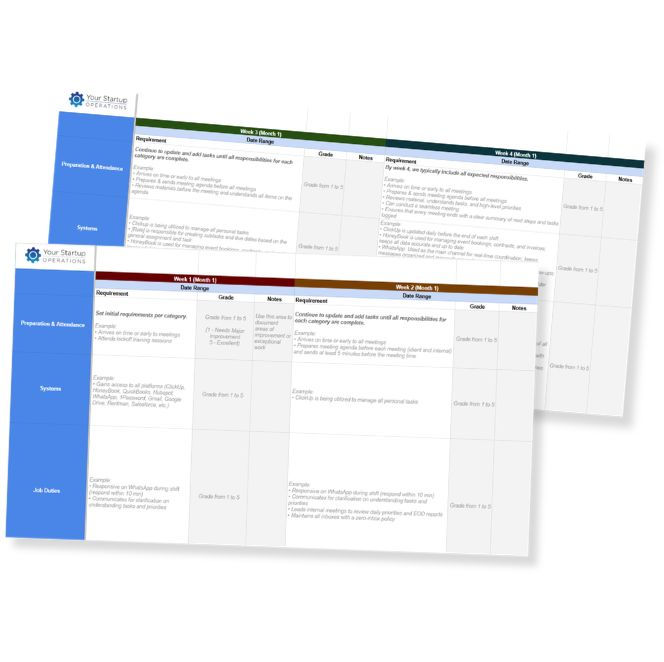
90-Day Onboarding
Template
A strong onboarding process helps new hires become productive without adding unnecessary work to your plate. Use this template to establish clear expectations, define responsibilities, and track performance during the first 90 days with confidence.

Best Practices for Creating an SOP
When important processes aren't documented, your team has to rely on you for answers. This guide walks you through creating clear, repeatable SOPs that make delegation easier, improve consistency, and help work move forward with less oversight.


