%20(1).png)

What Is a Virtual Event Assistant: The Complete Guide for Event Planners

Updated: Aug 20

If you run events for a living, you already know the quiet math of the job: for every hour spent on the craft, the design, the client experience, the creative direction, there are two or three spent on the administrative machinery that makes it possible. Inquiries, proposals, scheduling, vendor coordination, invoicing, follow-up. That machinery is essential, but it's also exactly the work that pulls event planners away from what they're actually great at and what clients actually pay for.
A virtual event assistant exists to take that machinery off your plate. But the role is widely misunderstood, often flattened into "someone who answers emails," which badly undersells what a good one does. This complete guide explains what a virtual event assistant really is, the full range of virtual event assistant duties, how the role compares to related positions, what it costs, and how to decide whether hiring one is the right move for your business.
Key Takeaways
A virtual event assistant is a trained, remote professional who owns the operational and administrative side of an event business, far more than a general assistant who happens to answer emails.
Core virtual event assistant duties span the whole operational spine: inquiry management, CRM ownership, proposals, scheduling, vendor coordination, invoicing, and follow-up.
Virtual event support is distinct from an on-site coordinator (who runs events live) and from a general VA (who lacks event-industry fluency).
The primary benefits are reclaimed time, faster response times, a cleaner pipeline, and lower cost than an in-house hire.
The role suits event planners whose administrative load has outgrown what they can personally handle, which for most growing businesses happens sooner than expected.
What Is a Virtual Event Assistant?
Let's start with a clear definition. A virtual event assistant is a professional who provides remote administrative and operational support specifically to event businesses. The three key words each carry weight. "Virtual" means they work remotely, off-site, on flexible hours. "Event" means they have industry-specific fluency, they know event CRMs, seasonal rhythms, vendor dynamics, and the event client journey. "Assistant" is the part that undersells the role, because a good one functions less like a helper and more like the operator who runs the business behind the scenes.
The distinction that matters most: a virtual event assistant is not a generic virtual assistant who happens to work for an event company. General VAs can be excellent at inbox management and calendar upkeep but lack the specialized knowledge that makes event support effective, familiarity with platforms like HoneyBook, Dubsado, and Aisle Planner, an understanding of how event bookings flow, and the judgment to handle the constant last-minute changes event work produces. A virtual event assistant brings that specialization.
The role has grown alongside the broader shift toward remote and flexible work. As event planning has become more competitive and operationally complex, and as more owners recognize they can't scale by working more hours, the virtual event assistant has moved from a nice-to-have to a core part of how many event businesses operate. Industry bodies that track the profession, such as Meeting Professionals International, document how central operational and logistical skill has become to running events well, and the U.S. Bureau of Labor Statistics projects continued demand for meeting, convention, and event planners, the broader field this support role serves.
Virtual Event Assistant Duties: What They Actually Do
Here's the full picture of virtual event assistant duties, the work a trained one typically owns. This is the section that corrects the "just answers emails" misconception.
Inquiry and lead management
Monitoring inquiries across channels (website forms, email, social DMs), responding quickly, triaging and tagging leads, and following up with those who haven't responded. Because response speed strongly influences booking rate, this is often the single highest-impact duty.
CRM ownership
Setting up, running, and maintaining the CRM as the reliable source of truth: pipeline hygiene, automations, and keeping every lead correctly tracked. A virtual event assistant doesn't just use your CRM, they own it.
Proposals and contracts
Building and customizing tiered proposal templates, sending them, tracking them, and managing the contract and e-signature flow.
Scheduling and calendar management
Booking consults, coordinating vendor calls and site visits, sending reminders, and preventing double-bookings across concurrent events.
Vendor coordination (the remote parts)
Sending and tracking vendor confirmations, chasing outstanding ones before the event, and maintaining vendor contact lists and paperwork.
Invoicing and payment follow-up
Creating and sending invoices and deposit requests, tracking payment schedules against event dates, and following up on overdue balances, the awkward, easily-procrastinated work that a virtual event assistant handles consistently.
Post-event workflows
Thank-you sequences, review requests while the experience is fresh, and referral follow-up, capturing the reputation and pipeline value most planners are too busy to chase.
Email, calendar, and document management
The ongoing administrative baseline that keeps the business organized.
Content and light marketing support
Social media scheduling, basic content coordination, and administrative marketing tasks, depending on the assistant's skill set and your needs.
The common thread across all of these: a virtual event assistant takes ownership of the operational spine so you can focus on the craft and the client relationships. For a closer look at the qualities that separate an exceptional one from an average one, see our guide on what makes a great event VA.
Virtual Event Assistant vs. Related Roles
Part of understanding the role is knowing how it differs from adjacent ones, because the titles get used loosely and conflated.
Virtual event assistant vs. on-site event coordinator
The clearest distinction. A virtual event assistant works remotely and owns the business's operational spine (the work between and around events). An on-site coordinator runs events live, on the day: run-of-show, on-site execution, and real-time problem-solving. They're complementary, not competing, and many growing businesses eventually use both. We compare them in detail in our event coordinator vs event virtual assistant guide.
Virtual event assistant vs. general virtual assistant
A general VA offers broad administrative support across any industry. A virtual event assistant brings event-specific fluency, the CRMs, the workflows, the seasonal rhythms, that makes them effective in this niche without a long ramp.
Virtual event assistant vs. event operations manager
An operations manager is a more senior, strategic role that owns systems, team oversight, and the broader operational structure. A virtual event assistant typically executes and owns the operational spine, though a highly experienced one can grow into operations-lead responsibilities. We explore that distinction in our event operations manager vs event coordinator comparison.
Understanding these distinctions helps you hire for the role you actually need rather than the title that sounds most senior.
The Benefits of Virtual Event Support
Why are so many event planners bringing on virtual event support? The benefits are concrete.
Reclaimed time for high-value work
The most important benefit. Offloading the operational spine returns your hours to the craft, the client relationships, and the strategic work that only you can do, the work that actually differentiates and grows the business.
Faster, more consistent response times
A virtual event assistant ensures inquiries get answered quickly and consistently, even during peak season. Since response speed strongly affects booking rate, this often pays for the role on its own.
A cleaner, more reliable pipeline
With someone owning CRM hygiene and follow-up, leads stop falling through the cracks, proposals go out same-day, and nothing gets lost, which directly protects revenue.
Lower cost than an in-house hire
Virtual event support delivers operational capacity without the salary, benefits, payroll taxes, office space, and equipment of a full-time employee, and with hours that flex to your seasonal demand. The financial and legal considerations of employee-versus-contractor arrangements, which underlie much of this cost difference, are laid out in the U.S. Small Business Administration's guidance on hiring and managing staff.
Scalability without burnout
Perhaps the deepest benefit. Virtual event support is how many planners break through the ceiling of their own capacity, growing the business without growing their hours, and avoiding the burnout that comes from trying to do everything personally.
Flexibility
Remote, flexible support fits the seasonal nature of event work far better than a fixed full-time salary, scaling up in peak season and down in the off-season.
When Does an Event Planner Need a Virtual Event Assistant?
Not every event business needs one yet, so here's how to tell. Consider a virtual event assistant when several of these are true:
Inquiries are slipping, and your response times are measured in days rather than hours.
You're spending significant time on administrative work during peak season instead of high-value work.
Your CRM is underused or disorganized, and follow-ups are falling through the cracks.
The events themselves go well, but the business around them (booking, proposals, invoicing, follow-up) feels chaotic.
You feel constantly busy but can't point to where your hours went.
Growth has stalled because you've become the bottleneck for everything.
If several of these resonate, the operational load has likely outgrown what you can personally sustain, which is the signal that virtual event support would pay off. This tends to happen earlier in a business's growth than most owners expect, because the administrative load scales faster than the events themselves.
How to Hire a Virtual Event Assistant
If you've decided the role fits, here's how to approach hiring one well.
Decide on scope first
Clarify which duties you most need covered (inquiry management, CRM, proposals, follow-up) so you can match the hire to your actual bottleneck rather than hiring vaguely.
Prioritize event-industry fluency
The single most important qualification is genuine familiarity with event CRMs and workflows. A great virtual event assistant can screen-share a CRM setup, not just describe one.
Vet for judgment and communication
Beyond technical skill, the traits that make a virtual event assistant effective are proactivity, judgment, and clear communication, the ability to anticipate needs and handle the constant changes event work produces. A short paid trial task reveals these faster than any interview.
Decide between hiring directly or through an agency
Hiring an individual freelancer gives you direct control but requires you to vet, train, and manage them. Working with an agency means the vetting and training are done for you, and you get continuity if someone is unavailable. Each path has tradeoffs worth weighing against your time and risk tolerance.
Set clear expectations and systems
However you hire, the role works best when responsibilities are explicit and the assistant works from a shared system and documented processes rather than guesswork.
You can read more about the traits to test for in our event VA hiring checklist, and if you'd like to talk through what your business needs, you can reach us directly through our contact page.
What Does a Virtual Event Assistant Cost?
Cost varies widely based on scope, experience, hours, and whether you hire directly or through an agency, so no single figure fits every business. What's consistent is the structural cost advantage over an in-house hire. A full-time in-house operations or admin employee carries salary, benefits, payroll taxes, equipment, and office space as fixed costs, regardless of season. Virtual event support delivers the operational capability at a meaningfully lower total cost, with hours that flex to your actual volume.
At YSO, clients save an average of roughly $40,800 per year compared to a full-time hire. The point of that figure isn't that it applies identically to every business, it's that the structure of virtual event support (remote, flexible, specialized) is simply more cost-efficient than the in-house alternative for most event businesses, while delivering the operational capacity they need. For a seasonal, margin-conscious event business, that efficiency is often what makes the decision straightforward.
You can see the range of outcomes across different event businesses on our case studies page, and learn more about our approach on our about page.
Case Study: The Think Mill
The Think Mill, an events portfolio company YSO supports, shows what virtual event support looks like at the more complex end of the spectrum, and why the role is so much more than administrative help.
As the business grew across multiple entities and event lines, its operational load had outgrown the informal systems holding it together. The challenge was classic: talented people carrying an entire operational and financial back-office personally, which is exactly the setup that caps growth and burns out the team. Rather than a stopgap, what the business needed was real operational infrastructure.
Working with YSO, that infrastructure got built and owned. The engagement included multi-entity financial workflows structured in QuickBooks, Bill.com implemented to handle vendor payments, and a trained virtual assistant embedded in day-to-day operations. Work that had been personally shouldered, entity by entity, became systematized and distributed, which is precisely the transition virtual event support is meant to enable.
The lesson for event planners weighing this decision: a virtual event assistant isn't just someone who lightens your inbox. At its best, the role is the operational backbone that lets a growing event business scale without the founders being the bottleneck for everything. The Think Mill illustrates the full scope of what virtual event support can be. Full details, along with other client outcomes, are on our case studies page.
Frequently Asked Questions
What is a virtual event assistant?
A virtual event assistant is a trained professional who provides remote administrative and operational support to event businesses. They own the operational spine, inquiry management, CRM, proposals, scheduling, vendor coordination, invoicing, and follow-up, with event-industry-specific fluency that a general virtual assistant lacks. It's an operational role, not merely a clerical one.
What are the main virtual event assistant duties?
The core duties include inquiry and lead management, CRM ownership and pipeline hygiene, building and sending proposals and contracts, scheduling and calendar management, the remote parts of vendor coordination, invoicing and payment follow-up, and post-event workflows like review and referral requests. Many also provide light content and marketing support. The unifying theme is owning the operational and administrative work that keeps an event business running.
How is a virtual event assistant different from an event coordinator?
A virtual event assistant works remotely and owns the business's operational spine, the work between and around events. An event coordinator works on-site and runs events live: run-of-show, on-site execution, and real-time problem-solving. They solve different problems and many growing event businesses eventually use both.
How much does virtual event support cost?
It varies by scope, experience, hours, and whether you hire directly or through an agency, but it's structurally cheaper than a full-time in-house hire, which carries salary, benefits, taxes, equipment, and space as fixed costs. At YSO, clients save an average of roughly $40,800 per year versus a full-time hire, and the flexibility to scale hours with the season adds to the efficiency.
When should an event planner hire a virtual event assistant?
When the administrative load has outgrown what you can personally handle: inquiries slipping, slow response times, a disorganized CRM, chaos around the events even when the events themselves go well, or growth stalling because you've become the bottleneck. For most growing event businesses, this point arrives earlier than expected, because administrative work scales faster than the events.
Do virtual event assistants work with my existing tools?
Yes. A trained virtual event assistant is typically fluent in the major event CRMs (HoneyBook, Dubsado, Aisle Planner) and common event tools, or able to ramp quickly. A key part of the role is often setting up and running these systems well, not just working within them.
About Your Startup Operations
Your Startup Operations (YSO) is a Women-Owned Small Business (WOSB) certified, white-glove operations agency co-founded by Jenna Henao and Alexis Schomer. YSO helps event business owners and other service-based companies step out of daily operations by installing a dedicated Ops Assistant trained specifically for their business, typically helping owners reclaim 30–40 hours per week.
YSO has been featured in Forbes, Voyage LA, Authority Maximizer, EIN Presswire, and AP News.
Explore our event vendor ops services, see client outcomes on our case studies page, or get in touch to talk through what your business needs.
About the Author

Alexis Schomer is the Co-Founder and Marketing & Operations Expert at Your Startup Operations. She works with business owners to optimize operations, improve delegation, and build scalable systems that support sustainable business growth. Drawing on her experience in marketing, entrepreneurship, and business operations, Alexis believes effective delegation is about more than hiring a virtual assistant. It starts with selecting the right person, creating efficient workflows, establishing clear expectations, and providing the training and support needed for teams to succeed. This practical, systems-first philosophy guides every client partnership at YSO. Connect with Alexis on LinkedIn.
Reviewed by

Jenna Henao is the Co-Founder and Operations Expert at Your Startup Operations. She partners with business owners to streamline operations, strengthen workflows, and build reliable teams that drive long-term growth. With a background in entrepreneurship and business operations, Jenna has led initiatives across HR, finance, recruitment, operations, sales, marketing, and team leadership. She has helped businesses grow from six to seven figures by developing scalable systems, recruiting outstanding talent, and implementing processes that support lasting success. Connect with Jenna on LinkedIn.
Free Resources
Access practical tools, templates, and SOPs designed to simplify operations, improve delegation, and support business growth.

25 Tasks You Can Offload To Your VA Today
Your day fills up fast with follow-ups, inbox replies, scheduling, and admin.
This guide
shows exactly
what to hand
off first so
you can
stop doing it all yourself and
free up
real time.

The Ultimate Productivity Toolkit for Event Professionals
Managing clients, coordinating vendors, and handling daily administrative tasks can quickly fill your schedule. This toolkit shares five practical ways a virtual assistant can help streamline your workload so you can spend more time growing your business.
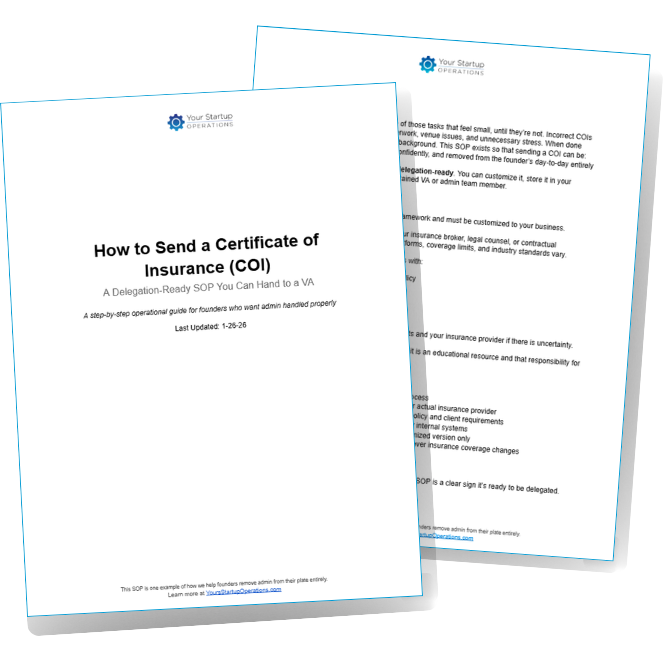
How to Send a Certificate of Insurance (COI)
Submitting a Certificate of Insurance doesn't have to be complicated.
This SOP
provides a clear, step-by-step process to help you submit accurate COIs, avoid delays, and keep approvals moving forward.
The Bottom Line for Event Planners
A virtual event assistant is far more than someone who answers your emails. Done well, the role is the operational engine of an event business: fast inquiry responses, a clean pipeline, proposals out the door same-day, vendors confirmed, follow-ups sent, and your own time returned to the craft and clients that actually grow the business. For event planners feeling the weight of the administrative machinery, virtual event support is one of the highest-leverage moves available, and understanding what the role really is, as this guide has laid out, is the first step to using it well.
If you're ready to explore what virtual event support could do for your business, we'd be glad to help you figure out the right fit.


