%20(1).png)

The Best CRM for Event Planners in 2026

Updated: Sep 10
Between the two of us, we've placed virtual assistants inside more than a dozen event businesses: florists, DJs, planners, rental companies, and venues. On almost every kickoff call, the same story comes up. The CRM was picked in a hurry, half configured, and now it's the reason inquiries sit unread until Tuesday. So when someone asks for the best CRM for event planners, the honest answer isn't a single name.
It's whichever CRM matches how that specific business books, contracts, communicates, and hands off work to a team, set up by someone who turns its features on in the first place.
Key Takeaways
HoneyBook and Dubsado lead solo and small-team event businesses because proposals, contracts, and payments all live in one flow. HoneyBook sets up faster. Dubsado goes deeper on customization.
Aisle Planner and Planning Pod are built for the events industry specifically, with venue diagrams, seating charts, timelines, and vendor management that a generalist CRM doesn't include.
17hats suits solo planners who want a clean inquiry-to-invoice pipeline without paying for features they won't use.
HubSpot only makes sense for larger event agencies running a real sales pipeline, corporate clients, and marketing automation.
The best CRM for event planners depends on the business model. Selling packages, designing bespoke events, and running multi-event operations each point to a different tool.
Most CRM failures aren't tool problems. They're implementation problems, and a trained VA setting up templates, automations, and inquiry routing is usually what unlocks the software's value.
Why There's No Single Best CRM for Event Planners
Every CRM on this list can send a proposal and collect a signature. Where they differ in practice is the specifics: how much customization the proposal builder allows, whether the platform includes event-specific tools like seating charts, and how the business is set up to sell. A wedding florist selling three package tiers has different needs than a full-service wedding planner designing a bespoke event from scratch, and both look different from a venue running two hundred bookings a year. Ranking these tools 1 through 6 would miss the point. Matching one to a specific business model is the actual exercise.
What Event Planners Need From a CRM That a Generic Sales Tool Doesn't
Before comparing tools, it's worth naming what an event CRM has to handle that a generic sales CRM wasn't built for:
Inquiry capture and routing: a lead form that pulls event date, guest count, budget, and venue, then routes to the right person or auto-responds
Proposal and contract generation, branded and editable, with e-signature
Payment scheduling: retainers, milestone payments, and final balances tied to the event date, not the invoice date
Client-facing workflows: questionnaires, style quizzes, planning portals, and timelines the client can see
Team assignment and internal communication: who's the lead planner, who's the day-of coordinator, who's supporting
Event-specific data: venue, guest count, event date, dietary restrictions, vendor list, timeline
Post-event workflow: thank-you sequences, review requests, referral tracking
A CRM that nails five of these seven for a specific business type is a better fit than one that half-does all seven. That's the frame the rest of this comparison uses.
The Six CRMs Compared
HoneyBook: Best for Solo and Small-Team Event Pros Who Want Speed

Image credit to HoneyBook
HoneyBook is the most-adopted CRM among the independent wedding and event vendors we work with, and there's a reason. From inquiry to signed contract to first payment, everything happens in one linked flow, with no switching tabs.
Where it wins:
Contact form to automated inquiry response to proposal to contract to invoice, all natively linked
A mobile app built for real-time inquiry alerts, which matters when a weekend response time decides whether a wedding gets booked
A built-in scheduler for consultation calls
Automated workflows: drip emails for leads who don't book, review request sequences after the event
Where it doesn't:
Less customization on proposals compared to Dubsado
No native seating charts or event diagrams
Reporting is thin if a business wants cohort or channel-level analytics
Most florists, DJs, photographers, and small-team planners land on HoneyBook because implementation takes days, not weeks. HoneyBook publishes its own comparison against Dubsado, though as with any vendor-published comparison, it's worth checking claims against third-party reviews on G2.
Dubsado: Best for Event Pros Who Want Deep Customization

Image credit to Dubsado
Dubsado trades speed for control. The forms, proposals, and workflows go further than HoneyBook's. A business can build conditional logic into questionnaires, create tiered proposal templates that swap sections based on service, and design branded client portals that feel like an extension of its own website.
Where it wins:
A stronger form and questionnaire builder
Highly customizable proposal templates
Workflow automation with conditional logic (send template A if the client answered B)
Unlimited projects on the paid plan
Where it doesn't:
A steeper learning curve. Setup is a project, not a weekend.
An interface that feels dated next to HoneyBook
A mobile experience that lags behind
Dubsado is what event businesses tend to graduate to once they hit HoneyBook's customization ceiling. Wedding planners with distinct service tiers (full planning, partial planning, month-of coordination) often prefer Dubsado because they can build one intelligent proposal template instead of three separate ones.
Aisle Planner: Best for Wedding Planners Specifically

Image credit to Aisle Planner
Aisle Planner isn't a general-purpose CRM. It's built specifically for wedding planners, with tools a generalist CRM doesn't include: guest list management, seating charts, floor plan design, wedding-day timelines with vendor assignments, and a client-facing planning portal.
Where it wins:
Event-specific tools: RSVPs, seating charts, timelines, checklists
A client portal couples use in practice, instead of the generic-CRM pattern of a portal abandoned by month two
A vendor directory and referral network
Where it doesn't:
Weaker on the sales side. Proposals and contracts are functional but not polished.
Overkill for a business that isn't doing full-service wedding planning
Pricing tiers that add up for a growing team
If a business is 80% or more full-service weddings, Aisle Planner probably belongs in the stack. Many planners pair it with HoneyBook or Dubsado, running sales through the generalist CRM and delivery through Aisle Planner.
Planning Pod: Best for Venues, Caterers, and Corporate Events

Image credit to Planning Pod
Planning Pod is the CRM most often chosen by venues, caterers, and corporate event teams. It handles multi-event pipelines, room and space booking, BEO (Banquet Event Order) generation, and payment schedules tied to event milestones.
Where it wins:
Purpose-built for high-volume event operations
Strong room and resource booking tools
BEO and floor plan generation
Team collaboration across multiple concurrent events
Where it doesn't:
Less oriented toward creative solo pros
A more utilitarian interface
More configuration required at setup
A venue booking 200 or more events a year will likely find Planning Pod's structure a relief. A solo florist will likely find it overbuilt.
17hats: Best for Solo Planners Who Want Simple

Image credit to 17hats
17hats is the lightest option on this list. It handles the same core loop as HoneyBook (inquiry, proposal, contract, invoice) with a cleaner, simpler interface, and it's often chosen by solo planners who want the fundamentals without paying for features they won't use.
Where it wins:
A simple, clean interface
A lower price point on entry tiers
Solid bookkeeping and a straightforward quote-to-invoice flow
Where it doesn't:
More limited automation than HoneyBook or Dubsado
Fewer template resources in the surrounding community
Weaker fit for teams rather than solo operators
HubSpot: Only for Large Event Agencies

Image credit to HubSpot
HubSpot is worth mentioning only because larger event agencies with corporate clients, outbound sales teams, and marketing automation needs sometimes land here. For a five-person event business, it's the wrong tool. For a thirty-person agency selling to enterprise event teams, it's often the right one.
Matching a CRM to Your Workflow
Rather than ranking these six tools, here's how we'd match them to specific event businesses, based on what we see across YSO clients.
Business Type | Best Primary CRM | Common Pairing |
Wedding florist | HoneyBook | Florist-specific quoting tool like Curate |
Wedding or event DJ | HoneyBook or 17hats | None needed |
Full-service wedding planner | Dubsado or Aisle Planner | Both together |
Boutique planning studio | Dubsado | Aisle Planner for delivery |
Venue | Planning Pod | None needed |
Caterer | Planning Pod | A catering-specific tool like Total Party Planner |
Corporate agency (10+ people) | HubSpot | Planning Pod for event operations |
The right answer depends on which of the seven core needs listed above matter most for a given business.
Real Results: Two Event Vendors Who Fixed Implementation, Not Software
Naunet Floral: When the CRM Wasn't the Problem
Naunet Floral, a wedding florist YSO supports, is a good example of how CRM decisions unlock or block growth. Before working with YSO, inquiries came in through the website, Instagram DMs, and email: three channels, no single source of truth, and follow-ups that kept slipping. The team had already invested in HoneyBook but hadn't set up automated inquiry responses, proposal templates, or a review request sequence.
The CRM wasn't the issue. The implementation was. With a trained YSO virtual assistant embedded in the workflow, HoneyBook's automations finally got turned on: an instant inquiry auto-response with a link to the pricing guide, three-tier proposal templates, a payment schedule tied to the event date, and a post-event review request. Inquiries stopped falling through the cracks, and the studio's proposal-to-booking rate improved once leads got a response inside the first hour instead of the next business day.
DJ Will Gill: Booking More Weddings Without Adding Admin Hours
DJ Will Gill runs a high-volume wedding and event DJ business, recognized on the Forbes Next 1000 list. The bottleneck wasn't marketing. Inquiries were healthy. It was the admin bandwidth to respond, send proposals, follow up on holds, and track deposits across dozens of weddings at once.
The stack was HoneyBook, and again, the value showed up in who was running it. A YSO virtual assistant handled inquiry triage, proposal customization inside HoneyBook's templates, and follow-up on holds that hadn't converted. Every inquiry got a response the same day, and every hold got a follow-up before it went cold.
Common CRM Implementation Mistakes
Across the event businesses we've worked with, a handful of mistakes show up more than any others, roughly in order of frequency:
No automated inquiry response. The lead form works, but nothing fires when a lead submits. In our experience, response time is one of the strongest predictors of booking rate for event vendors, and a manual response misses the window more often than not.
One generic proposal template. Every service tier gets the same proposal, so the vendor spends twenty minutes customizing each one instead of building three tiered templates a single time.
Payment schedules tied to invoice date, not event date. Cash flow becomes unpredictable because retainers, milestones, and final balances aren't anchored to the event calendar.
A client portal that's set up but never used. Couples log in once and never return because the vendor keeps sending updates by email instead.
No post-event review sequence. In our experience, reviews are one of the most valuable lead-gen assets an event pro has, and most CRMs can send review requests automatically once that automation is turned on.
Every one of these is a solvable configuration problem, not a software problem.
Frequently Asked Questions
What is the best CRM for event planners in 2026?
For most solo and small-team event pros, HoneyBook remains the fastest to implement and the most flexible for the inquiry-to-payment loop. Dubsado fits better for businesses that need deep customization. Wedding planners often add Aisle Planner for delivery, and venues and caterers usually choose Planning Pod. There isn't a single winner. The best CRM depends on the business model behind the question.
Do I need a separate CRM if I use QuickBooks or Xero?
Yes. Accounting software isn't a CRM. A business needs both: a CRM for the sales, contract, and client workflow, and accounting software for the books. Most event CRMs integrate directly with QuickBooks or Xero.
How much should an event business spend on a CRM?
Entry tiers for HoneyBook, Dubsado, and 17hats sit in a similar range for solo pros. Aisle Planner and Planning Pod cost more because they're more specialized. HubSpot's paid tiers run substantially higher. It's worth checking each vendor's current pricing page directly, since tiers and features change often enough that a specific number here would likely be out of date already.
Can I switch CRMs later?
Yes, but it's painful. Migrating templates, workflows, and historical client data takes weeks, not days. It's worth picking carefully the first time. For a business that isn't sure where to start, HoneyBook's fast setup makes it the lowest-regret starting point.
Do I need a virtual assistant to run a CRM?
Not strictly, but the CRMs that deliver real value are the ones that get actively maintained: templates updated, automations tuned, follow-ups sent, tags kept clean. For a business without the time to keep up with that, a trained virtual assistant is usually the highest-leverage hire it can make.
Ready to Make Your CRM Earn Its Subscription?
The best CRM for event planners only pays off once someone runs it: templates built, automations turned on, follow-ups sent on schedule. An events virtual assistant from YSO can set up and maintain whichever platform fits your business, so the CRM you're already paying for finally does the job it was bought for.
About Your Startup Operations
Your Startup Operations (YSO) is a Women-Owned Small Business (WOSB) certified, white-glove operations agency co-founded by Jenna Henao and Alexis Schomer. YSO helps event business owners and other service-based companies step out of daily operations by installing a dedicated Ops Assistant trained specifically for their business, typically helping owners reclaim 30–40 hours per week.
YSO has been featured in Forbes, Voyage LA, Authority Maximizer, EIN Presswire, and AP News.
Explore our event vendor ops services, see client outcomes on our case studies page, or get in touch to talk through what your business needs.
About the Author

Jenna Henao is the Co-Founder and Operations Expert at Your Startup Operations. She works with business owners to strengthen operations, optimize workflows, and build reliable teams that support long-term business growth. With experience in entrepreneurship and operations leadership, Jenna has overseen initiatives across HR, finance, recruitment, operations, sales, marketing, and team development. She has helped businesses scale from six figures to seven figures by building efficient systems, recruiting top talent, and implementing processes that create a solid foundation for lasting success. Connect with Jenna on LinkedIn.
Reviewed by

Alexis Schomer is the Co-Founder and Marketing & Operations Expert at Your Startup Operations. She partners with business owners to streamline operations, improve delegation, and develop scalable systems that support sustainable growth. With a background in marketing, entrepreneurship, and business operations, Alexis knows that effective delegation goes beyond hiring a virtual assistant. It involves selecting the right person, creating efficient workflows, establishing clear expectations, and providing the training and support teams need to thrive. This practical, systems-focused approach guides every client partnership at YSO. Connect with Alexis on LinkedIn.
Free Resources
Access practical tools, templates, and SOPs designed to simplify operations, improve delegation, and support business growth.

25 Tasks You Can Offload To Your VA Today
Your day fills up fast with follow-ups, inbox replies, scheduling, and admin.
This guide
shows exactly
what to hand
off first so
you can
stop doing it all yourself and
free up
real time.

The Ultimate Productivity Toolkit for Event Professionals
Managing clients, coordinating vendors, and handling daily administrative tasks can quickly fill your schedule. This toolkit shares five practical ways a virtual assistant can help streamline your workload so you can spend more time growing your business.
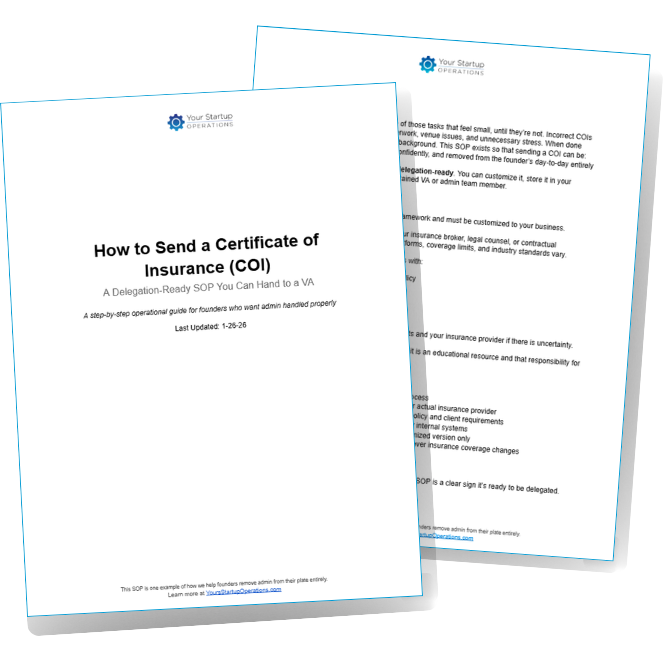
How to Send a Certificate of Insurance (COI)
Submitting a Certificate of Insurance doesn't have to be complicated.
This SOP
provides a clear, step-by-step process to help you submit accurate COIs, avoid delays, and keep approvals moving forward.


