%20(1).png)
Virtual Assistants for Solar Installation Companies
- Jenna Henao
- 5 days ago
- 13 min read
Updated: 4 days ago

Solar installation is technically a home service, but it doesn't operate like one. A plumber gets called when the pipe bursts and fixes it the same day. An HVAC technician gets called when the AC breaks and diagnoses it within 24 hours. A solar installer gets a lead and then spends the next 30, 60, sometimes 90+ days walking that lead through consultations, design, financing options, permits, contracts, installation scheduling, inspection, and utility approval before the customer ever gets a functioning system.
That long sales cycle is what makes solar operationally distinct from every other home service category. And it's where most independent solar installation companies leak the most revenue, not because the leads aren't there, but because the sales cycle infrastructure to nurture leads through 90 days of decision-making, coordination, and paperwork isn't built. Prospects go cold. Proposals get lost. Permit timelines slip. Referrals from installed customers never get requested.
This guide walks through what a virtual assistant for solar installers actually does across the full sales cycle from initial lead through post-installation customer relationship and why the operational infrastructure a VA supports is often what separates solar companies that scale from ones that stall. It's written for solar installation company owners and operations leaders who want to build the long-cycle support that most competitors haven't.
Key Takeaways
Solar's long sales cycle (typically 30–90+ days) requires operational infrastructure most home service categories don't need: consistent nurture communication, multi-stage paperwork coordination, and long-term customer relationship management.
The biggest revenue leak in most solar businesses isn't lead volume; it's inconsistent follow-through across the sales cycle stages. Leads go cold between consultation and contract; contracts get held up by permit delays without owner visibility; post-install referrals never get requested.
A VA supports the sales cycle across five main stages: lead management, consultation coordination, contract and financing paperwork, permit and installation coordination, and post-install customer relationship management.
Solar businesses that build systematic sales cycle support typically see measurable improvement in close rates and referral pipeline within 90–120 days.
The technical work (system design, installation, electrical work) stays with licensed team members. The operational scaffolding around the technical work is what a VA absorbs.
Why Solar's Sales Cycle Is Operationally Different
Solar isn't just a longer version of an HVAC sale. The whole shape of the customer journey is different.
High deal value. Residential solar installations typically run $15,000–$50,000+, with commercial installations going substantially higher. Every deal is significant, which means every lost deal is significant.
Consultative sales model. Unlike break-fix home services, solar requires customer education. Prospects come in with questions about financing options, roof suitability, energy production, payback timelines, tax credits, warranties, and utility interconnection. The sales conversation isn't "here's the price"; it's a multi-touch education process.
Multi-stage workflow after the sale. Signing a contract doesn't complete a solar sale. It kicks off a stage-heavy operational sequence: system design finalization, permit application to the local jurisdiction, utility interconnection agreement, HOA approval where applicable, installation scheduling, inspection scheduling, and permission to operate (PTO) from the utility. Each stage has its own timeline, paperwork, and coordination requirements. Any of them can stall the whole sequence.
Regulatory complexity. Solar operates within federal, state, and utility-specific regulatory frameworks. The federal Investment Tax Credit affects customer economics. Net metering programs vary by state and utility. Solar Renewable Energy Certificates (SRECs) matter in some markets and not in others. Prospects want to understand all of it before signing.
Long-term customer relationship. A solar system typically operates for 25+ years. That produces ongoing customer touchpoints: annual monitoring reviews, warranty questions, service calls, panel additions (if the customer's electric usage grows), and referrals from installed customers. The customer relationship doesn't end at installation; it lasts decades.
The U.S. Bureau of Labor Statistics classification of Solar Photovoltaic Installers as a distinct occupational category (SOC 47-2231) reflects the industry's professionalization over the last decade; solar is treated by the labor classification system as a specialized construction trade, not as general electrical or roofing work. The operational infrastructure supporting that specialized work is equally distinct.
The 5 Stages of the Solar Sales Cycle (And What a VA Supports at Each)
The full solar sales cycle typically breaks into five operational stages. Each has specific work a VA can own; each has specific work that stays with the technical or sales team.
Stage 1: Lead Management
What it looks like: A prospect fills out a web form, calls in, submits an inquiry through a marketplace, or gets referred by an installed customer. Traditional response: the sales team calls back "when they get to it," sometimes hours or days later, and the lead may or may not still be warm.
What the VA owns:
Initial response within the defined SLA (usually under an hour during business hours)
Basic qualification: property type, homeowner status, monthly electric bill range, timeline urgency
Scheduling the initial consultation with a sales consultant
Sending pre-consultation materials (educational content on financing options, tax credits, how solar works)
Tracking every inquiry in the CRM with source attribution
Why it matters: Research widely cited in sales operations, including the Harvard Business Review analysis by James Oldroyd on the short life of online sales leads, documented that leads contacted within an hour convert dramatically better than delayed ones. In solar, where deal values are high and competitors are actively pursuing the same prospects, response time matters even more than in most industries.
What stays with the sales team: The actual consultative conversation, the technical assessment questions, financing discussions.
Stage 2: Consultation Coordination and Follow-Up
What it looks like: The consultant meets with the prospect (in person or virtually), presents preliminary information, and in most solar sales, the customer says "let me think about it." That thinking period ranges from days to months. Most solar sales are lost in this stage, not because the prospect said no but because they got busy, distracted, or approached by a competitor while the original company waited passively.
What the VA owns:
Post-consultation follow-up: thank-you note, summary of what was discussed, any promised materials
Nurture sequence for prospects who haven't decided 3-day, 7-day, 14-day, 30-day, 60-day, 90-day touchpoints
Coordination between customer and sales consultant when questions come up
Sending relevant case studies, testimonials, and educational content aligned to the customer's specific concerns
CRM updates on every touchpoint and every customer response
Why it matters: This is where most solar sales are quietly lost. Sales consultants are focused on the next fresh consultation, not on nurturing the prospect from three weeks ago. Without systematic follow-up, warm leads go cold, and the company either loses them entirely or has to re-warm them at higher cost. See YSO's post on why hiring through an operations agency gets you a better virtual assistant for context on how structured follow-up outperforms sales-team-driven follow-up.
What stays with the sales team: Any conversation involving custom pricing, technical questions the VA doesn't have the depth to answer, or negotiation of terms.
Stage 3: Contract, Design, and Financing Paperwork
What it looks like: Prospect says yes. Contract needs to be drafted with the specific system design, pricing, financing terms, and terms and conditions. Financing paperwork needs to be routed to a cash payment plan, solar loan through a lender partner, lease, or Power Purchase Agreement (PPA). Each financing path has its own documentation.
What the VA owns:
Contract drafting from templates once the sales consultant confirms the terms
Coordinating financing paperwork with the customer and the lender/financing partner
Following up on outstanding customer signatures and documents
Tracking contract status in the CRM
Sending welcome and next-steps communication once the contract is fully executed
Why it matters: Contract and financing paperwork is where deals stall in the 7–14 days after verbal commitment. Customers get busy. Lenders have documentation requirements. Cosigners need to review. Without active follow-through, a signed verbal commitment can silently become a lost sale. See YSO's post on managing clients, quotes, and event logistics with a VA; the same "coordinating paperwork across parties" principle applies.
What stays with licensed team members: The system design itself, financial advice or recommendations, contract terms outside the standard templates.
Stage 4: Permits, Utility Interconnection, and Installation Coordination
What it looks like: After the contract is signed, the operational work starts. Permits get applied for with the local Authority Having Jurisdiction (AHJ). Utility interconnection agreements get filed. Installation gets scheduled once permits come in. Inspections get scheduled after installation. Permission to Operate (PTO) gets requested from the utility once inspections pass.
What the VA owns:
Tracking every stage of every project in a shared dashboard visible to sales, operations, and customer
Coordinating permit application submission and follow-up with jurisdictions
Coordinating utility interconnection paperwork
Scheduling the installation crew based on permit approval timing
Coordinating inspection scheduling with the AHJ inspector
Sending customers proactive updates at every stage transition
Following up on PTO submissions
Why it matters: This is the operational stage most customers experience as "waiting." Every week of unnecessary delay is a week the customer isn't producing solar energy and isn't feeling served. Proactive communication is what separates solar companies that get glowing reviews from ones that get angry reviews about "communication was poor." The Harvard Business Review article on delegation by Jesse Sostrin frames the underlying principle: real operational systems depend on defined ownership of every workflow step, not on someone remembering to check in.
What stays with the technical team: The actual installation work, the technical inspections, the design revisions that come up during permitting.
Stage 5: Post-Installation Customer Relationship
What it looks like: System is installed, inspected, and operating. Traditional model: solar company sends a thank-you email, then loses touch until the customer has a warranty issue or needs service. That's the pattern that leaves the referral pipeline unbuilt.
What the VA owns:
Warranty registration and documentation
Monitoring account setup and initial customer walkthrough of the monitoring app
Review requests on Google Business Profile, EnergySage, SolarReviews, or similar platforms
Referral program communication asking for referrals, tracking who sent what, thank-you outreach when referrals convert
Annual system check-in outreach (monitoring review, offer to answer questions)
Warranty and service coordination when issues come up
Long-term nurture for customers who might add capacity or refer additional business
Why it matters: Solar installations produce customers who theoretically remain active for 25+ years. The businesses that treat post-install as an ongoing relationship, not a completed transaction, build referral pipelines that operate independently of ad spend. According to research summarized by the Solar Energy Industries Association (SEIA), a national trade organization at seia.org, residential solar sales in the U.S. continue to be significantly driven by referrals from installed customers, meaning the post-install customer relationship is a real revenue engine, not a nice-to-have.
What stays with the technical or service team: Actual warranty repairs, technical service calls, panel replacements if needed.
Case Study: What Structured Multi-Stage Client Support Actually Produces
One of YSO's clearest documented examples of what operational infrastructure produces in a multi-stage client onboarding context is the EmployLaw Group engagement where YSO helped the firm onboard 30+ clients and free up 20+ hours per week for the founder.
The engagement, documented in YSO's case studies, reflects the pattern that applies directly to solar installation businesses: complex multi-stage client processes with paperwork, coordination across parties, and long timelines got systematized and delegated to trained VA support. Twenty hours per week returned to the founder plus 30+ additional clients onboarded is the outcome of building the operational scaffolding that multi-stage client workflows require.
To be transparent: EmployLaw is a legal firm, not a solar installation company. The industry is different, but the operational pattern is closely analogous; both involve managing customers through a long, paperwork-heavy, multi-stage journey where each stage has its own timeline and coordination requirements. Across YSO's published case studies, including home services engagements with Laguna Electric and other verticals, the same principle repeats: the businesses that build multi-stage coordination infrastructure produce measurably better client outcomes and freed founder time.
What to Keep Off the VA's Plate
Even at full engagement, several categories stay with licensed or specialized team members:
System design decisions. Panel selection, inverter type, string configuration, and mounting design are all technical work that stays with the design engineer or master electrician.
Financing recommendations. Advice on which financing path is best for a specific customer situation is regulated advice that stays with licensed professionals or authorized sales consultants.
Technical customer questions during consultation. Anything requiring solar-specific expertise (roof suitability assessment, energy production estimates, technical tradeoffs) stays with the sales consultant or design team.
Installation supervision. Physical installation, inspection interactions, and jobsite decisions stay with the installation crew and lead installer.
Contract terms outside templates. Standard contracts VA drafts from templates. Any negotiation of terms, custom pricing, or unusual clauses stays with the owner or authorized sales lead.
Warranty determinations. Whether a specific issue is covered under warranty, what the resolution should be, and any commitments to the customer are technical and legal judgment that stays with the owner or service manager.
The U.S. Small Business Administration's guidance on delegating operations captures the underlying principle: successful delegation depends on drawing the boundary clearly between executional work (which can be delegated) and judgment work (which stays with authorized decision-makers). Solar has more judgment work than most home service categories, but the executional work is still substantial, and it's exactly what a VA can absorb.
How the Workflow Actually Integrates
Solar isn't just five separate stages. The stages depend on each other, and the VA's role is often the connective tissue between them.
Consultation follow-up (Stage 2) affects contract close rates (Stage 3). A prospect who receives systematic nurture is more likely to sign; a prospect who gets ignored likely doesn't.
Contract paperwork (Stage 3) affects install timeline (Stage 4). Delayed financing paperwork delays permit submission, which delays install scheduling.
Install experience (Stage 4) affects post-install customer satisfaction (Stage 5). A smoothly coordinated install with proactive communication produces referral-generating customers; a poorly coordinated install produces detractors regardless of the system's technical quality.
Post-install relationship (Stage 5) feeds new lead volume (back to Stage 1). Referrals from installed customers become the highest-quality lead source for most established solar companies.
A VA who owns the workflow across all five stages is more valuable than one who owns just one because the integration points across stages are where most solar operations quietly break down. For related workflow context, see YSO's post on why process mapping and SOPs come first.
Common Mistakes Solar Installers Make With Sales Cycle Support
Treating the sales cycle as sales-team-only work. Consultation follow-up, paperwork coordination, and post-install relationship building aren't sales work; they're operational work. Assigning them to sales consultants means they don't happen consistently because the consultants are focused on the next fresh consultation.
No nurture sequence for prospects between consultation and contract. This is where the majority of solar sales are lost. A prospect who saw a consultation last month and hasn't decided isn't dead; they're waiting for the next reason to say yes. Without a nurture sequence, the reason never arrives.
Not communicating during permit and install stages. Customers assume nothing is happening when they don't hear from you. Proactive updates at each stage transition prevent the "when is this actually going to happen?" phone calls.
Skipping post-install referral outreach. The installed customer base is the highest-ROI referral source in the solar business. Not asking systematically for referrals leaves that pipeline unbuilt.
Not tracking every stage in a shared system. When sales, operations, and installation each track projects separately, handoffs break down. A single shared project dashboard visible to everyone usually the CRM or a purpose-built solar project management platform is what makes multi-stage coordination possible.
How YSO Supports Solar Installation Companies
YSO places trained virtual assistants specifically with home service businesses, including solar installation companies. The VAs we place come in with experience running long sales cycle support nurture sequences, multi-stage paperwork coordination, and long-term customer relationship management, meaning your operation doesn't start from scratch on how to structure the work.
If you want to talk through what sales cycle support could look like in your specific solar operation, book a free consultation.
Frequently Asked Questions
What does a virtual assistant for solar installers actually do?
A VA for a solar installation company handles the operational work across the full sales cycle: initial lead response and qualification, consultation follow-up and nurture, contract and financing paperwork coordination, permit and installation stage tracking, and post-installation customer relationship management. They don't do the technical work (system design, installation, electrical), but they own the operational scaffolding around it.
How much does a solar VA cost?
Part-time (20–30 hours per week) VAs typically run $1,500–$3,500 per month depending on experience and market. Full-time (40+ hours per week) VAs run $3,000–$6,000+ per month for equivalent-quality talent. Agency-placed VAs cost more per hour but include hiring, training, and replacement management overhead.
Why does solar need long sales cycle support specifically?
Because solar sales cycles run 30–90+ days, not the same-day or same-week timelines of most home services. Without systematic support across that long cycle, prospects go cold, contracts stall, permits slip, and post-install customers get lost. Solar businesses that build this infrastructure convert more leads and generate more referrals than businesses that treat solar sales like any other home service sale.
Can a VA handle solar-specific financing paperwork?
Yes, for the coordination and documentation work collecting customer signatures, following up on lender requirements, and tracking status through the financing partner's process. What the VA can't do is provide financial advice or make recommendations on which financing path is best for a specific customer. That stays with authorized sales consultants or licensed professionals.
How quickly will a VA improve solar sales cycle metrics?
Response time on new leads usually improves in the first 30 days. Consultation-to-contract conversion typically improves over 60–90 days as the nurture sequence produces effects. Post-install referral pipeline stabilizes over 6–12 months as the systematic relationship management builds.
Do I need a specific CRM for solar?
Not required, but solar-specific platforms (Aurora Solar, Enerflo, Solo, SunSpec) integrate with the solar workflow better than generic CRMs. General options like HubSpot or Zoho work with more custom setup. What matters is that the CRM can track projects across multiple stages, integrate with financing partners, and produce reports the whole team can use.
Can a VA coordinate permit applications?
The submission, follow-up, and tracking work, yes. The actual permit content (system design, electrical calculations, structural details) has to come from licensed team members. VAs handle the paperwork flow around the permits, not the technical content of the permits themselves.
How is solar VA work different from general home service VA work?
The sales cycle length is the main difference. Most home service VAs focus on quick-turn workflows: inquiry to booking in days, service to review in weeks. Solar VAs focus on multi-month sales cycles with extensive paperwork coordination, plus the long-term post-install customer relationship. The skill set is adjacent but not identical; solar-specific experience shortens the ramp meaningfully.
About YSO
Your Startup Operations (YSO) is a Women-Owned Small Business (WOSB)-certified virtual assistant and operations agency founded by Jenna Henao and Alexis Schomer. The agency supports event vendors, home service businesses, and bookkeeping firms by matching them with trained virtual assistants who help streamline daily operations and improve efficiency. YSO has been featured in Forbes, Authority Maximizer, and Voyage LA, and has published 14 client case studies highlighting measurable operational improvements and documented business results.
About the Author

Jenna Henao is the Co-Founder and Operations Expert at Your Startup Operations. She works with business owners to strengthen operations, optimize workflows, and build reliable teams that support long-term business growth. With experience in entrepreneurship and operations leadership, Jenna has overseen initiatives across HR, finance, recruitment, operations, sales, marketing, and team development. She has helped businesses scale from six figures to seven figures by building efficient systems, recruiting top talent, and implementing processes that create a solid foundation for lasting success. Connect with Jenna on LinkedIn.
Reviewed by

Alexis Schomer is the Co-Founder and Marketing & Operations Expert at Your Startup Operations. She partners with business owners to streamline operations, improve delegation, and develop scalable systems that support sustainable growth. With a background in marketing, entrepreneurship, and business operations, Alexis knows that effective delegation goes beyond hiring a virtual assistant. It involves selecting the right person, creating efficient workflows, establishing clear expectations, and providing the training and support teams need to thrive. This practical, systems-focused approach guides every client partnership at YSO. Connect with Alexis on LinkedIn.
Free Resources
Access free tools, templates, and SOPs that help you streamline your operations, delegate more effectively, and build systems that support sustainable business growth.

25 Tasks You Can Offload to Your VA Today
Your schedule can quickly fill up with emails, follow-ups, scheduling, and other administrative work. This guide highlights 25 tasks you can confidently delegate to a virtual assistant, giving you more time to focus on growing your business instead of managing the day-to-day.
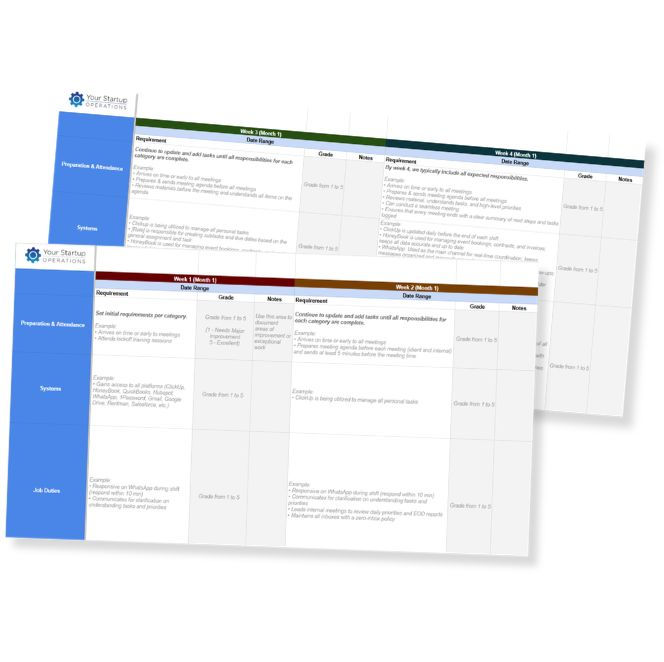
90-Day Onboarding
Template
A strong onboarding process helps new hires become productive without adding unnecessary work to your plate. Use this template to establish clear expectations, define responsibilities, and track performance during the first 90 days with confidence.

Best Practices for Creating an SOP
When important processes aren't documented, your team has to rely on you for answers. This guide walks you through creating clear, repeatable SOPs that make delegation easier, improve consistency, and help work move forward with less oversight.