

Event Coordinator and Virtual Assistant: How to Split the Work So Nothing Falls Through the Cracks

Updated: Aug 20

When an event business finally has both an event coordinator and a virtual assistant, the owner expects relief. Two capable people covering the work should mean nothing slips. But without a clear division of labor, the opposite often happens: things fall through the cracks precisely because there are two people, each assuming the other has it. The vendor confirmation nobody sent. The timeline detail that lived in two versions. The client question that both saw and neither answered.
An event coordinator and virtual assistant make a genuinely powerful team, but only when their responsibilities are split cleanly. The magic isn't in having both roles. It's in the boundary between them being so clear that every task has exactly one owner, and every handoff has a defined path. Ambiguity is where things get dropped.
This is a practical guide to drawing that boundary: who owns what, where the dangerous handoff points are, and the systems that keep an event coordinator and virtual assistant working as one operation instead of two overlapping ones.
Key Takeaways
A coordinator and a VA fail as a team not from lack of effort but from unclear ownership. When both assume the other has a task, it falls through the cracks.
The clean split follows the roles' natural strengths: the VA owns the remote operational spine (inquiries, CRM, proposals, scheduling, follow-up), the coordinator owns on-site execution (run-of-show, day-of vendor management, live problem-solving).
The riskiest moments are the handoffs between them: vendor information, timelines, and client details that pass from one to the other.
Every task needs exactly one clear owner, and every handoff needs a defined path and a single source of truth.
Systems (a shared CRM, documented handoffs, a communication rhythm) are what hold the split together, especially in peak season.
First, a Clean Recap of the Two Roles
The split only works if both roles are clearly understood, so a quick recap. (If you're still deciding whether you need one or both of these roles at all, our event coordinator vs event virtual assistant comparison works through that decision. This article assumes you have or want both, and need to divide the work.)
An event virtual assistant owns the business's operational and administrative spine, working remotely: inquiry response, CRM management, proposal formatting, scheduling, invoicing, vendor confirmations, and follow-up. Their value is week-to-week, keeping the business running smoothly between and around events.
An event coordinator owns the execution of individual events, often on-site: the run-of-show, day-of vendor management, live problem-solving, and directing the flow of the event itself. This is the client-facing, real-time coordination work the U.S. Bureau of Labor Statistics associates with meeting, convention, and event planners. Their value peaks on event day.
The clean way to remember it: the VA runs the business behind the events, the coordinator runs the events themselves. That natural division is the foundation of the split.
How an Event Coordinator and Virtual Assistant Should Split the Work
Here's the practical division of labor. The principle throughout: assign each responsibility to whichever role it naturally belongs to, and make sure it belongs to only one of them.
What the Virtual Assistant Owns
Inquiry response and lead triage
CRM setup, management, and pipeline hygiene
Proposal and contract formatting and sending
Scheduling consults, calls, and site visits
Pre-event vendor confirmations and paperwork
Invoicing and payment follow-up
Post-event follow-up, review requests, and referrals
Email, calendar, and document management
In short, the remote operational spine. The work that happens between events and can be done off-site. Our guide on remote support for event businesses breaks this category down in more detail.
What the Coordinator Owns
Building the run-of-show and event-day timeline
On-site setup and event-day management
Day-of vendor coordination and direction
Live, real-time problem-solving during the event
Directing the flow of the event itself
On-site client and guest management
In short, the live execution. The work that requires physical presence and real-time judgment on the day.
The Shared Zones (Where Cracks Form)
Some things touch both roles, and these shared zones are exactly where things fall through the cracks if ownership isn't explicit:
Vendor information. The VA confirms vendors pre-event; the coordinator directs them on the day. The vendor list and details must pass cleanly between them.
The timeline. The VA may draft it; the coordinator runs it. There can only be one authoritative version.
Client details and preferences. Gathered by the VA through the inquiry and planning process; needed by the coordinator on the day.
The rule for shared zones: one role owns the item, the other is a defined recipient, and there's a single source of truth both work from. Ambiguity here is the number-one cause of dropped balls.
The Handoff Points That Cause Dropped Balls
Most cracks aren't in the clearly-owned work. They're at the handoffs, the moments where responsibility passes from VA to coordinator or back. Here are the critical ones and how to close each.
The pre-event handoff (VA to coordinator). Everything the VA gathered (confirmed vendors, final timeline, client details, special requests) has to reach the coordinator completely before the event. The fix: a standardized event-handoff document the VA completes and the coordinator confirms receipt of, a defined number of days before every event. No verbal handoffs, no "I'll text you the details."
The vendor-confirmation handoff. The VA confirms vendors weeks out; the coordinator needs to know exactly what was confirmed to direct them on the day. The fix: confirmations logged in the shared system, not held in the VA's inbox, so the coordinator can see the current status directly.
The post-event handoff (coordinator to VA). After the event, the coordinator has information the VA needs: what happened, any issues to follow up on, notes for the review and referral process. The fix: a brief post-event debrief, even a short written one, that hands the follow-up work back to the VA.
The in-planning handoff. During planning, a client request might land with whichever role the client happened to contact. The fix: a clear rule for routing, client-facing operational questions go to the VA, event-execution questions get routed appropriately, and both know the routing so nothing sits unowned.
Each of these is a defined process, not a matter of two people being conscientious. Conscientiousness fails under peak-season load. Process doesn't.
The Systems That Hold the Split Together
A clean division on paper still falls apart without the systems to support it. Three are essential.
A shared single source of truth. Both roles must work from the same CRM and the same documents, not parallel inboxes and personal notes. When the VA logs a vendor confirmation and the coordinator can see it instantly, the handoff is automatic. When they work from separate systems, every handoff becomes a manual transfer that can be missed. For which CRMs support this well, see our CRM comparison for event planners.
Documented handoff processes. The pre-event handoff document, the post-event debrief, the vendor-confirmation log. These turn the risky handoff moments into repeatable checklists. The point of documentation is that the handoff happens the same way every time, regardless of who's busy or distracted.
A communication rhythm. A predictable cadence of communication between the two roles (a weekly sync, a pre-event check, a post-event debrief) so information flows on a schedule instead of only when someone remembers. The communication standards that apply to client communication apply internally too.
A useful lens borrowed from project management is the idea that every task should have a single accountable owner. When you can point to any responsibility in your operation and name exactly one person accountable for it, the cracks close. When two people are vaguely responsible for the same thing, it's the thing most likely to be dropped. The U.S. Small Business Administration's guidance on managing your business frames this kind of clear role definition and documented process as core to running a team that scales.
Common Failure Modes
A few patterns that break the coordinator-and-VA split:
Overlapping ownership. Two people vaguely responsible for the same task, so each assumes the other has it. The most common cause of dropped balls.
Parallel systems. The VA and coordinator working from separate tools and notes, so handoffs require manual transfer and get missed.
Verbal-only handoffs. Critical information passed by text or in passing rather than through a documented process, so it's incomplete or forgotten under pressure.
No routing rule for inbound requests. Client questions landing with whichever role the client contacted, then sitting unowned because neither is sure it's theirs.
Skipping the debrief. No post-event handoff back to the VA, so follow-up, reviews, and referral opportunities get lost.
Each traces back to the same root: a responsibility without a single clear owner.
Case Study: Naunet Floral
Naunet Floral, a luxury wedding florist YSO supports, illustrates why clear operational ownership is what stops things falling through the cracks. Before working with YSO, inquiries were arriving across three channels (the website, email, and Instagram) with no single owner and no single source of truth. Predictably, things slipped. Follow-ups were missed, and leads fell through the gaps between channels because no one clearly owned the operational spine.
The fix was exactly the principle this article is about: clear ownership. A trained YSO virtual assistant took definitive ownership of the operational spine, the inquiries, the CRM, the proposals, the follow-up, consolidated into one system with one owner. Once there was a single accountable owner working from a single source of truth, the cracks closed. Inquiries stopped slipping because someone specific owned them, and per YSO's documented case study, the owner reclaimed more than 30 hours a week to return to the creative work.
The lesson maps directly onto the coordinator-and-VA split. Naunet's gains came from consolidating ownership on the VA side. The same principle applies when you add a coordinator: the reason a two-person team stops dropping balls is that every task, and every handoff, has exactly one clear owner. Full details are on our case studies page.
Frequently Asked Question
How should an event coordinator and virtual assistant divide responsibilities?
Along the natural line between the two roles. The virtual assistant owns the remote operational spine (inquiry response, CRM, proposals, scheduling, pre-event vendor confirmations, invoicing, follow-up). The coordinator owns on-site execution (run-of-show, day-of vendor management, live problem-solving). The key is that every task belongs to exactly one of them, with no vague overlap.
Why do things fall through the cracks when I have both a coordinator and a VA?
Almost always because of unclear ownership. When a task or handoff isn't clearly assigned to one person, both assume the other has it, and it gets dropped. The fix isn't more effort, it's making every responsibility and every handoff explicitly owned, backed by a shared system both work from.
What are the most dangerous handoff points between a VA and a coordinator?
The pre-event handoff (the VA passing confirmed vendors, the timeline, and client details to the coordinator), the vendor-confirmation handoff, and the post-event debrief (the coordinator passing follow-up information back to the VA). These are where information moves between roles, so they need documented processes rather than verbal handoffs.
Do a coordinator and VA need to use the same tools?
Yes. A shared single source of truth (the same CRM and documents) is what makes handoffs automatic instead of manual. When the two roles work from separate systems, every handoff becomes a transfer that can be missed. Shared systems are one of the three things that hold the split together.
Can one person be both a coordinator and a VA?
Early on, the owner often is both. But the roles require different focus (remote operational management versus on-site live execution) and often can't be done well simultaneously, especially during peak season. As a business grows, splitting them, with a clear division of labor, is usually what keeps quality high on both sides.
About Your Startup Operations
Your Startup Operations (YSO) is a Women-Owned Small Business (WOSB) certified, white-glove operations agency co-founded by Jenna Henao and Alexis Schomer. YSO helps event business owners and other service-based companies step out of daily operations by installing a dedicated Ops Assistant trained specifically for their business, typically helping owners reclaim 30–40 hours per week.
YSO has been featured in Forbes, Voyage LA, Authority Maximizer, EIN Presswire, and AP News.
Explore our event vendor ops services, see client outcomes on our case studies page, or get in touch to talk through what your business needs.
About the Author

Jenna Henao is the Co-Founder and Operations Expert at Your Startup Operations. She works with business owners to strengthen operations, optimize workflows, and build reliable teams that support long-term business growth. With experience in entrepreneurship and operations leadership, Jenna has overseen initiatives across HR, finance, recruitment, operations, sales, marketing, and team development. She has helped businesses scale from six figures to seven figures by building efficient systems, recruiting top talent, and implementing processes that create a solid foundation for lasting success. Connect with Jenna on LinkedIn.
Reviewed by

Alexis Schomer is the Co-Founder and Marketing & Operations Expert at Your Startup Operations. She partners with business owners to streamline operations, improve delegation, and develop scalable systems that support sustainable growth. With a background in marketing, entrepreneurship, and business operations, Alexis knows that effective delegation goes beyond hiring a virtual assistant. It involves selecting the right person, creating efficient workflows, establishing clear expectations, and providing the training and support teams need to thrive. This practical, systems-focused approach guides every client partnership at YSO. Connect with Alexis on LinkedIn.
Free Resources
Access free tools, templates, and SOPs that help you streamline your operations, delegate more effectively, and build systems that support sustainable business growth.

25 Tasks You Can Offload to Your VA Today
Your schedule can quickly fill up with emails, follow-ups, scheduling, and other administrative work. This guide highlights 25 tasks you can confidently delegate to a virtual assistant, giving you more time to focus on growing your business instead of managing the day-to-day.
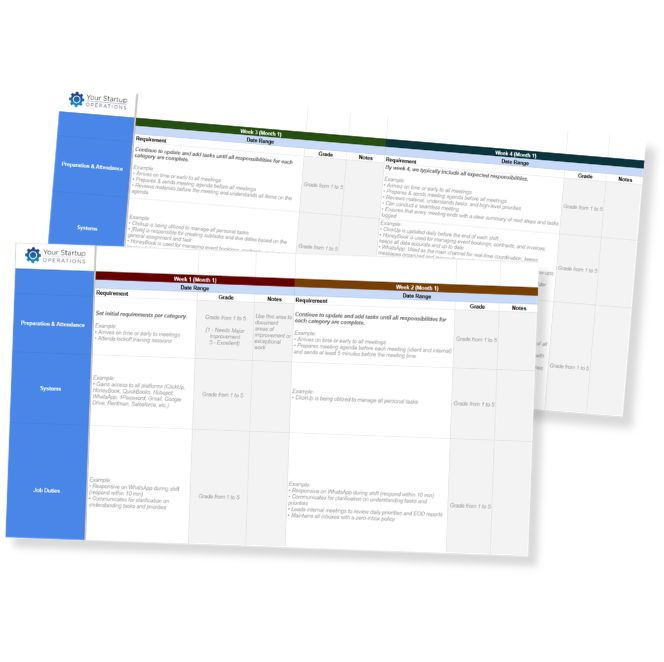
90-Day Onboarding
Template
A strong onboarding process helps new hires become productive without adding unnecessary work to your plate. Use this template to establish clear expectations, define responsibilities, and track performance during the first 90 days with confidence.

Best Practices for Creating an SOP
When important processes aren't documented, your team has to rely on you for answers. This guide walks you through creating clear, repeatable SOPs that make delegation easier, improve consistency, and help work move forward with less oversight.


