%20(1).png)

Event Assistant Communication Standards: The Response-Time Rules Top Vendors Live By

Updated: Aug 20

Ask a couple why they booked one wedding vendor over another that was equally talented and similarly priced, and you'll hear a version of the same answer surprisingly often: "They just got back to us so fast. It felt easy." That's not a small thing. In an industry where clients are shopping several vendors at once for the biggest day of their year, communication isn't the soft stuff around the edges of the work. It often is the deciding factor.
Strong event assistant communication standards are what separate vendors who feel effortless to work with from ones who feel like a hassle, and the difference usually comes down to a handful of concrete, learnable rules, most of them about how fast and how clearly you respond. The best vendors don't leave this to instinct or mood. They operate by explicit standards, so good communication happens by default instead of depending on whether someone remembered to reply.
This is the playbook: the response-time rules and broader communication standards that top event vendors live by, and how to actually put them into practice.
Key Takeaways
Communication is a primary purchasing factor in events, not an afterthought. Clients routinely choose the vendor who responds fastest and most clearly.
The single most important standard is response time. In events, clients shop multiple vendors simultaneously, so the first strong response has an outsized advantage.
Great communication standards are explicit, not instinctive. Top vendors define response-time targets by scenario (new inquiries, existing clients, vendors, after-hours) so good communication happens by default.
Speed isn't the only standard. Clarity, proactivity, closing the loop, and consistent status updates matter just as much.
These standards are best enforced through systems (auto-responders, templates, CRM automation), not willpower, which fails during peak season.
Why Response Time Is the Standard That Matters Most
Before the specific rules, it's worth understanding why response time sits at the center of event communication standards, because the logic shapes everything else.
Event clients almost never inquire with just one vendor. They send the same message to several florists, photographers, DJs, or planners at once, then compare. It's a competitive, service-driven field: the U.S. Bureau of Labor Statistics notes that strong interpersonal and communication skills are central to the work of meeting, convention, and event planners, precisely because so much of the job is client-facing. In that context, the vendor who responds first, while the client is actively engaged and still forming impressions, has a structural advantage that has nothing to do with talent or price. A fast, warm, helpful first response signals reliability and makes the client feel prioritized at the exact moment they're deciding who to trust.
The reverse is just as powerful. A response that arrives a day or two later lands after the client has already had strong conversations with faster competitors. You're no longer the first impression. You're the late one, and you're now trying to win back attention you never had to lose. This is why slow response is such a costly and invisible error, something we covered as one of the most common failures in our article on event assistant mistakes. This article is the positive inverse: the standards that prevent it.
Response speed is also a proxy. Clients can't evaluate your event execution before they hire you, so they judge what they can see, and how you communicate before booking is the clearest signal they have of what working with you will feel like. Fast, clear communication early tells them the whole experience will be smooth.
Event Assistant Communication Standards: The Response-Time Rules
Here are the response-time standards top vendors operate by, organized by scenario. Treat these as targets to build your systems around, not rigid absolutes, and adjust to your own business realities.
New Inquiries: The Fastest Standard
New inquiries get the tightest standard because they're the most time-sensitive and the highest-stakes. The target most strong vendors aim for is a response within the hour during business hours, and same-day at the absolute latest. Even a brief, warm acknowledgment that buys time for a fuller reply is far better than silence while a lead cools.
The practical move: an automated instant first response the moment an inquiry lands, one that thanks them, sets expectations for the personal follow-up, and ideally includes a pricing guide or booking link. That auto-response holds the lead's attention and buys your team the window to send a thoughtful, personalized reply.
Existing Clients: Prompt and Predictable
Booked clients don't need instant replies, but they do need predictable ones. A common standard is responding to client messages within a few hours during business hours, and always same-day. What matters most to a booked client is knowing roughly when to expect a reply, so the real rule is setting and meeting a consistent expectation rather than hitting any specific number.
Vendors and Partners: Reliable Within a Day
Vendor communication runs on a slightly relaxed but still reliable standard, typically within 24 hours during business days. Vendors are partners, not prospects, so the priority is dependability. Being the vendor who always responds within a day makes you the one other vendors want to work with and refer.
After-Hours: Boundaries, Backed by Systems
Here's where standards and sustainability meet. You can't (and shouldn't) respond instantly at all hours, but silence during evenings and weekends, when many event inquiries actually arrive, costs bookings. The standard that resolves this: an automated after-hours response that acknowledges the message instantly, sets a clear expectation for when a human will reply, and provides any immediately useful info. The client feels attended to, and your team keeps its boundaries. The system holds the standard so a person doesn't have to sacrifice their evening to it.
Holds and Tentatives: Proactive, Not Reactive
The standard most vendors miss entirely. When a client has a proposal or a tentative hold, the communication standard shouldn't be reactive (waiting for them to follow up). It should be proactive: a defined follow-up cadence that reaches out before the lead goes cold. A gentle check-in a few days after the proposal, another within a week, a final note before a held date is released. Proactive follow-up on holds recovers a meaningful share of bookings that would otherwise quietly evaporate.
Beyond Speed: The Other Communication Standards
Response time is the headline, but the vendors who feel truly effortless to work with hold standards on more than just speed.
Clarity. Every message should be easy to understand, free of jargon, and clear about any next step. A fast but confusing reply isn't a good reply. The standard is that the client never has to re-read a message to figure out what you meant or what they're supposed to do next.
Proactivity. Great communication anticipates. It surfaces the vendor who hasn't confirmed, the deposit that's due, the detail that needs a decision, before the client has to ask. Proactive communication is what makes clients feel genuinely taken care of rather than merely responded to.
Closing the loop. When something is asked or promised, the standard is to close it out explicitly. "That's confirmed," "I've sent that over," "you're all set." Open loops create low-grade anxiety, even when the work is actually getting done. Closing them is what lets clients relax.
Consistent status visibility. Clients and owners shouldn't have to ask where things stand. A predictable rhythm of updates (a status note at key milestones, a summary when relevant) removes the need to chase, which is one of the biggest sources of friction in event work. We go deeper on the traits behind this in our guide on what makes a great event VA.
Matching your brand voice. An assistant communicating on your behalf should sound like you: warm where you're warm, polished where you're polished. Consistency of voice is part of the standard, because to the client, the assistant is you.
How to Actually Hold These Standards
Standards that depend on willpower fail, especially in peak season when everyone is stretched. The vendors who actually maintain these standards do it through systems, not discipline.
Automate the first touch. An instant auto-response on every new inquiry is the single highest-leverage system. It guarantees the most important response-time standard is met 100% of the time, regardless of what your team is doing.
Build response templates. Pre-written, customizable templates for common scenarios (inquiry responses, follow-ups, vendor confirmations) mean fast replies don't require writing from scratch each time. Speed and quality stop being a tradeoff.
Use CRM automation for sequences. Automated follow-up sequences on proposals and holds enforce the proactive-communication standard without anyone having to remember. Most event CRMs support this. For which platforms do it best, see our CRM comparison for event planners.
Set explicit internal targets. If you have help, the standards only work if they're written down and shared. "New inquiries within the hour, client messages same-day, vendors within 24 hours" is the kind of explicit target that turns good communication from a hope into a process. The U.S. Small Business Administration's guidance on managing your business treats this kind of documented, repeatable process as core operational infrastructure, not a nice-to-have.
Route after-hours through automation. Auto-responders that hold the standard when humans are off protect both the booking and the boundary.
The pattern across all of these: the system holds the standard so the person doesn't have to. That's what makes the standards sustainable rather than a source of the very burnout that erodes communication in the first place.
Case Study: DJ Will Gill
DJ Will Gill runs a high-volume wedding and corporate entertainment business, and his engagement with YSO is a clean illustration of response-time standards in practice. With healthy inquiry volume across dozens of events at once, the challenge was holding a consistent communication standard at scale: responding to every lead quickly, and following up on every hold before it went cold, without any of it slipping during busy stretches.
The standards got enforced through a trained YSO assistant and systematized workflows in HoneyBook: inquiry triage with fast, consistent first responses, and structured follow-up sequences on holds that hadn't converted. The result was exactly the discipline this article describes. Every inquiry got a same-day response. Every hold got a proactive follow-up. The communication standard stopped depending on whether the owner had a free moment between performances and started running as a reliable system.
Per YSO's documented case study, the business grew 57% and DJ Will Gill was recognized on the Forbes Next 1000 list. Consistent, fast communication wasn't the only factor, but it was foundational: you can't grow a high-volume event business if leads are cooling in an unanswered inbox. Full details are on our case studies page.
Frequently Asked Questions
What are event assistant communication standards?
They're the explicit rules an event business (or its assistant) operates by for how quickly and clearly to communicate. They typically cover response-time targets by scenario (new inquiries, existing clients, vendors, after-hours, holds) plus standards for clarity, proactivity, closing the loop, and consistent status updates. The point is to make good communication happen by default rather than depending on memory or mood.
How fast should an event vendor respond to a new inquiry?
The standard most strong vendors aim for is within the hour during business hours, and same-day at the latest. Because event clients shop multiple vendors at once, the first strong response has a major advantage. An automated instant acknowledgment that buys time for a personal reply is the most reliable way to hit this consistently.
How do I maintain fast response times without being on call 24/7?
Through systems, not constant availability. Automated first responses on new inquiries, after-hours auto-responders that set clear expectations, response templates, and CRM-automated follow-up sequences let you hold the standards without sacrificing your evenings. The system holds the standard so a person doesn't have to.
Are communication standards only about response speed?
No. Speed is the most important single factor, but clarity, proactivity (anticipating needs before being asked), closing the loop on requests, consistent status visibility, and matching your brand voice are all part of strong communication standards. A fast but unclear or inconsistent response still falls short.
What's the most overlooked communication standard?
Proactive follow-up on holds and tentatives. Most vendors wait for the client to follow up after a proposal, and bookings quietly evaporate as a result. A defined follow-up cadence that reaches out before the lead goes cold recovers a meaningful share of business that would otherwise be lost to silence.
About Your Startup Operations
Your Startup Operations (YSO) is a Women-Owned Small Business (WOSB) certified, white-glove operations agency co-founded by Jenna Henao and Alexis Schomer. YSO helps event business owners and other service-based companies step out of daily operations by installing a dedicated Ops Assistant trained specifically for their business, typically helping owners reclaim 30–40 hours per week.
YSO has been featured in Forbes, Voyage LA, Authority Maximizer, EIN Presswire, and AP News.
Explore our event vendor ops services, see client outcomes on our case studies page, or get in touch to talk through what your business needs.
About the Author

Jenna Henao is the Co-Founder and Operations Expert at Your Startup Operations. She works with business owners to strengthen operations, optimize workflows, and build reliable teams that support long-term business growth. With experience in entrepreneurship and operations leadership, Jenna has overseen initiatives across HR, finance, recruitment, operations, sales, marketing, and team development. She has helped businesses scale from six figures to seven figures by building efficient systems, recruiting top talent, and implementing processes that create a solid foundation for lasting success. Connect with Jenna on LinkedIn.
Reviewed by

Alexis Schomer is the Co-Founder and Marketing & Operations Expert at Your Startup Operations. She partners with business owners to streamline operations, improve delegation, and develop scalable systems that support sustainable growth. With a background in marketing, entrepreneurship, and business operations, Alexis knows that effective delegation goes beyond hiring a virtual assistant. It involves selecting the right person, creating efficient workflows, establishing clear expectations, and providing the training and support teams need to thrive. This practical, systems-focused approach guides every client partnership at YSO. Connect with Alexis on LinkedIn.
Free Resources
Access free tools, templates, and SOPs that help you streamline your operations, delegate more effectively, and build systems that support sustainable business growth.

25 Tasks You Can Offload to Your VA Today
Your schedule can quickly fill up with emails, follow-ups, scheduling, and other administrative work. This guide highlights 25 tasks you can confidently delegate to a virtual assistant, giving you more time to focus on growing your business instead of managing the day-to-day.
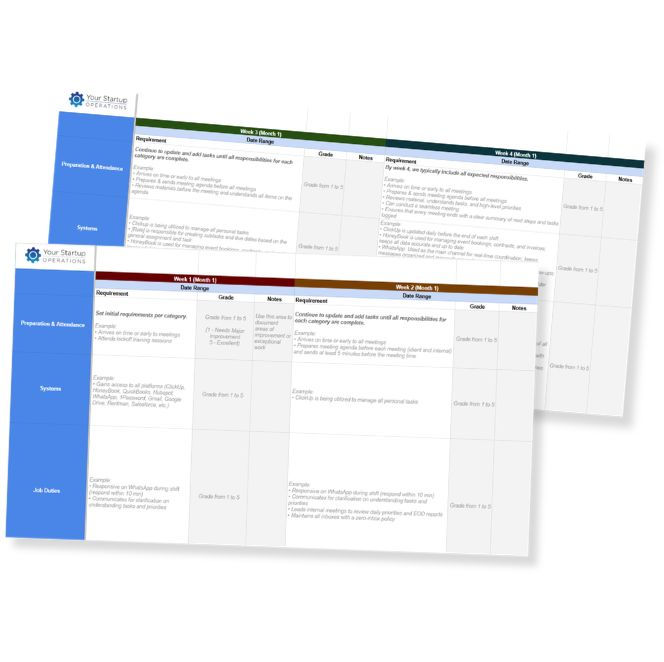
90-Day Onboarding
Template
A strong onboarding process helps new hires become productive without adding unnecessary work to your plate. Use this template to establish clear expectations, define responsibilities, and track performance during the first 90 days with confidence.

Best Practices for Creating an SOP
When important processes aren't documented, your team has to rely on you for answers. This guide walks you through creating clear, repeatable SOPs that make delegation easier, improve consistency, and help work move forward with less oversight.


