%20(1).png)

What Makes a Great Event VA: A Hiring Checklist for Event Businesses


Most event businesses hire their first virtual assistant reactively. They're drowning, someone recommends a VA, they bring one on, and within two months they're either thrilled or quietly disappointed. The difference almost never comes down to luck. It comes down to whether they knew what to look for before they hired.
So this is the question worth answering before you post a job or sign with an agency: what makes a great event VA, specifically, as opposed to a generally competent assistant who happens to be available?
Event work is its own discipline. The seasonality, the vendor coordination, the client-facing stakes, and the CRM-heavy workflows all demand things a general VA may never have encountered. Below is the checklist we use, both the traits that matter and, more usefully, how to actually test for each one before you commit.
Key Takeaways
A great event VA is defined less by task-completion and more by anticipation, judgment, and systems fluency. The best ones prevent fires, they don't just report them.
The non-negotiable traits: CRM fluency, proactive communication, calendar and deadline discipline, vendor-communication polish, discretion with client data, and comfort with seasonal intensity.
Vetting is about testing for these traits, not asking about them. Anyone can claim they're "detail-oriented." A short paid trial task reveals the truth faster than any interview.
The biggest red flags are task-taking without judgment, slow or unclear communication, and no demonstrable experience with event-industry tools.
Match the VA to your specific event vertical. A great wedding VA and a great corporate-events VA share a foundation but diverge in the specifics.
The right hire pays for itself by protecting your response time and booking rate, not just by saving you hours.
Why Vetting an Event VA Is Different
Before the checklist, it's worth naming why you can't just apply generic "how to hire a VA" advice here.
An event business runs on a specific operational spine: inquiries that arrive at all hours and need fast responses, CRMs like HoneyBook and Dubsado that structure the entire client journey, vendor relationships that require professional communication, and a calendar where a single missed deadline can cascade into a ruined event. A general administrative VA might be excellent at inbox management and still be lost inside your CRM's proposal builder or unaware that a Saturday inquiry needs a Saturday response.
The U.S. Bureau of Labor Statistics groups the underlying administrative skill set under secretaries and administrative assistants, but the event-specific layer sits on top of that foundation. You're vetting for both: the administrative fundamentals and the event-industry fluency. Miss either and the hire underperforms.
What Makes a Great Event VA: The Checklist
Here are the traits that actually separate a great event VA from an adequate one, and how to test for each.
1. CRM Fluency (Not Just CRM Familiarity)
The single most important skill. A great event VA doesn't just "know HoneyBook." They can build a tiered proposal template, set up an automated inquiry response, configure a payment schedule tied to the event date, and clean up a messy pipeline. If your CRM is the operational heart of your business (and it is), this is the trait that matters most.
How to test it: Ask them to walk you through, screen-shared, how they'd set up an automated inquiry-to-proposal workflow in your specific CRM. Fluency shows immediately. Someone who's only "familiar" will describe it vaguely. Someone who's fluent will click through it. If you're still choosing a platform, our CRM comparison for event planners covers which tools a VA should know.
2. Proactive Communication
The difference between a good VA and a great one often comes down to a single behavior: does the VA tell you about a problem before it becomes your problem? A great event VA flags the vendor who hasn't confirmed, the deposit that's overdue, the inquiry that's been sitting for three hours, without being asked.
How to test it: During a paid trial, deliberately leave a small ambiguity in a task (an unconfirmed detail, a missing piece of information). A great VA will surface it and propose a solution. A task-taker will either guess or do nothing and wait.
3. Calendar and Deadline Discipline
Event work is unforgiving on timing. A great event VA treats deadlines as fixed points, builds in buffers, and never lets a confirmation slip to "tomorrow" when tomorrow is the event. This is partly a personality trait and partly a systems habit.
How to test it: Ask how they track commitments across multiple concurrent events. A great VA has a system (a specific tool, a specific method) and can describe it. "I just remember" is a red flag at any volume above a handful of events.
4. Vendor-Communication Polish
Your VA will represent your brand to vendors and sometimes clients. A great event VA writes clearly, professionally, and warmly, and matches your voice. A sloppy email from your VA to a venue coordinator is a reflection on you.
How to test it: Give them a scenario (a vendor is late on a confirmation, a client asked to change a detail) and ask them to draft the email. You'll learn everything you need to know about tone, clarity, and professionalism in one sample.
5. Discretion With Client and Financial Data
Event VAs handle sensitive information: client contact details, payment data, contracts, and sometimes personal details about private events. A great one treats confidentiality as non-negotiable and understands basic data hygiene. The U.S. Small Business Administration's guidance on protecting business and customer data is a reasonable baseline for the standards to expect.
How to test it: Ask directly how they handle passwords, shared logins, and client data. A professional has thought about this. Vague answers are a warning.
6. Comfort With Seasonal Intensity
Event work isn't a steady 20 hours a week. It spikes. A great event VA understands and can flex with peak-season intensity without their quality collapsing when volume triples.
How to test it: Ask about their current client load and availability during peak months. If they're already at capacity with other event clients during your busy season, that's a scheduling conflict you want to know about before, not after, you hire.
7. Judgment Over Task-Completion
The trait that underlies all the others. A great event VA exercises judgment. They understand the goal behind the task, not just the task itself, so when circumstances change (and in events, they always do), they adapt intelligently instead of executing the now-wrong instruction to the letter.
How to test it: This is what a paid trial reveals better than any question. Give real work, then watch whether they solve the actual problem or just complete the literal request.
The Fastest Vetting Move: A Paid Trial Task
If you take one thing from this article, take this. Interviews measure how well someone interviews. A short paid trial task measures how well they actually work.
Give a candidate a small, real, paid piece of work that touches the traits above: set up one proposal template in your CRM, respond to a batch of sample inquiries in your voice, draft a vendor confirmation sequence. Two or three hours of paid trial work tells you more than an hour of questions ever will. A great event VA will welcome it. A weak one will resist.
This is also how reputable agencies vet internally before placing anyone. When you work with a trained placement, the trial-and-error has largely been done for you, which is part of what our event vendor VA service is built to provide.
Red Flags to Walk Away From
The inverse of the checklist. Any one of these should give you pause:
Task-taking without judgment. They do exactly what's asked and nothing more, even when the request obviously needs adjustment. This never improves with time.
Slow or unclear communication during the hiring process. How they communicate while trying to win your business is the best version you'll ever see. It doesn't get better after you hire.
No demonstrable event-tool experience. They can't screen-share a CRM workflow or have never touched HoneyBook, Dubsado, Aisle Planner, or similar. The learning curve on your dime, during your peak season, is a real cost.
Overcommitted during your peak season. They're already stretched across other event clients when you need them most.
Defensive about a paid trial. A confident, competent VA sees a trial as an opportunity. Resistance to being evaluated is telling.
Match the VA to Your Vertical
A great wedding VA and a great corporate-events VA share the same foundation (the seven traits above) but diverge in specifics. A wedding VA needs fluency with the emotional, high-touch client journey and tools like Aisle Planner. A corporate-events VA needs comfort with procurement processes, multi-stakeholder communication, and often tighter documentation.
When vetting, weight the checklist toward your actual vertical. If you're a florist, CRM fluency and proactive inquiry handling matter most. If you run corporate events, vendor coordination and documentation discipline rise to the top. The foundation is universal, the emphasis is specific.
If you're weighing whether a VA is even the right role versus an on-site coordinator, our event coordinator vs event virtual assistant comparison works through that decision first.
Case Study: Naunet Floral
Naunet Floral, a luxury wedding florist YSO supports, is a clear illustration of what a great event VA actually delivers. The studio was strong at its craft but stretched thin on the operational side: inquiries arriving across the website, email, and Instagram, a HoneyBook account that wasn't fully leveraged, and an owner spending hours on administrative work that pulled her away from design and clients.
With a trained YSO virtual assistant embedded in the workflow, that operational load shifted. The VA took ownership of the CRM (automated inquiry responses, tiered proposal templates, payment schedules tied to event dates), inquiry triage, and follow-up. The result, per YSO's documented case study, was more than 30 hours freed for the owner, hours that went back into the creative and client-facing work that differentiates the business.
The point for this article: notice which traits the engagement depended on. CRM fluency, proactive communication, and judgment, exactly the top of the checklist. That's not a coincidence. Those are the traits that produce results, which is why they belong at the top of your vetting priorities.
Full details are on our case studies page.
Frequently Asked Questions
What makes a great event VA different from a general virtual assistant?
A great event VA combines general administrative fundamentals with event-industry-specific fluency: CRM platforms like HoneyBook and Dubsado, vendor communication, seasonal-intensity stamina, and the judgment to handle the constant last-minute changes event work produces. A general VA may be excellent at inbox management and still be lost inside an event CRM or unaware that weekend inquiries need weekend responses.
What's the single most important trait in an event VA?
CRM fluency is the most consequential hard skill, because the CRM is the operational heart of an event business. But judgment is the most important underlying trait, because it's what makes every other skill useful when circumstances change. The best event VAs have both.
How do I actually test whether a VA is good before hiring?
A short paid trial task is the most reliable method. Give two to three hours of real, paid work that touches CRM setup, inquiry response, and vendor communication. Watching someone work reveals far more than interview answers, and a confident VA welcomes the evaluation.
Should an event VA have experience in my specific vertical?
Ideally, yes. The seven core traits are universal, but a wedding VA and a corporate-events VA emphasize different specifics. Vertical experience shortens the learning curve, though a strong VA with the foundational traits can often adapt quickly if the fundamentals are there.
How much does a great event VA cost?
Rates vary widely by experience, scope, and whether you hire directly or through an agency. The more useful frame is value: a great event VA protects your response time and booking rate, which for most event businesses is worth substantially more than the hourly cost. Compare the cost against the revenue lost to slow inquiry response, not against zero.
About YSO
Your Startup Operations (YSO) is a Women-Owned Small Business (WOSB)-certified virtual assistant and operations agency founded by Jenna Henao and Alexis Schomer. The agency supports event vendors, home service businesses, and bookkeeping firms by matching them with trained virtual assistants who help streamline daily operations and improve efficiency. YSO has been featured in Forbes, Authority Maximizer, and Voyage LA, and has published 14 client case studies highlighting measurable operational improvements and documented business results.
About the Author

Jenna Henao is the Co-Founder and Operations Expert at Your Startup Operations. She works with business owners to strengthen operations, optimize workflows, and build reliable teams that support long-term business growth. With experience in entrepreneurship and operations leadership, Jenna has overseen initiatives across HR, finance, recruitment, operations, sales, marketing, and team development. She has helped businesses scale from six figures to seven figures by building efficient systems, recruiting top talent, and implementing processes that create a solid foundation for lasting success. Connect with Jenna on LinkedIn.
Reviewed by

Alexis Schomer is the Co-Founder and Marketing & Operations Expert at Your Startup Operations. She partners with business owners to streamline operations, improve delegation, and develop scalable systems that support sustainable growth. With a background in marketing, entrepreneurship, and business operations, Alexis knows that effective delegation goes beyond hiring a virtual assistant. It involves selecting the right person, creating efficient workflows, establishing clear expectations, and providing the training and support teams need to thrive. This practical, systems-focused approach guides every client partnership at YSO. Connect with Alexis on LinkedIn.
Free Resources
Access free tools, templates, and SOPs that help you streamline your operations, delegate more effectively, and build systems that support sustainable business growth.

25 Tasks You Can Offload to Your VA Today
Your schedule can quickly fill up with emails, follow-ups, scheduling, and other administrative work. This guide highlights 25 tasks you can confidently delegate to a virtual assistant, giving you more time to focus on growing your business instead of managing the day-to-day.
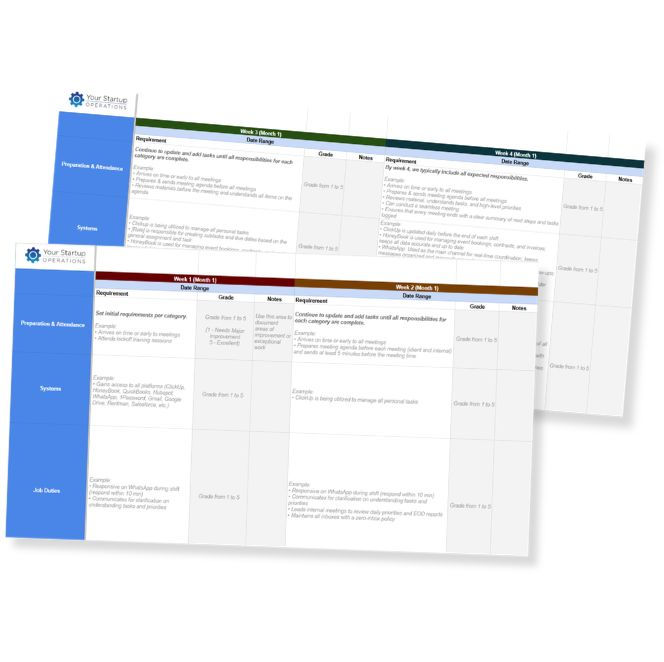
90-Day Onboarding
Template
A strong onboarding process helps new hires become productive without adding unnecessary work to your plate. Use this template to establish clear expectations, define responsibilities, and track performance during the first 90 days with confidence.

Best Practices for Creating an SOP
When important processes aren't documented, your team has to rely on you for answers. This guide walks you through creating clear, repeatable SOPs that make delegation easier, improve consistency, and help work move forward with less oversight.


