%20(1).png)

The Virtual Event Coordination Checklist Every Planner Needs

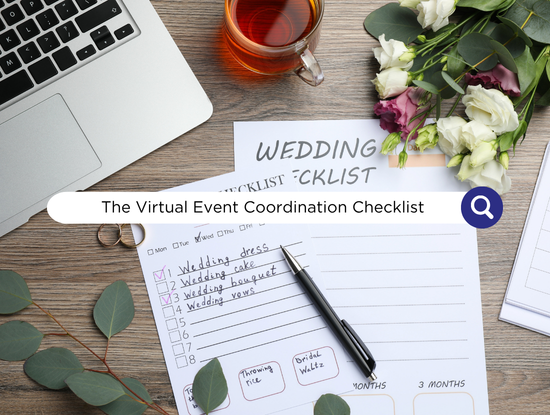
Coordination is where events are won or lost. The design gets the client excited, but it's the coordination, the timelines, the vendor confirmations, the day-of run of show, that determines whether the event runs smoothly or unravels in a hundred small ways. And here's what most planners discover as they grow: a large share of that coordination work doesn't require them to be physically present. It can be handled virtually, by a trained assistant working remotely, freeing the planner to focus on the parts that genuinely need them on-site.
That's what this virtual event coordination checklist is built around. It walks through every coordination task, phase by phase, from 30 days out to the post-event wrap, and then shows you which tasks can be handled virtually and which need the planner in the room. Use it as a complete event coordination checklist for any event you run, and as a map for what to hand off so you're not doing all of it yourself.
Key Takeaways
Coordination determines whether an event runs smoothly, and most of it follows a predictable, checklist-friendly sequence from 30 days out to post-event.
A large share of coordination work (vendor confirmations, timeline building, detail collection, follow-up) can be handled virtually by a remote assistant.
The day-of run of show is where on-site presence matters most; much of the rest does not require the planner to be physically present.
Working the checklist by phase (30 days out, 7 days out, day-of, post-event) prevents the last-minute scrambles that derail events.
Assigning each task deliberately between a VA and the planner is what lets a planner run more events without doing more personally.
How This Virtual Event Coordination Checklist Works
The checklist is organized by phase, because coordination is fundamentally about timing: doing the right things at the right point in the runway to the event. Each phase builds on the last. Skip a step at 30 days out and it resurfaces as a crisis at 7 days out. Work the phases in order, and the event comes together in a controlled, predictable way rather than a frantic one.
At the end, the "Where to Assign Each Task" section maps these virtual event planning steps to the person best suited to each, so you can see at a glance what to keep and what to hand off.
30 Days Out Checklist
The 30-days-out phase is about locking down the foundation while there's still time to fix problems. Nothing here is urgent yet, which is precisely why it's the best time to handle it.
Confirm every vendor is booked, contracted, and clear on their role.
Build the first draft of the master timeline and run of show.
Confirm the guest count status and the deadline for the final number.
Finalize the floor plan or layout with the venue.
Collect any outstanding client details, questionnaires, or preferences.
Confirm rentals, equipment, and staffing needs against the plan.
Review the budget and the payment schedule status.
Build the master vendor contact sheet (names, roles, arrival times, phone numbers).
Confirm any permits, licenses, or insurance requirements are in order.
By the end of this phase, the event's skeleton should be fully in place, with a month of runway to resolve anything that isn't.
7 Days Out Checklist
The final week is about confirmation and detail. Everything planned earlier gets verified, tightened, and distributed so the day-of runs on rails.
Re-confirm every vendor: arrival times, deliverables, load-in details, and day-of contacts. A confirmation from a month ago is not a confirmation for this week.
Finalize the run of show and distribute it to vendors, staff, and the client.
Lock in the final guest count and communicate it to catering and the venue.
Confirm staffing assignments and make sure everyone knows their role.
Prepare the day-of kit (the physical and informational essentials for on-site).
Send final details and timing to the client and all vendors.
Confirm setup and breakdown logistics, venue access times, and load-out windows.
Run a weather contingency check for any outdoor elements.
By the end of this phase, there should be no open questions left for the day of the event. Everything is confirmed, distributed, and ready.
Day-Of Run of Show
This is the event execution checklist, the live coordination that happens in real time on the day. It's also the phase where physical presence matters most.
Arrive and coordinate setup against the timeline, confirming each vendor as they arrive.
Serve as the single point of contact for vendors, staff, and the client throughout.
Manage the timeline live, cueing transitions and keeping the event on schedule.
Handle real-time problem-solving as issues come up, because they always do.
Oversee the flow of the event, adjusting as needed without disrupting the experience.
Coordinate breakdown and load-out at the end, confirming nothing is left behind.
Do a final walkthrough before leaving the venue.
The day-of run of show is the least delegable phase to a remote assistant, because it requires someone physically present making real-time decisions. This is the planner's or an on-site coordinator's domain.
Post-Event Wrap
The event isn't finished when the guests leave. The wrap phase captures value and closes loops that are easy to drop once the pressure is off.
Confirm all vendors are paid and final invoices are settled.
Return rentals and reconcile any equipment.
Send the client a thank-you while the experience is fresh.
Request a review and any feedback, the single most valuable follow-up for future bookings.
Make a referral ask at the moment of peak client satisfaction.
Archive the event in your CRM with notes for future reference.
Debrief on what went well and what to adjust, and update your templates accordingly.
Skipping the wrap is one of the most common ways planners leave reputation and pipeline value on the table. It's also almost entirely delegable.
Where to Assign Each Task: VA vs Planner
Here's the part that makes this a virtual event coordination checklist rather than a generic one. Most of the tasks above can be handled by a virtual assistant working remotely, which is what lets a planner run more events without personally doing every piece. The dividing line is physical presence and real-time, on-site judgment.
Tasks a virtual assistant can own (remote):
Vendor confirmations and re-confirmations
Building and distributing the timeline and run of show
Guest count and detail tracking
Collecting client questionnaires and preferences
Building the vendor contact sheet
Invoicing, payment tracking, and payment follow-up
Post-event follow-up: thank-you, review requests, referral asks
CRM archiving and record-keeping
Coordinating logistics that don't require being on-site
Tasks the planner (or an on-site coordinator) should own:
The day-of run of show and live event execution
Real-time, on-site problem-solving
In-person vendor and setup supervision on the day
The high-stakes, relationship-driven moments with the client
On-the-day judgment calls that require being in the room
The pattern is clear: the planning, confirming, tracking, and following-up (the bulk of coordination by hours) is remote-friendly, while the live execution needs a person on-site. Understanding this division is what lets a planner scale, and it's the same distinction we cover in depth in our event coordinator vs event virtual assistant comparison. For a fuller view of what a remote assistant can take on, our guide on remote support for event businesses breaks it down.
Frequently Asked Questions
What is a virtual event coordination checklist?
It's a phased coordination checklist (30 days out, 7 days out, day-of, and post-event) that maps each task to whether it can be handled virtually by a remote assistant or needs the planner on-site. It helps planners run events smoothly while delegating the large share of coordination work that doesn't require physical presence.
Which event coordination tasks can be handled virtually?
Most of them: vendor confirmations, timeline building and distribution, guest count and detail tracking, client questionnaire collection, invoicing and payment follow-up, and post-event follow-up like thank-yous, reviews, and referrals. What can't be handled virtually is the day-of run of show, live on-site execution, and real-time in-person problem-solving.
How far in advance should event coordination start?
The checklist here starts at 30 days out, which is the phase for locking down vendors, the timeline, and the floor plan while there's still runway to fix issues. Larger or more complex events benefit from starting earlier, but the 30-day mark is where the structured, phase-by-phase coordination should be well underway.
What's the difference between a virtual assistant and an on-site coordinator for events?
A virtual assistant handles coordination remotely: the confirmations, timelines, tracking, and follow-up. An on-site coordinator runs the event live, on the day, handling setup, real-time problem-solving, and execution in the room. Many planners use both, a VA for the remote coordination and a coordinator (or themselves) for the day-of.
Can one virtual assistant handle coordination for multiple events at once?
Yes, within reason. Because remote coordination tasks are spread across the runway to each event rather than concentrated on a single day, a trained VA can manage the coordination for several events in different phases at the same time, which is part of why the model scales so well for busy planners.
About Your Startup Operations
Your Startup Operations (YSO) is a Women-Owned Small Business (WOSB) certified, white-glove operations agency co-founded by Jenna Henao and Alexis Schomer. YSO helps event business owners and other service-based companies step out of daily operations by installing a dedicated Ops Assistant trained specifically for their business, typically helping owners reclaim 30–40 hours per week.
YSO has been featured in Forbes, Voyage LA, Authority Maximizer, EIN Presswire, and AP News.
Explore our event vendor ops services, see client outcomes on our case studies page, or get in touch to talk through what your business needs.
About the Author

Alexis Schomer is the Co-Founder and Marketing & Operations Expert at Your Startup Operations. She works with business owners to optimize operations, improve delegation, and build scalable systems that support sustainable business growth. Drawing on her experience in marketing, entrepreneurship, and business operations, Alexis believes effective delegation is about more than hiring a virtual assistant. It starts with selecting the right person, creating efficient workflows, establishing clear expectations, and providing the training and support needed for teams to succeed. This practical, systems-first philosophy guides every client partnership at YSO. Connect with Alexis on LinkedIn.
Reviewed by

Jenna Henao is the Co-Founder and Operations Expert at Your Startup Operations. She partners with business owners to streamline operations, strengthen workflows, and build reliable teams that drive long-term growth. With a background in entrepreneurship and business operations, Jenna has led initiatives across HR, finance, recruitment, operations, sales, marketing, and team leadership. She has helped businesses grow from six to seven figures by developing scalable systems, recruiting outstanding talent, and implementing processes that support lasting success. Connect with Jenna on LinkedIn.
Free Resources
Access practical tools, templates, and SOPs designed to simplify operations, improve delegation, and support business growth.

25 Tasks You Can Offload To Your VA Today
Your day fills up fast with follow-ups, inbox replies, scheduling, and admin.
This guide
shows exactly
what to hand
off first so
you can
stop doing it all yourself and
free up
real time.

The Ultimate Productivity Toolkit for Event Professionals
Managing clients, coordinating vendors, and handling daily administrative tasks can quickly fill your schedule. This toolkit shares five practical ways a virtual assistant can help streamline your workload so you can spend more time growing your business.
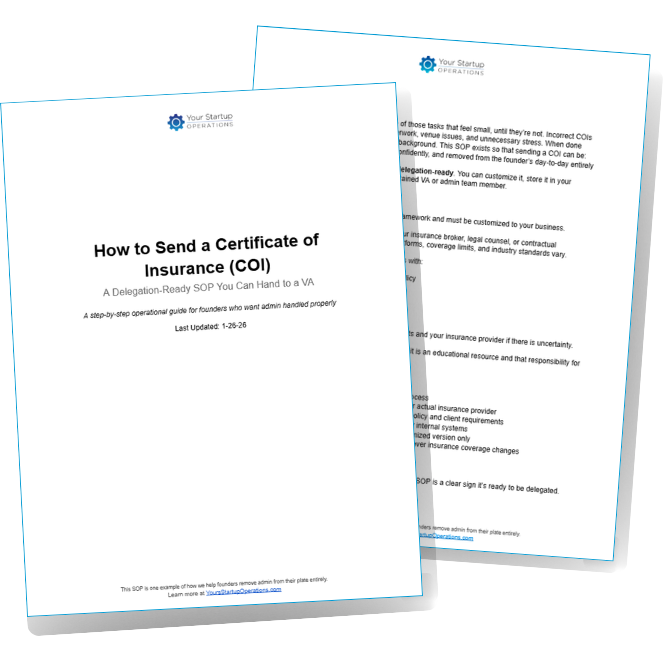
How to Send a Certificate of Insurance (COI)
Submitting a Certificate of Insurance doesn't have to be complicated.
This SOP
provides a clear, step-by-step process to help you submit accurate COIs, avoid delays, and keep approvals moving forward.
Coordinate Smarter, Not Harder
Great event coordination isn't about doing more personally, it's about doing the right things at the right time and assigning each task to the right person. Work this virtual event coordination checklist by phase, and you close the gaps that derail events. Assign the remote-friendly tasks to a virtual assistant, keep the day-of execution for yourself or an on-site coordinator, and you can run more events, more smoothly, without carrying every piece of the coordination alone.