%20(1).png)

How Virtual Event Support Works Day to Day


Virtual event support is a remote team member handling the administrative and coordination work of running events, without being physically present at the office or on-site. The concept is simple enough. What trips planners up is the mechanics: how communication happens, what access a remote person needs and how to grant it safely, how long it takes before support runs smoothly without constant check-ins.
This guide covers that operational reality rather than the broader question of whether to bring on support at all, which our event planning assistance guide already covers in depth.
Key Takeaways
Virtual event support works best with a defined communication cadence, not ad hoc check-ins, since a remote relationship depends on structure that an in-person one can get away without.
Access should be scoped to what the role requires, most virtual support needs CRM and calendar access, far fewer roles need direct payment system access, and that distinction matters for security.
Onboarding typically runs a few weeks before support operates independently, and that ramp-up time is normal, not a sign of a poor fit.
Time zone differences matter less than response-time expectations. A support person two hours behind can still meet a same-day turnaround; the key is setting that expectation clearly from the start.
The tasks best suited to virtual support are the ones with a clear deliverable and a defined deadline: vendor confirmations, timeline updates, contract tracking. Judgment calls and in-person execution stay with the planner.
What "Virtual" Means in Practice
Virtual event support isn't a scaled-down version of an in-house hire. It's a different working relationship built around asynchronous work and defined deliverables, rather than shared physical space and informal hallway updates. That distinction shapes everything else in this guide: the tools used, how access gets granted, and how quickly a new person becomes genuinely useful rather than a source of extra oversight work.
How Communication Happens
A remote working relationship needs a communication structure an in-person one can often skip. A few patterns that tend to work well:
A brief daily or near-daily check-in, even five minutes, so nothing sits unaddressed for a full day
A shared task tracker or project board, so status is visible without someone having to ask for an update
A clear escalation path for anything time-sensitive, a direct message or call rather than an email that might sit unread
A weekly summary of what got done and what's coming up, so the planner has a standing view of the workload without micromanaging it
The absence of structure, not the distance itself, is usually what makes virtual support feel unreliable. A remote person checking in daily on a shared tracker is often easier to stay aligned with than an in-office hire whose updates depend on catching them between tasks.
Setting Up Access Without Compromising Security
Virtual event support typically needs access to a few core systems: the CRM, the shared calendar, vendor contact records, and whatever tool holds the event timeline. Fewer roles need direct access to payment processing or banking, and that access should be the exception granted deliberately, not the default.
The Federal Trade Commission publishes small business guidance on data security that applies directly here: limiting access to what a role requires, rather than granting broad access by default, reduces exposure without slowing down the work that access is meant to support. Most CRM and project management platforms support role-based permissions for exactly this reason, so a virtual support person can see and edit what the role needs without a blanket login to everything the business runs on.
Onboarding: What the First Few Weeks Look Like
Support that runs independently from day one is rare, and expecting it sets an unrealistic bar. A more typical ramp-up:
Week one: shadowing existing workflows, learning the tools, and handling smaller, lower-stakes tasks with review
Weeks two to three: taking on full ownership of a few task categories (vendor confirmations, timeline updates) with lighter oversight
By week four: operating independently on the bulk of the role, with the planner's involvement limited to exceptions and judgment calls
This timeline shortens with clear documentation already in place (templates, standard email language, a written process for common tasks) and stretches out without it. Building that documentation once, even informally, tends to pay for itself many times over across future onboarding.

Time Zones and Availability
A time zone difference matters less than most planners expect, as long as response-time expectations are explicit rather than assumed. Support based a few hours behind can still meet a same-day turnaround if "same day" is defined clearly (by end of business, by a specific time) rather than left as an unstated assumption that only surfaces when it's missed.
What matters more than the time zone itself is overlap during the hours that need real-time back-and-forth, a discovery call, a live vendor negotiation, and coverage during the hours that don't, like contract tracking or CRM updates that can happen asynchronously without anyone waiting on a reply.
What Still Needs Someone On-Site
Virtual event support handles the administrative and coordination layer well. It doesn't replace a physical presence for day-of execution, live vendor supervision, or the in-person judgment calls that come up during setup and the event itself. Our event planning assistance guide covers that division in more detail, including the different models businesses use to cover both sides of the work.
Frequently Asked Questions
What is virtual event support?
Virtual event support is a remote team member who handles the administrative and coordination work of running events, vendor communication, timeline documents, contract tracking, and similar tasks, without being physically present at an office or event site.
How does virtual event support handle access to sensitive systems like payment processors?
Access should be scoped to what the role requires. Most virtual support needs CRM, calendar, and vendor contact access. Direct access to payment processing or banking is far less common and should be granted deliberately, using role-based permissions where the platform supports them, rather than as a default.
How long does it take to onboard virtual event support?
A typical ramp-up runs three to four weeks: shadowing and smaller tasks in the first week, growing ownership over specific task categories through weeks two and three, and largely independent operation by around week four, faster with existing documentation in place.
Can virtual event support work across different time zones?
Yes, as long as response-time expectations are explicit. A support person in a different time zone can meet a same-day turnaround if "same day" is clearly defined, and overlap hours matter most for anything requiring real-time back-and-forth, like a discovery call or live vendor negotiation.
What tasks still need someone on-site instead of virtual support?
Day-of event execution, live vendor supervision, and in-person judgment calls during setup and the event itself. Virtual support handles the administrative and coordination layer well but doesn't replace a physical presence for those tasks.
Ready to Set Up Virtual Event Support That Works?
The difference between virtual event support that runs smoothly and support that creates extra oversight work usually comes down to structure: clear communication cadence, scoped access, and a real onboarding plan. An events virtual assistant from YSO comes with that structure already built in.
About Your Startup Operations
Your Startup Operations (YSO) is a Women-Owned Small Business (WOSB) certified, white-glove operations agency co-founded by Jenna Henao and Alexis Schomer. YSO helps event business owners and other service-based companies step out of daily operations by installing a dedicated Ops Assistant trained specifically for their business, typically helping owners reclaim 30–40 hours per week.
YSO has been featured in Forbes, Voyage LA, Authority Maximizer, EIN Presswire, and AP News.
Explore our event vendor ops services, see client outcomes on our case studies page, or get in touch to talk through what your business needs.
About the Author

Jenna Henao is the Co-Founder and Operations Expert at Your Startup Operations. She partners with business owners to streamline operations, strengthen workflows, and build reliable teams that drive long-term growth. With a background in entrepreneurship and business operations, Jenna has led initiatives across HR, finance, recruitment, operations, sales, marketing, and team leadership. She has helped businesses grow from six to seven figures by developing scalable systems, recruiting outstanding talent, and implementing processes that support lasting success. Connect with Jenna on LinkedIn.
Reviewed by

Alexis Schomer is the Co-Founder and Marketing & Operations Expert at Your Startup Operations. She works with business owners to optimize operations, improve delegation, and build scalable systems that support sustainable business growth. Drawing on her experience in marketing, entrepreneurship, and business operations, Alexis believes effective delegation is about more than hiring a virtual assistant. It starts with selecting the right person, creating efficient workflows, establishing clear expectations, and providing the training and support needed for teams to succeed. This practical, systems-first philosophy guides every client partnership at YSO. Connect with Alexis on LinkedIn.
Free Resources
Access practical tools, templates, and SOPs designed to simplify operations, improve delegation, and support business growth.

25 Tasks You Can Offload To Your VA Today
Your day fills up fast with follow-ups, inbox replies, scheduling, and admin.
This guide
shows exactly
what to hand
off first so
you can
stop doing it all yourself and
free up
real time.

The Ultimate Productivity Toolkit for Event Professionals
Managing clients, coordinating vendors, and handling daily administrative tasks can quickly fill your schedule. This toolkit shares five practical ways a virtual assistant can help streamline your workload so you can spend more time growing your business.
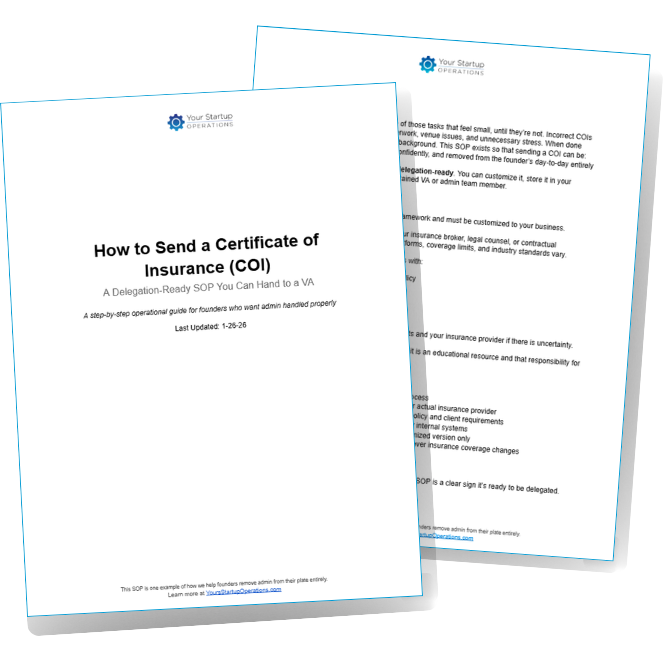
How to Send a Certificate of Insurance (COI)
Submitting a Certificate of Insurance doesn't have to be complicated.
This SOP
provides a clear, step-by-step process to help you submit accurate COIs, avoid delays, and keep approvals moving forward.


