%20(1).png)

The Wedding Planner Delegation Guide for Growing Businesses


Every growing wedding planner reaches the same wall. The business is doing well, the bookings are coming in, and that success has quietly become the problem: there's more work than one person can do, and the planner is drowning in it. The obvious answer is to delegate. And yet, for wedding planners specifically, delegation is one of the hardest things to do in practice, not because they don't know they should, but because handing off work in a business this personal feels risky in a way it doesn't in most industries.
This wedding business delegation guide is built for that exact moment. It addresses why delegation feels so hard for wedding planners, which tasks to hand off first, how to think about what's safe to delegate versus what to keep, and how to build the trust that makes delegation work. Wedding planner delegation isn't about caring less or losing your personal touch. Done right, it's what protects your personal touch by freeing you from the administrative load that's burying it.
Key Takeaways
Delegation feels hard for wedding planners because the work is personal and high-stakes, not because they lack the will, and naming those barriers is the first step to getting past them.
Start with low-risk, behind-the-scenes tasks (inbox, scheduling, CRM, vendor confirmations, invoicing) rather than client-facing work.
The client-facing versus behind-the-scenes distinction is the clearest framework for deciding what to delegate and in what order.
Building trust with a new assistant is a gradual process: start small, document your process, and expand scope as reliability is proven.
Effective wedding planner delegation protects your personal touch by clearing the administrative load that steals time from it, rather than diluting it.
Why Wedding Planner Delegation Feels Hard
Before the how, it's worth being honest about the why, because the barriers to delegation are real and mostly psychological, and you can't get past them by pretending they aren't there.
The work feels too personal to hand off. Weddings are one of the most emotionally significant days of a client's life, and planners take that seriously. The fear that an assistant won't care as much, or will drop a detail that matters enormously to a couple, makes handing off feel dangerous in a way that handing off, say, bookkeeping for a software company does not.
"No one can do it like me." Most planners built their business on their own taste, judgment, and standards, so the belief that the work requires them personally is deeply held. Some of it genuinely does. But a lot of it doesn't, and conflating the two keeps planners doing work anyone could do.
It feels faster to do it yourself. In the short term, it often is. Explaining a task takes longer than doing it once. The problem is that this logic keeps you doing the same task forever instead of investing once to never do it again.
Letting go of control is uncomfortable. When your name and reputation are on every wedding, ceding control of any part of the process feels like a risk to the thing you've built.
The processes live in your head. Many planners have never documented how they do things, which makes delegation feel impossible, because you can't hand off what you can't explain. This one is practical rather than emotional, and it's the most fixable.
Recognizing which of these is holding you back matters, because the fix is different for each. Some are about mindset, some about documentation, and some about starting small enough to build confidence. The good news is that none of them are permanent, and effective wedding planner time management on the other side of delegation is more than worth the discomfort of getting there.
The First 5 Tasks to Hand Off
The mistake most planners make with delegation is starting with something too big or too client-facing, having a bad experience, and concluding that delegation doesn't work. The fix is to start with low-risk, high-relief tasks that build your confidence and your assistant's track record. Here are five strong starting points, all behind-the-scenes and low-risk.
Inbox monitoring and inquiry first response
Having an assistant monitor your inbox and send fast, warm first responses to new inquiries relieves a huge daily burden and directly protects your booking rate, without requiring them to make high-stakes decisions.
Calendar and scheduling management
Handing off the coordination of consults, vendor calls, and meetings removes a constant low-level time drain and the back-and-forth that eats your day.
CRM data entry and pipeline updates
Keeping the CRM current (tagging leads, updating statuses, logging next steps) is essential, delegable, and low-risk, and it keeps the rest of your operation reliable.
Vendor confirmations and follow-ups
Sending and tracking vendor confirmations is detail-heavy, repetitive, and behind-the-scenes, a strong fit for delegation that also removes a common source of last-minute stress.
Invoicing and payment reminders
Sending invoices and following up on outstanding balances is uncomfortable work most planners procrastinate on, and handing it off protects your cash flow while removing a task you probably dread.
These five share a pattern: they're behind-the-scenes, repeatable, and low-risk, which makes them the ideal proving ground for a new delegation relationship. Once these are running smoothly, you expand from there. For the full picture of what a wedding assistant can take on as you grow, our breakdown of what a wedding virtual assistant does lays it out.
Client-Facing vs Behind-the-Scenes Work
The single most useful framework for wedding planner delegation is the distinction between client-facing and behind-the-scenes work, because it tells you both what to delegate and in what order.
Behind-the-scenes work should be delegated first. This is the administrative and operational load that clients never see: CRM management, scheduling, vendor coordination, invoicing, data entry, and follow-up tracking. It's low-risk to hand off because a mistake here rarely reaches the couple, and it's high-relief because it consumes so much of your time. This is where wedding planner outsourcing delivers the fastest, safest wins.
Client-facing work can be delegated later, with care. Direct communication with couples, responding to their questions, sending updates, managing their experience, can be delegated, but it requires an assistant who knows your voice, your standards, and your brand well enough to represent you faithfully. This comes after trust is established, not at the start, and it works best when the assistant has clear guidelines and templates to work from.
The core creative and relationship work stays with you. The design vision, the high-stakes emotional moments, the judgment calls that define your service, this is your differentiator, and it's what you're freeing up time for by delegating everything else. The goal of delegation isn't to hand off the work only you can do; it's to stop doing the work anyone could do so you have more capacity for the work that's uniquely yours.
Used this way, the framework resolves most of the anxiety around delegation. You're not handing off the personal, high-stakes parts. You're handing off the administrative parts that were stealing time from them.
Building Trust With a New Assistant
Delegation isn't a single act; it's a relationship that builds over time. Rushing it, dumping everything on a new assistant at once, is how it fails. Building it deliberately is how it succeeds.
Start small and specific. Begin with a few of the low-risk tasks above, clearly defined. Early wins build the mutual confidence that makes bigger handoffs possible.
Document your processes. The single highest-leverage investment in delegation is writing down (or recording) how you do things. Documentation lets an assistant do the work your way, turns your standards into something transferable, and benefits every future hire, not only this one. If your processes live only in your head, start extracting them.
Use a gradual ramp. Increase scope and autonomy as reliability is proven. Move from "check with me before this goes out" to exception-based review to full ownership over weeks, not days. Trust earned in stages is trust that holds.
Build a feedback loop. Give clear, specific feedback early and often, both corrections and confirmation of what's working. An assistant can only meet a standard they understand, and the feedback loop is how your standard gets transmitted.
Let go of perfectionism. A task done well by someone else is worth more than a task done perfectly by you at the cost of your time and sanity. Accepting "excellent" instead of demanding "exactly how I would have done it" is often the real unlock, and it gets easier as trust grows. Our guide on how to hire a wedding virtual assistant covers the onboarding process that makes this trust-building structured rather than ad hoc.
Trust, built this way, compounds. The more reliably an assistant handles what you've handed off, the more comfortable you become handing off more, until the delegation that once felt impossible becomes the foundation your growing business runs on.
Frequently Asked Questions
What is wedding planner delegation?
Wedding planner delegation is the practice of handing off tasks (especially administrative and operational work) to an assistant or team so the planner can focus on the high-value creative and relationship work only they can do. For growing wedding businesses, it's the shift from doing everything personally to building an operation, and it's what allows a planner to scale without burning out.
Why is delegation so hard for wedding planners?
Because the work is personal and high-stakes. Weddings matter enormously to clients, so planners fear that an assistant won't care as much or will drop a critical detail. Add the belief that "no one can do it like me," the short-term feeling that it's faster to do it yourself, discomfort with losing control, and processes that live only in the planner's head, and delegation feels risky. Most of these barriers are mindset and documentation issues that can be worked through.
What should a wedding planner delegate first?
Start with low-risk, behind-the-scenes tasks: inbox monitoring and inquiry response, scheduling, CRM data entry, vendor confirmations, and invoicing follow-up. These relieve a large daily burden, rarely risk reaching the client if a mistake happens, and build the trust and track record that make bigger handoffs possible later.
What should a wedding planner never delegate?
The core creative and relationship work that defines your service: the design vision, the high-stakes emotional moments with couples, and the judgment calls that are your differentiator. The point of delegation is to hand off the work anyone could do so you have more time for the work that's uniquely yours, not to hand off what makes your business special.
How do I build trust with a new assistant?
Start small with clearly defined tasks, document your processes so the assistant can work to your standard, ramp up scope and autonomy gradually as reliability is proven, and maintain a clear feedback loop. Trust in delegation is built in stages, not granted all at once, and it compounds as the assistant reliably handles what you hand off.
Does delegating make my service less personal?
No, done right it protects your personal touch. By handing off the administrative load that was stealing your time, delegation frees you to be more present for the creative and relationship work that makes your service personal in the first place. You delegate the parts anyone could do so you can focus on the parts only you can.
About the Author

Jenna Henao is the Co-Founder and Operations Expert at Your Startup Operations. She partners with business owners to streamline operations, strengthen workflows, and build reliable teams that drive long-term growth. With a background in entrepreneurship and business operations, Jenna has led initiatives across HR, finance, recruitment, operations, sales, marketing, and team leadership. She has helped businesses grow from six to seven figures by developing scalable systems, recruiting outstanding talent, and implementing processes that support lasting success. Connect with Jenna on LinkedIn.
Reviewed by

Alexis Schomer is the Co-Founder and Marketing & Operations Expert at Your Startup Operations. She works with business owners to optimize operations, improve delegation, and build scalable systems that support sustainable business growth. Drawing on her experience in marketing, entrepreneurship, and business operations, Alexis believes effective delegation is about more than hiring a virtual assistant. It starts with selecting the right person, creating efficient workflows, establishing clear expectations, and providing the training and support needed for teams to succeed. This practical, systems-first philosophy guides every client partnership at YSO. Connect with Alexis on LinkedIn.
Free Resources
Access practical tools, templates, and SOPs designed to simplify operations, improve delegation, and support business growth.

25 Tasks You Can Offload To Your VA Today
Your day fills up fast with follow-ups, inbox replies, scheduling, and admin.
This guide
shows exactly
what to hand
off first so
you can
stop doing it all yourself and
free up
real time.

The Ultimate Productivity Toolkit for Event Professionals
Managing clients, coordinating vendors, and handling daily administrative tasks can quickly fill your schedule. This toolkit shares five practical ways a virtual assistant can help streamline your workload so you can spend more time growing your business.
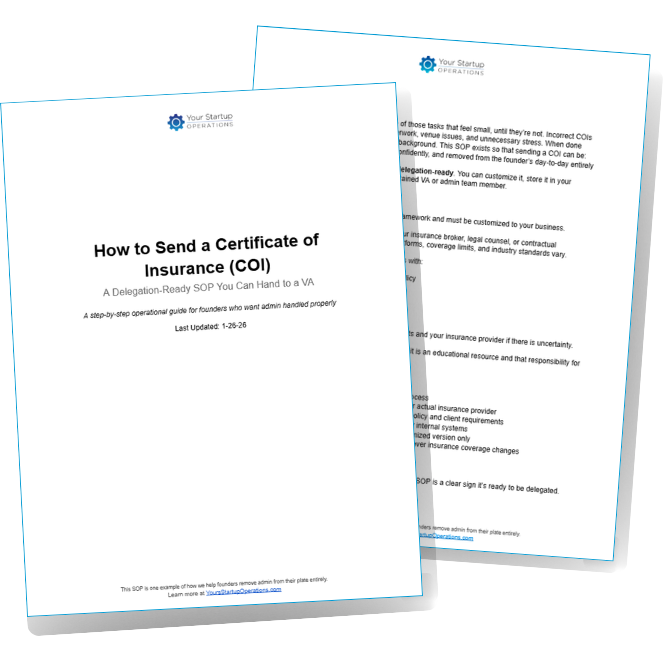
How to Send a Certificate of Insurance (COI)
Submitting a Certificate of Insurance doesn't have to be complicated.
This SOP
provides a clear, step-by-step process to help you submit accurate COIs, avoid delays, and keep approvals moving forward.
Delegate to Protect What Makes You Great
The wedding planners who scale without burning out aren't the ones who work the most hours. They're the ones who learned to delegate the work that was burying them, so their own time and energy could go to the design, the couples, and the vision that built their business in the first place. Wedding planner delegation feels hard because the work is personal, but that's exactly why it matters: the administrative load isn't merely tiring, it's stealing time from the personal touch that is your whole advantage. Start small, hand off the behind-the-scenes work first, build trust in stages, and delegation stops being a threat to your business and becomes the thing that lets it grow.
If you've hit the wall and you're ready to hand off the load, we'd be glad to help you figure out where to start.


