%20(1).png)

How to Train an Event Coordinator in 30 Days (Even When You're Slammed in Peak Season)

Updated: Aug 20

Every event business owner has felt this exact bind. You desperately need a coordinator because you're drowning, but training one requires time you don't have, because you're drowning. So the coordinator either gets thrown in with no real training and makes costly mistakes, or the training keeps getting postponed until peak season ends, by which point you needed the help three months ago.
The paradox feels unsolvable, but it isn't. The mistake is assuming that training means shadowing, that you personally have to walk a new coordinator through everything, hour by hour, while events are happening. That version of training genuinely is impossible in peak season. But it's also the wrong model. Knowing how to train an event coordinator quickly is really about knowing how to train through systems and structured autonomy rather than through your personal presence.
This is a practical 30-day plan for doing exactly that: getting a coordinator from day one to genuinely useful in a month, even when you barely have time to breathe.
Key Takeaways
The peak-season training paradox (needing help but having no time to train) is solved by training through systems and documentation, not through personal shadowing.
A coordinator can reach real usefulness in 30 days with a staged plan: foundation, supported execution, increasing autonomy, then full ownership with a safety net.
Most of the training load can be front-loaded into documentation (SOPs, run-of-show templates, vendor lists) that you build once and reuse for every future hire.
The fastest path is progressive responsibility: start with small, checklist-guided tasks and expand the coordinator's ownership each week.
What you document before day one matters more than how much time you spend hand-holding after it.
The Core Principle: Train Through Systems, Not Shadowing
Before the plan, understand the shift that makes it possible. Traditional training is high-touch: the owner personally demonstrates each task while the trainee watches, over and over, until they can replicate it. It works, but it consumes enormous amounts of the owner's time, exactly what's unavailable in peak season.
Systems-based training inverts this. Instead of your time being the training medium, documented processes are. The coordinator learns from SOPs, recorded walkthroughs, checklists, and templates, then demonstrates competence on progressively larger responsibilities with defined checkpoints. Your involvement shifts from constant demonstration to periodic review, which takes a fraction of the time.
This is also why the upfront documentation matters so much. An hour spent recording a screen-share of your event-day workflow trains every coordinator you'll ever hire, whereas an hour spent shadowing trains one person, once. Front-loading the effort into reusable systems is what makes 30-day training feasible while you're slammed. It's the same systems-over-effort principle that underpins scaling an event business at all, which we cover in how to scale an event business.
How to Train an Event Coordinator: The 30-Day Plan
The plan moves the coordinator through four stages, one per week, each building on the last. The through-line is progressive responsibility: they own a little more, with a little less oversight, every week.
Days 1 to 7: Foundation
The first week is about context and absorption, not execution. The coordinator needs to understand the business, the systems, and the standards before touching live work.
Give them access to your systems (CRM, shared drive, communication tools) and your documented SOPs.
Have them study your run-of-show templates, vendor lists, and past event documentation.
Provide recorded walkthroughs of your key workflows if you have them (and if you don't, this is the week to record a few, once, for every future hire).
If an event happens this week, have them observe, in person or through your documentation, with a specific focus on how the pieces fit together.
The goal by day 7: the coordinator understands how your events run and where everything lives, even if they haven't executed anything yet.
Days 8 to 14: Supported Execution
Week two introduces real tasks, but small, defined, and checklist-guided. The coordinator starts doing, with heavy structure and a safety net.
Assign discrete, low-risk tasks with clear checklists: confirming a set of vendors, building a timeline from your template, preparing an event-day kit.
Every task comes with a checklist and a defined "check with me before this goes out" gate.
Review their work at defined points rather than hovering. The checklists do the moment-to-moment guiding.
The goal by day 14: the coordinator can complete defined coordination tasks correctly with a checklist and a review checkpoint.
Days 15 to 21: Increasing Autonomy
Week three widens the scope. The coordinator takes ownership of larger pieces with less frequent review.
Have them own a full workflow end to end (all vendor coordination for one event, or the complete timeline build and confirmation process).
Move from "check before it goes out" to "do it and flag anything unusual."
If possible, have them handle a small element of a live event with you or a senior team member as backup.
The goal by day 21: the coordinator owns meaningful chunks of work with only exception-based oversight.
Days 22 to 30: Full Ownership With a Safety Net
The final stretch is about proving they can run it, with backup available but not hovering.
Have them coordinate a full event (or a substantial portion) as the primary owner, with you or a senior person as a defined safety net rather than an active participant.
Debrief afterward: what went well, what to adjust, what to add to the documentation for next time.
Formalize their ongoing responsibilities based on what they've demonstrated.
The goal by day 30: the coordinator can own event coordination with normal supervision, and you've reclaimed the time their help was meant to create.
How to Train When You Genuinely Have No Time
Even the staged plan assumes some owner involvement. Here's how to minimize it when you're truly underwater.
Front-load documentation once. The single highest-leverage move. Spend a few hours before day one (or in the earliest days) documenting your core workflows as SOPs and recorded walkthroughs. This is reusable forever and replaces most live demonstration.
Delegate the training itself. You don't have to be the trainer. A senior team member, an experienced VA, or a well-built onboarding document can carry much of the load. The owner's scarce time is best spent on review checkpoints, not demonstration.
Use checklists as silent trainers. A good checklist teaches while it guides. Every checklist you build lets a coordinator execute correctly without you explaining, and it trains the next hire too.
Review asynchronously. You don't need to review work in real time. Batch your review into defined windows so it fits around events rather than interrupting them.
The pattern: convert your knowledge into reusable assets once, then spend your live time only on the review that assets can't replace. The U.S. Small Business Administration's guidance on hiring and managing employees reinforces that structured onboarding, rather than ad hoc training, is what makes new staff productive faster.
What to Document Before Day One
The 30-day plan runs on documentation. If you build these before the coordinator starts, training gets dramatically easier. If you build them during, you're doing it once anyway and every future hire benefits.
Run-of-show and timeline templates for your typical event types.
Vendor lists and contact protocols, including how you prefer vendors to be communicated with.
Event-day SOPs: setup sequence, common problems and their fixes, escalation rules.
Your standards: what "done right" looks like, and the communication standards you expect, which we detail in our event assistant communication standards guide.
Checklists for the recurring coordination tasks.
Note that education requirements for the profession are modest, the U.S. Bureau of Labor Statistics notes that many event planners learn substantially through on-the-job training, which is exactly what a good documentation-driven onboarding provides in a structured, accelerated form.
Common Training Mistakes
A few patterns that slow coordinator training or derail it:
Trying to shadow-train in peak season. Insisting on high-touch personal demonstration when there's no time for it, so training stalls entirely.
No documentation. Expecting the coordinator to absorb everything verbally, so nothing is reusable and every question comes back to you.
Too much too soon. Handing over full event ownership on day two, then being surprised by mistakes. Progressive responsibility exists for a reason.
No checkpoints. Either hovering constantly or disappearing entirely, rather than defined review gates that give autonomy with a safety net.
Skipping the debrief. Not capturing what was learned into the documentation, so the next hire starts from scratch.
Each one either overloads your time or under-supports the coordinator. The staged, documented approach avoids both.
Case Study: The Think Mill
The Think Mill, an events portfolio company YSO supports, illustrates why documented systems are what make fast, low-touch onboarding possible, even in genuinely complex operations.
As the business grew across multiple entities and event lines, bringing operational support up to speed could easily have consumed enormous amounts of the founders' time, the exact resource a growing event business can least spare. What made ramping feasible instead was systematization: multi-entity financial workflows documented in QuickBooks, Bill.com set up for vendor payments, and repeatable processes that support could learn and run rather than requiring constant hand-holding. Because the operation was captured in systems rather than living only in the founders' heads, embedded support could take ownership without the founders having to personally demonstrate every step.
The lesson maps directly onto training a coordinator. The reason a new hire can become useful in 30 days rather than six months isn't heroic hand-holding, it's that the knowledge exists in documented, learnable form. When your operation is systematized, onboarding is fast. When it lives only in your head, every hire is slow and every training depends on time you don't have. Full details are on our case studies page.
Frequently Asked Questions
How long does it take to train an event coordinator?
With a structured, documentation-driven approach, a coordinator can reach genuine usefulness in about 30 days, progressing from foundation and supported execution to increasing autonomy and full ownership with a safety net. Without documentation and structure, it commonly takes far longer, because everything depends on the owner's limited time.
How do I train a coordinator when I have no time during peak season?
Train through systems rather than personal shadowing. Front-load your knowledge into reusable SOPs, recorded walkthroughs, and checklists once; delegate the hands-on training to documentation or a senior team member; and spend your scarce time only on periodic review checkpoints rather than constant demonstration.
What should I document before training an event coordinator?
At minimum: run-of-show and timeline templates, vendor lists and communication protocols, event-day SOPs (including common problems and their fixes), your quality and communication standards, and checklists for recurring tasks. These reusable assets carry most of the training load and benefit every future hire.
What's the biggest mistake when training an event coordinator?
Trying to shadow-train during peak season, insisting on high-touch personal demonstration when there's no time for it, so training stalls. The fix is inverting the model: let documented systems do the teaching and reserve your time for review.
Can I train a coordinator without doing it myself?
Largely, yes. Much of the training can be carried by documentation, recorded walkthroughs, checklists, and a senior team member or experienced assistant. The owner's involvement is best concentrated at review checkpoints rather than spread across constant demonstration, which is what makes training feasible while you're slammed.
About Your Startup Operations
Your Startup Operations (YSO) is a Women-Owned Small Business (WOSB) certified, white-glove operations agency co-founded by Jenna Henao and Alexis Schomer. YSO helps event business owners and other service-based companies step out of daily operations by installing a dedicated Ops Assistant trained specifically for their business, typically helping owners reclaim 30–40 hours per week.
YSO has been featured in Forbes, Voyage LA, Authority Maximizer, EIN Presswire, and AP News.
Explore our event vendor ops services, see client outcomes on our case studies page, or get in touch to talk through what your business needs.
About the Author

Jenna Henao is the Co-Founder and Operations Expert at Your Startup Operations. She works with business owners to strengthen operations, optimize workflows, and build reliable teams that support long-term business growth. With experience in entrepreneurship and operations leadership, Jenna has overseen initiatives across HR, finance, recruitment, operations, sales, marketing, and team development. She has helped businesses scale from six figures to seven figures by building efficient systems, recruiting top talent, and implementing processes that create a solid foundation for lasting success. Connect with Jenna on LinkedIn.
Reviewed by

Alexis Schomer is the Co-Founder and Marketing & Operations Expert at Your Startup Operations. She partners with business owners to streamline operations, improve delegation, and develop scalable systems that support sustainable growth. With a background in marketing, entrepreneurship, and business operations, Alexis knows that effective delegation goes beyond hiring a virtual assistant. It involves selecting the right person, creating efficient workflows, establishing clear expectations, and providing the training and support teams need to thrive. This practical, systems-focused approach guides every client partnership at YSO. Connect with Alexis on LinkedIn.
Free Resources
Access free tools, templates, and SOPs that help you streamline your operations, delegate more effectively, and build systems that support sustainable business growth.

25 Tasks You Can Offload to Your VA Today
Your schedule can quickly fill up with emails, follow-ups, scheduling, and other administrative work. This guide highlights 25 tasks you can confidently delegate to a virtual assistant, giving you more time to focus on growing your business instead of managing the day-to-day.
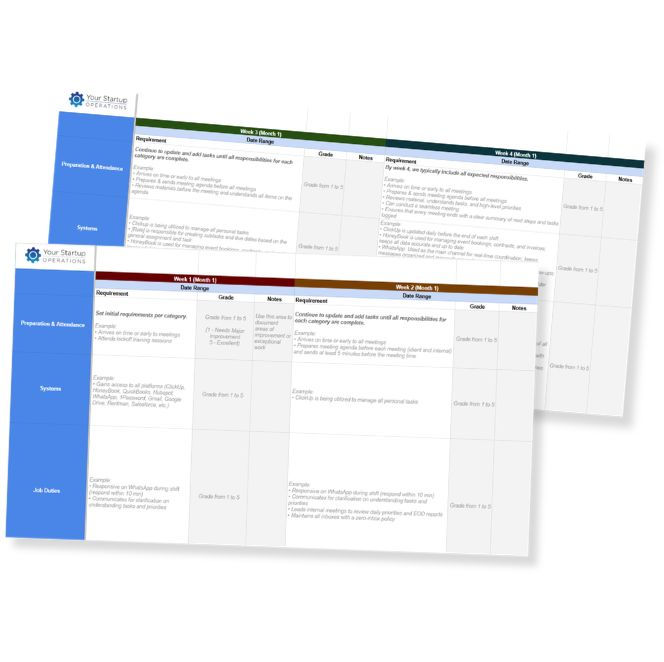
90-Day Onboarding
Template
A strong onboarding process helps new hires become productive without adding unnecessary work to your plate. Use this template to establish clear expectations, define responsibilities, and track performance during the first 90 days with confidence.

Best Practices for Creating an SOP
When important processes aren't documented, your team has to rely on you for answers. This guide walks you through creating clear, repeatable SOPs that make delegation easier, improve consistency, and help work move forward with less oversight.


