%20(1).png)

How to Brief an Event Assistant So You Only Have to Explain It Once

Updated: Aug 20

Here's the delegation trap almost every event business owner falls into. You hand a task to your assistant, they do it slightly wrong, you explain it again, they get closer, you clarify once more, and by the third round you're thinking "it would have been faster to just do it myself." So next time, you do. And the whole point of having help quietly evaporates.
The problem usually isn't the assistant. It's the brief. A task explained incompletely or ambiguously the first time guarantees a second, third, and fourth conversation, and that re-explaining tax is what makes delegation feel like more work than doing it yourself. Learning how to brief an event assistant properly, completely and clearly the first time, is what turns delegation from a frustration into the time-saver it's supposed to be.
This is a practical guide to briefing so well that you only have to explain it once, and to turning those one-time briefs into assets you never have to recreate.
Key Takeaways
Repeated explaining is almost always a briefing failure, not an assistant failure. An incomplete or ambiguous first brief guarantees follow-up rounds.
A brief you only give once is complete: it covers the outcome, the context, the specifics, the deadline, the format, and what to do when stuck.
Ambiguity is the enemy. The clearer you are about what "done right" looks like, the less back-and-forth follows.
The highest-leverage move is turning one-time briefs into reusable assets (templates and SOPs), so recurring tasks never need re-briefing at all.
Good briefing is a learnable process, not a personality trait, and it's one of the biggest determinants of whether delegation actually saves you time.
Why You Keep Explaining the Same Things
Understanding why re-explaining happens is the key to preventing it, because the causes are consistent and fixable.
Incomplete briefs. You explain the task but leave out something you assumed was obvious: the deadline, the format, a constraint, where to find something. The assistant fills the gap with a guess, guesses wrong, and now you're explaining the part you skipped.
Ambiguity about "done." You describe the task but not what a good result looks like. The assistant completes it to their interpretation, which differs from yours, so you send it back.
Verbal-only handoffs. You explain in passing or on a call, nothing is written down, and the details fade. A week later neither of you remembers exactly what was agreed, so you explain again.
No reusable capture. Even when you brief a recurring task well, you brief it fresh every single time because it was never documented. The tenth time is as much work as the first.
Every one of these is a briefing-process problem, not an assistant problem, and every one has a fix built into a good brief. Clear delegation is a core part of the administrative and coordination skill set the U.S. Bureau of Labor Statistics associates with event and administrative support roles, and it's as much on the person delegating as on the person receiving.
How to Brief an Event Assistant: The Anatomy of a One-Time Brief
A brief you only have to give once is complete. Here are the components. Cover these and you close the gaps that force follow-up conversations.
The outcome. Start with what "done" looks like, not just what to do. "Send follow-up emails" is a task. "Every lead who got a proposal last week receives a warm check-in that moves them toward booking" is an outcome. When the assistant understands the goal, they can handle variations you didn't anticipate without coming back to ask.
The context. A sentence on why this matters and how it fits the bigger picture. Context is what lets an assistant exercise judgment. Someone who knows why they're confirming vendors early will handle a surprise better than someone just ticking a box.
The specifics and constraints. The concrete details: which leads, which template, what tone, what to include or avoid, any hard rules. This is where most incomplete briefs fall short. If there's a constraint in your head ("but never quote a price without checking with me"), it has to be in the brief.
The deadline. Explicit, not implied. "By Thursday end of day" rather than "soon." Ambiguous timing is one of the most common causes of a redo.
The format and deliverable. What form the finished work should take, and where it should go. A document in the shared drive? A draft in the CRM? A message to you for review? Specify it.
Examples, where useful. A good example (and sometimes a bad one) communicates more than a paragraph of description. "Like this one from last month" is often the clearest instruction you can give.
What to do when stuck. Define the decision authority and the escalation path. Can they make judgment calls, or should they check first? Who do they ask if you're unavailable? This single component prevents both the "they guessed wrong" problem and the "they waited and did nothing" problem.
Not every brief needs all seven in full, a two-minute task doesn't warrant a formal brief. But for anything substantial, running through these mentally is what turns a brief into one you only give once.
A Simple Reusable Brief Structure
You don't need a formal document for every task, but having a mental (or literal) template makes complete briefing fast and automatic. A workable structure:
What I need: the outcome, in one line.
Why: the context, in one line.
Details: the specifics, constraints, and any hard rules.
By when: the explicit deadline.
Deliver as: the format and where it goes.
If stuck: decision authority and who to ask.
Run any real task through that six-line structure and you'll catch the gaps that would otherwise become follow-up conversations. Over time it becomes automatic, and your briefs get complete without you having to think about it. This is closely related to the communication standards that keep the rest of your operation running smoothly.
Turn One-Time Briefs Into Permanent Assets
Here's the move that eliminates re-explaining entirely for recurring work. The best briefs aren't just given once, they're captured once, so they never have to be given again.
When you brief a recurring task well, turn that brief into a reusable asset:
A template for anything with a repeatable structure (the follow-up email sequence, the vendor confirmation, the event-day checklist).
An SOP for any recurring process, capturing the steps, the standards, and the decision rules once.
A saved example of "done right" the assistant can reference instead of asking.
Do this and a recurring task moves from "I explain it every time" to "I explained it once, documented it, and now it just runs." This is the same systematizing principle behind training staff efficiently, which we cover in how to train an event coordinator. The one-time effort of documenting pays off across every future instance and every future hire. It's also, notably, how structured delegation is supposed to work: the U.S. Small Business Administration's guidance on managing your business frames documented process as the backbone of a team that runs without the owner in every decision.
Common Briefing Mistakes
The patterns that guarantee you'll explain things more than once:
Briefing the task, not the outcome. Telling the assistant what to do without what success looks like, so they hit the letter and miss the intent.
Assuming shared context. Leaving out details that are obvious to you but not to them, then being surprised by the gap.
Verbal-only handoffs. Explaining in passing with nothing written, so the details evaporate and get re-explained later.
No decision authority. Failing to say whether they can make judgment calls, so they either guess wrong or freeze.
Never documenting recurring briefs. Re-explaining the same recurring task from scratch every time instead of capturing it once.
Each maps to a missing component of a complete brief, which is why running through the anatomy above closes them.
Case Study: Naunet Floral
Naunet Floral, a luxury wedding florist YSO supports, illustrates the payoff of briefing and handing off well the first time. Before working with YSO, the operational spine (inquiries across three channels, the CRM, proposals, follow-up) was scattered and owner-dependent, the kind of setup where every task tends to route back through the owner repeatedly.
The shift came from a thorough, one-time handoff rather than perpetual re-explaining. A trained YSO virtual assistant was brought fully up to speed on the operational spine and then given clear ownership of it, with the workflows and standards captured rather than re-communicated task by task. Because the handoff was complete and documented, the owner didn't have to keep explaining how things should run. The VA owned it and ran it. Per YSO's documented case study, that clean transfer of ownership freed the owner more than 30 hours a week to return to the creative work.
The lesson generalizes to everyday briefing. The reason Naunet reclaimed so much time wasn't that the owner explained things constantly. It's that the operational knowledge was transferred once, completely, and captured, so it didn't have to be explained again. That's the "explain it once" principle at the scale of a whole operation. Full details are on our case studies page.
Frequently Asked Questions
How do I brief an event assistant so I don't have to repeat myself?
Give a complete brief the first time. Cover the outcome (what "done" looks like), the context (why it matters), the specifics and constraints, an explicit deadline, the format and where it goes, and what to do when stuck. Most repeated explaining comes from leaving one of these out, so the assistant guesses and guesses wrong.
What makes a good task brief for an assistant?
Completeness and clarity. A good brief describes the desired outcome rather than just the task, includes all the constraints and details you're holding in your head, sets an explicit deadline and format, and defines decision authority. Adding a good example of "done right" often communicates more than any description.
Why does my assistant keep getting tasks slightly wrong?
Usually because the brief left room for interpretation. If you describe the task but not what a good result looks like, the assistant fills the gap with their best guess, which differs from yours. The fix is briefing the outcome and the standards explicitly, not just the action.
How do I stop re-explaining the same recurring tasks?
Capture the brief once as a reusable asset. Turn recurring tasks into templates, SOPs, or saved examples so the instructions live in a document instead of in your repeated explanations. After that, the task runs from the documentation rather than from another conversation.
Should I brief tasks verbally or in writing?
For anything substantial or recurring, in writing. Verbal-only handoffs fade from memory and get re-explained later. A brief written in a simple, consistent structure takes only a moment longer and prevents the follow-up conversations that verbal handoffs create.
About Your Startup Operations
Your Startup Operations (YSO) is a Women-Owned Small Business (WOSB) certified, white-glove operations agency co-founded by Jenna Henao and Alexis Schomer. YSO helps event business owners and other service-based companies step out of daily operations by installing a dedicated Ops Assistant trained specifically for their business, typically helping owners reclaim 30–40 hours per week.
YSO has been featured in Forbes, Voyage LA, Authority Maximizer, EIN Presswire, and AP News.
Explore our event vendor ops services, see client outcomes on our case studies page, or get in touch to talk through what your business needs.
About the Author

Jenna Henao is the Co-Founder and Operations Expert at Your Startup Operations. She works with business owners to strengthen operations, optimize workflows, and build reliable teams that support long-term business growth. With experience in entrepreneurship and operations leadership, Jenna has overseen initiatives across HR, finance, recruitment, operations, sales, marketing, and team development. She has helped businesses scale from six figures to seven figures by building efficient systems, recruiting top talent, and implementing processes that create a solid foundation for lasting success. Connect with Jenna on LinkedIn.
Reviewed by

Alexis Schomer is the Co-Founder and Marketing & Operations Expert at Your Startup Operations. She partners with business owners to streamline operations, improve delegation, and develop scalable systems that support sustainable growth. With a background in marketing, entrepreneurship, and business operations, Alexis knows that effective delegation goes beyond hiring a virtual assistant. It involves selecting the right person, creating efficient workflows, establishing clear expectations, and providing the training and support teams need to thrive. This practical, systems-focused approach guides every client partnership at YSO. Connect with Alexis on LinkedIn.
Free Resources
Access free tools, templates, and SOPs that help you streamline your operations, delegate more effectively, and build systems that support sustainable business growth.

25 Tasks You Can Offload to Your VA Today
Your schedule can quickly fill up with emails, follow-ups, scheduling, and other administrative work. This guide highlights 25 tasks you can confidently delegate to a virtual assistant, giving you more time to focus on growing your business instead of managing the day-to-day.
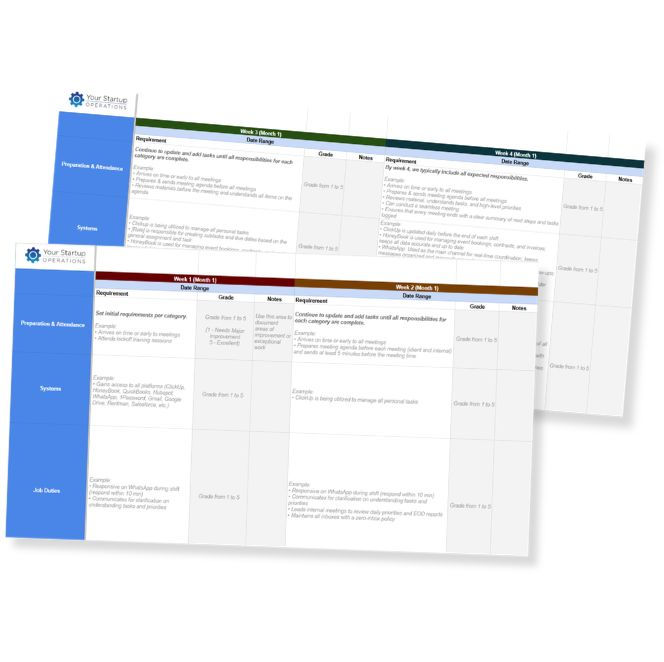
90-Day Onboarding
Template
A strong onboarding process helps new hires become productive without adding unnecessary work to your plate. Use this template to establish clear expectations, define responsibilities, and track performance during the first 90 days with confidence.

Best Practices for Creating an SOP
When important processes aren't documented, your team has to rely on you for answers. This guide walks you through creating clear, repeatable SOPs that make delegation easier, improve consistency, and help work move forward with less oversight.


