%20(1).png)
Event Operations KPIs: The 9 Metrics Worth Tracking Every Month
- Jenna Henao
- Jul 16
- 11 min read

Most event vendors run their businesses on a mix of gut feel and last month's bank balance. Both are useful. Neither is enough.
The businesses that scale past 40 or 50 events a year almost always share one habit that the businesses stuck at 20 don't: they track a small handful of numbers every month, and those numbers drive their decisions. Not a 30-line dashboard. Not a fancy report. Just the right nine or ten metrics, checked consistently, that tell them what's actually going on.
This guide walks through the nine event operations KPIs worth tracking every month, what they are, why they matter, and how to calculate each one without needing an analytics degree. It's written for event vendors and coordinators who want to run their business on real numbers, not vibes.
Key Takeaways
You don't need dozens of metrics. Nine is enough to run an event business well, and more than nine usually just creates noise.
The single most important KPI for most event vendors is inquiry response time. It's the number that drives everything else at the top of the funnel.
Track the same numbers every month. Consistency beats sophistication; a simple metric tracked for 12 months tells you more than a fancy one tracked for two.
The point of tracking KPIs isn't to hit targets. It's to spot trends early enough to do something about them.
Most event vendors overcomplicate their measurement systems. If your spreadsheet takes more than 30 minutes a month to update, it's too complicated.
What Makes a Good KPI (Quick Context)
Before we get into the nine, a quick note on what actually makes a metric worth tracking.
A good KPI is:
Specific. "Doing well" isn't a metric. "Booking rate of 22%" is.
Comparable over time. You should be able to look at the same number month after month.
Tied to a decision. If the number goes up or down, something changes about how you run the business.
If a metric doesn't fit those three criteria, it's a vanity number interesting to look at, but not worth the effort of tracking. The Harvard Business Review's foundational work on the balanced scorecard by Robert Kaplan and David Norton established this principle for measurement systems decades ago: metrics have to drive decisions, not just describe the past.
The 9 KPIs Worth Tracking
1. Inquiry Response Time
What it is: The average time it takes you to respond to a new inquiry from the moment it hits your inbox to the moment you send the first real reply.
Why it matters: More than any other single metric. Research widely cited in sales operations, including the Harvard Business Review analysis by James Oldroyd on lead response, found that leads contacted within an hour were roughly seven times more likely to have a meaningful conversation than leads contacted after that window. For event vendors quoting against three or four competitors on the same inquiry, this is the difference between "we booked with someone else" and "we sent the deposit."
How to calculate: Total time from inquiry to first reply across all inquiries in the month, divided by the number of inquiries. Aim for under 60 minutes during business hours.
What to do about it: If it's above two hours, this is your first fix. Everything downstream gets easier when this number gets smaller.
2. Inquiry-to-Booking Conversion Rate
What it is: The percentage of inquiries that turn into signed bookings.
Why it matters: Response time gets you the conversation. Conversion rate tells you whether your pricing, positioning, and pitch are actually landing. Low conversion means something in your sales process isn't working, often not the price you think it is.
How to calculate: Bookings in the month, divided by inquiries in the same month, times 100. For most event vendors, a healthy rate sits somewhere between 15% and 35%, depending on category and price point.
What to do about it: If it's below 15%, look at the sales conversation itself. Are you getting to a real qualifying conversation, or dropping leads at the quote stage?
For a related workflow on how quotes get managed, see YSO's post on managing clients, quotes, and event logistics with a VA.
3. Average Booking Value
What it is: The average revenue per booked event.
Why it matters: This is where a lot of event businesses accidentally cap themselves. If your average booking value hasn't moved in two years but your costs have, your margin is eroding without you noticing.
How to calculate: Total booked revenue in the month, divided by the number of bookings.
What to do about it: Track it trending, not just monthly. If it's flat or declining, you likely have a pricing or packaging problem, not a volume problem.
4. Deposit Collection Lag
What it is: The average number of days between contract signing and deposit received.
Why it matters: Cash flow. Signed contracts don't pay your bills; deposits do. Vendors who lose track of this number end up funding their peak season out of pocket while waiting on deposits that should already be in. The U.S. Small Business Administration's guidance on managing cash flow frames the underlying principle: small businesses fail more often from cash flow gaps than from unprofitability.
How to calculate: For each booking in the month, count days from the contract signed to the deposit cleared. Average across all bookings.
What to do about it: Anything over five days is a red flag. Most of the time, it's not the client; it's an invoicing delay on your end.
5. Owner Hours Per Event
What it is: The number of hours you personally spend on an average event, from inquiry through post-event follow-up.
Why it matters: This is the metric most owners never track, and the one that predicts whether the business will scale or stall. If your owner hours per event stay flat as your volume grows, you're a bottleneck. The U.S. Bureau of Labor Statistics data on event planners shows that event planning is fundamentally administrative and coordination-heavy work, which means most of the hours you spend per event are the ones that can eventually be delegated.
How to calculate: Track a rough hour estimate on each event for a month. Divide total hours by the number of events. Honesty matters more than precision. 20 hours or 5 hours is a big signal, even if you're off by a couple.
What to do about it: Any number that's growing over time is a delegation problem. YSO's post on what to delegate first to an event coordinator virtual assistant walks through the sequence for shrinking this number.
6. Team Utilization Rate
What it is: The percentage of your team's available hours that are booked to actual client work (as opposed to internal admin, downtime, or slack).
Why it matters: This is a capacity signal. Utilization consistently over 85% means your team is overbooked and burnout is coming. Under 60% means you have the capacity to sell but aren't. The sweet spot is usually 70–80%.
How to calculate: Hours worked on client-facing tasks in the month, divided by total available hours. Multiply by 100.
What to do about it: If it's climbing, hire before you crack. If it's falling, look at sales, not staffing. Related reading: YSO's post on how many event assistants your business actually needs.
7. Client Review Rate
What it is: The percentage of completed events that result in a public review on Google, The Knot, WeddingWire, or your primary review platform.
Why it matters: Reviews compound. A vendor with 200 five-star reviews outperforms a vendor with 30 five-star reviews on the same platform, even if the actual work is identical. Review rate is the metric that tells you whether your post-event workflow is running or not.
How to calculate: Reviews received in the month, divided by events completed in the same month. Aim for 40% or higher over time.
What to do about it: If it's below 20%, you don't have a review problem; you have a review request problem. Reviews don't happen unless someone asks for them.
8. Vendor Referral Rate
What it is: The percentage of new bookings that came from another vendor's referral (planner, venue, florist, DJ, photographer, or anyone in your event network).
Why it matters: Vendor referrals are the highest-quality lead source for most event businesses. They come pre-warmed, they convert at higher rates, and they don't cost anything in ad spend. If this number is low, your network isn't working for you.
How to calculate: New bookings sourced from vendor referrals in the month, divided by total new bookings. Aim for at least 25%.
What to do about it: If it's under 15%, the fix isn't marketing; it's the vendor relationships themselves. Are you actually maintaining the network, or just showing up when they refer? YSO's post on productivity hacks for event planners working with a VA covers some of the maintenance habits worth automating.
9. Repeat and Anniversary Booking Rate
What it is: The percentage of past clients who book again either directly (repeat weddings, vow renewals, corporate re-hires) or through anniversary events, milestone celebrations, and related life-stage events.
Why it matters: For weddings especially, this metric is easy to write off ("nobody has two weddings"). But repeat bookings for anniversaries, corporate events, family celebrations, and referrals from prior clients add up. If you have 0% repeat business over three years, your post-event workflow is missing something.
How to calculate: Bookings from prior clients (direct repeat, anniversary, milestone) in the month, divided by total bookings. Aim for at least 10%.
What to do about it: Post-event outreach cadence. Most vendors send a thank-you and then never contact the client again. A first anniversary check-in email is free and takes 15 minutes to set up.
How to Actually Track These Every Month
Here's the truth about KPI tracking: most event vendors fail at it, not because the metrics are hard, but because the tracking process is too complicated. If you build a system that takes two hours to update, you'll stop updating it by month three.
Keep it simple. Here's what works:
Pick one place to track. A single spreadsheet, one Notion database, or one report in your CRM. Not three tools. One.
Update at the same time every month. First Monday, last Friday, whatever, same time each month. Consistency matters more than the day.
Aim for 30 minutes total. If updating your KPI dashboard takes more than 30 minutes a month, the system is too complicated. Simplify.
Review with someone. Owners who review KPIs alone often stop tracking within six months. Owners who review with a partner, a coach, or their operations person keep it going for years. The accountability is what makes the habit stick.
Look for trends, not targets. Individual months bounce around. What matters is the six-month direction. If response time was 90 minutes six months ago and 45 minutes now, that's a win even if this specific month spiked to 110.
For a look at how KPIs and VA performance tie together, see YSO's post on evaluating the performance of virtual assistants; many of the same principles apply to measuring team members.
Case Study: What Metric-Driven Growth Looks Like
One YSO engagement that shows what happens when a business runs on real metrics is Saphineia, a business that scaled from 13 team members to 34 through structured operational delegation. That kind of growth doesn't happen on gut feel. It happens when the operation is measurable enough that adding people, capacity, and systems can be done deliberately instead of reactively.
The engagement, documented in YSO's case studies library, followed the pattern that shows up across most successful scaling stories: measure first, then act on what you measure. The pattern also shows up in other YSO-published case study engagements where operational metrics drove decisions about hiring, workflow changes, and where to invest next.
The lesson isn't complicated: businesses that measure grow. Businesses that don't measure guess.
Common Mistakes With KPI Tracking
Tracking too many metrics. More than 10 is where most vendors fall off. Nine is the sweet spot.
Only looking at revenue. Revenue is a lagging indicator. It tells you what happened. Response time and conversion rate tell you what's going to happen.
No baseline. Tracking a metric for one month doesn't tell you anything. You need at least three months to know what "normal" looks like for your business.
Reviewing alone. As covered above, solo reviews fade. Reviewing with someone else keeps the habit.
Reacting to a single month. One bad month isn't a trend. Reacting to it wastes energy. Wait for two or three months of movement before making changes.
Not writing down what "good" looks like. If you don't have a rough target for each KPI, you can't tell whether the current number is a problem.
For more on service pages related to event vendor operations, see YSO's events vendor VA hub.
How YSO Helps Event Businesses Track What Matters
YSO places trained virtual assistants with event vendors to run the operational side of the business, including the mechanical work of tracking and reporting KPIs each month. Most owners don't need to build the reports themselves. They need someone to update the numbers, flag anything unusual, and present the summary at a monthly check-in.
If you want to talk through what a KPI tracking workflow could look like in your business, book a free consultation with YSO.
Frequently Asked Questions
What are the most important event operations KPIs to start with?
Response time, booking rate, and average booking value. If you're not tracking anything yet, start with those three. They cover the top of the funnel, the middle, and the revenue outcome enough to spot most problems before they get expensive.
How often should I track event operations KPIs?
Monthly is the right rhythm for most event businesses. Weekly adds noise; quarterly is too infrequent to catch problems before they compound. Some vendors track response time daily because it moves fast, but the full dashboard is a monthly review.
Do I need special software to track these?
No. A single spreadsheet works fine for most vendors doing under 80 events a year. Above that volume, tools like Notion, Airtable, or your CRM's built-in reporting start to help. Fancy dashboards aren't required.
Which KPI has the biggest impact if I fix it?
Almost always inquiry response time. Every hour of delay past the first hour reduces booking rates measurably. Fixing this one metric usually improves several others downstream.
What if my numbers are worse than the targets in this guide?
The targets in this guide are directional, not universal. Your target depends on your category, market, and price point. What matters more than hitting a specific number is whether your metric is trending up or down over time. Improving the trend beats hitting an arbitrary benchmark.
Can a virtual assistant track KPIs for me?
Yes, and it's one of the most delegatable operational tasks. The VA pulls the numbers, updates the dashboard, and flags anything unusual. The owner reviews the summary at a monthly check-in and makes decisions on what to change.
How long until I see improvement from tracking KPIs?
Awareness comes fast, usually within the first month. Actual improvement takes three to six months because most fixes require changing habits or workflows. The tracking itself isn't the win; the decisions the tracking drives are the win.
About YSO
Your Startup Operations (YSO) is a Women-Owned Small Business (WOSB) certified virtual assistant and operations agency founded by Jenna Henao and Alexis Schomer. Featured in Forbes, Authority Maximizer, and Voyage LA, with 14 published client case studies documenting real operational outcomes.
About the Author

Jenna Henao is the Co-Founder and Operations Expert at Your Startup Operations. She helps business owners simplify complex operations by improving efficiency, strengthening delegation processes, and creating the right systems and support structures to help their businesses scale. Connect with Jenna on LinkedIn.
Reviewed by

Alexis Schomer is the Co-Founder and Marketing & Operations Expert at Your Startup Operations. She helps business owners turn complex processes into streamlined systems, efficient workflows, and high-performing teams that can execute with confidence. With expertise across HR, finance, operations, recruitment, management, sales, and marketing, Alexis has supported multiple startups in building the operational foundation needed to scale from six-figure businesses to seven-figure growth. Connect with Alexis on LinkedIn.
Free Resources
Practical guides, templates, and SOPs to help you streamline operations, delegate effectively, and grow your business.

25 Tasks You
Can Delegate to
Your VA Today
Learn which day-to-day tasks you can confidently hand off to a virtual assistant, giving you more time to focus on your business and less time on administrative work.
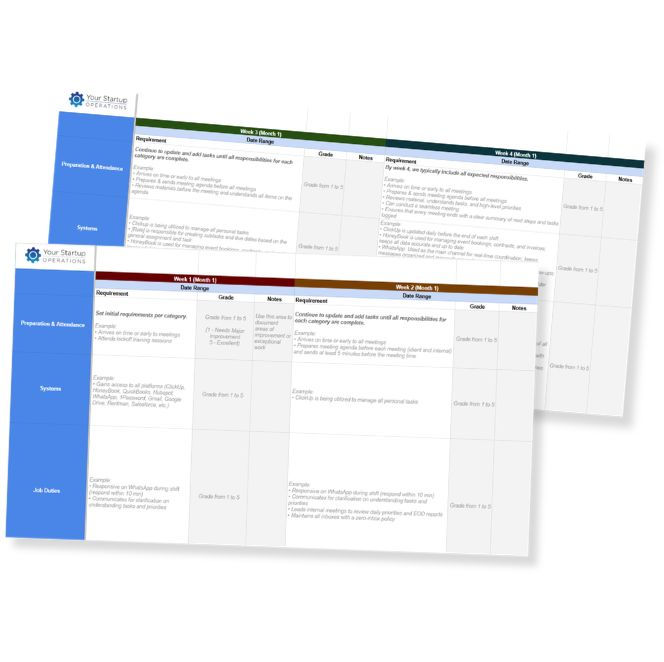
90-Day
Onboarding
Template
new hire should not create more work for you. Use this template to clarify expectations, define ownership, and evaluate performance with confidence from the start.

The Ultimate Productivity Toolkit for Event Professionals
Managing clients, coordinating vendors, and keeping up with daily tasks can quickly become overwhelming. This toolkit explores five practical ways a virtual assistant can help streamline operations, reduce administrative work, and give you more time to grow your business.


