%20(1).png)

Wedding Coordinator Tools Solo and Small-Team Businesses Rely On

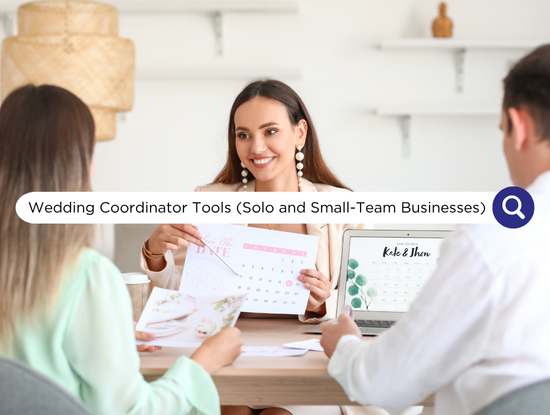
Wedding coordinator tools that solo and small-team businesses rely on tend to cluster into a few categories: building the timeline, keeping vendors and the team talking to each other, and managing day-of logistics like seating charts and floor plans. None of it requires a five-figure software budget. It requires picking the right tool for each job and making sure someone keeps it updated.
Here's a category-by-category look at what coordinators use, and where a wedding VA typically takes the work off a coordinator's plate.
Key Takeaways
A wedding coordinator's tech stack usually spans three working categories: timeline and run-of-show tools, vendor and team communication, and day-of logistics like seating charts and floor plans.
Dedicated wedding day tools tend to earn their cost when a wedding has many moving vendor pieces; a well-organized spreadsheet still works fine for a simpler event.
Vendor communication breaks down more often from an unclear point of contact than from a missing app. The tool matters less than having one place everyone checks.
Wedding coordinator apps for seating charts and floor plans save real time on multi-table weddings, but they're overkill for a small, simple guest list.
Client intake and CRM tools are their own category, covered in depth in our best CRM for event planners guide; this piece focuses on what happens after a client is booked.
A wedding VA can build and maintain the timeline document, keep the vendor contact sheet current, and set up the seating chart tool, so the coordinator stays focused on the client relationship instead of app administration.
What Belongs in a Wedding Coordinator's Tech Stack
Client intake and CRM software (HoneyBook, Dubsado, Aisle Planner, Planning Pod, and similar platforms) is its own decision, and it deserves its own comparison rather than a few lines here. Our best CRM for event planners guide covers that ground in detail, including which platform fits which business model.
What's left once a client is booked and under contract is a different set of tools entirely: building and sharing the actual wedding day timeline, keeping every vendor and team member on the same page, and managing the logistics that show up on the day itself, like where two hundred guests are supposed to sit.
Timeline and Run-of-Show Tools
The wedding day timeline is the single most important document a coordinator produces, and the tool used to build it matters less than whether every vendor has a copy.
Timeline Genius is a dedicated timeline-building tool used by wedding professionals specifically for this task: it lets a coordinator build a minute-by-minute schedule, tag which vendor needs which section, and push updates to everyone at once when something shifts. For a coordinator managing several weddings a month, that update-everyone-at-once feature alone tends to justify the cost, since a timeline change communicated unevenly across vendors is one of the more common sources of day-of confusion.
For a coordinator running fewer weddings, or a solo planner still getting started, a well-built Google Sheet or Google Doc does the same core job at no cost: one shared, dated version of the timeline, with edit history if something needs to be reconstructed later. The tool matters less than the discipline of keeping one single, current version instead of three slightly different ones floating around in different inboxes.
Vendor and Team Communication
Most vendor communication breakdowns aren't a technology problem. They're a point-of-contact problem: every vendor has the couple's cell number, or three different people are each managing a piece of the same conversation without seeing what the others said.
A shared vendor contact sheet, even a simple spreadsheet listing every vendor's name, role, arrival time, and confirmed details, solves a surprising amount of this on its own. Beyond that baseline, coordinators use a mix of tools depending on team size:
A dedicated group text or messaging thread per wedding, so every vendor question and answer lives in one visible place instead of scattered one-on-one conversations
Slack channels, one per wedding, for coordinators running a small team who need internal conversation separate from vendor-facing communication
Newer platforms built specifically for wedding vendor coordination, which aim to replace scattered texts and emails with one shared logistics view; it's worth evaluating these directly against a spreadsheet-based system to see whether the added structure earns its cost for a specific business
Software review platforms like Capterra and G2 list vendor and team collaboration tools by category, which is useful for comparing options once a coordinator has outgrown a plain group text.
Day-of Logistics: Seating Charts and Floor Plans
For weddings with a real guest list to manage, a dedicated seating chart and floor plan tool saves meaningful time over building the same thing from scratch in a slide deck.
AllSeated is a widely used tool among wedding and event professionals for building floor plans and seating charts, including drag-and-drop table arrangements and guest assignment. It matters most for larger weddings with complex family or vendor logistics (multiple tables, a head table, distinct zones for different parts of the reception), where getting the layout wrong on paper is expensive to fix on the day.
For a smaller, simpler wedding, the same task can be handled in a basic spreadsheet or even a printed diagram, and a dedicated tool may not earn its cost. The deciding factor is complexity, not wedding size alone: a hundred-guest wedding with three generations of extended family and specific seating requirements can need more careful planning than a two-hundred-guest wedding where most tables are interchangeable.
Where a Wedding VA Takes Over So You Can Stay Client-Facing
None of the tools above run themselves. Someone has to build the first draft of the timeline, keep the vendor contact sheet current as details change, load the final guest list into the seating chart tool, and confirm every vendor has the latest version of everything before the wedding day. That's the work a wedding VA is built to absorb:
Building and formatting the timeline document from the coordinator's notes, then distributing it to every vendor
Maintaining the vendor contact sheet: names, roles, confirmed arrival times, and updates as anything changes
Loading the final guest list into the seating chart tool and flagging any last-minute changes
Monitoring the group text or communication channel for vendor questions that don't need the coordinator's direct attention
Confirming, a few days out, that every vendor has the current timeline rather than an earlier draft
A coordinator doing all of this personally is spending time on app administration instead of the client relationships and on-site judgment that require a coordinator's expertise. Handing off the maintenance work is what keeps a solo or small-team business able to take on more weddings without the tech stack becoming a second job.
Frequently Asked Questions
What wedding coordinator tools do most solo and small-team businesses use?
Most rely on a mix: a timeline tool (either a dedicated app or a well-organized spreadsheet), a shared vendor contact sheet, a group text or messaging channel per wedding, and a seating chart or floor plan tool for weddings with a real guest list to manage. Client intake and CRM software is typically a separate, earlier decision.
Do I need dedicated wedding coordinator software, or can general tools work?
General tools like Google Sheets, Google Docs, and group texting handle the same core tasks as dedicated wedding coordinator software, with more manual setup. Dedicated tools tend to earn their cost once a coordinator is running enough weddings, or complex enough weddings, that the manual version starts creating real friction.
What wedding day tools help most for a large, multi-vendor wedding?
A timeline tool that pushes updates to every vendor at once, and a seating chart or floor plan tool for managing a large guest list, tend to matter most as vendor count and guest count grow. The more moving pieces a wedding has, the more a missed update or an outdated diagram costs to fix on the day.
How much should a coordinator's tech stack cost?
It depends heavily on volume and complexity, and pricing on these tools changes often enough that it's worth checking current rates directly with each vendor. A solo planner running a handful of weddings a year can often get by on free or low-cost tools, while a small team running weddings weekly usually finds dedicated tools pay for themselves in saved coordination time.
Are there free wedding coordinator apps worth using before I invest in paid tools?
Yes. Google Sheets and Google Docs cover timeline building and vendor contact tracking at no cost, and a simple group text handles vendor communication for smaller weddings. These free options are a reasonable starting point, with dedicated coordinator apps worth revisiting once volume or complexity makes the manual version harder to manage.
Ready to Get the Tech Stack Off Your Plate?
Picking the right wedding coordinator tools solves half the problem. Keeping them updated, timeline distributed, vendor sheet current, seating chart loaded, every single wedding, is the other half. A wedding virtual assistant from YSO can run that maintenance work so your time goes to clients and on-site execution instead of app administration.
About Your Startup Operations
Your Startup Operations (YSO) is a Women-Owned Small Business (WOSB) certified, white-glove operations agency co-founded by Jenna Henao and Alexis Schomer. YSO helps event business owners and other service-based companies step out of daily operations by installing a dedicated Ops Assistant trained specifically for their business, typically helping owners reclaim 30–40 hours per week.
YSO has been featured in Forbes, Voyage LA, Authority Maximizer, EIN Presswire, and AP News.
Explore our event vendor ops services, see client outcomes on our case studies page, or get in touch to talk through what your business needs.
About the Author

Jenna Henao is the Co-Founder and Operations Expert at Your Startup Operations. She partners with business owners to streamline operations, strengthen workflows, and build reliable teams that drive long-term growth. With a background in entrepreneurship and business operations, Jenna has led initiatives across HR, finance, recruitment, operations, sales, marketing, and team leadership. She has helped businesses grow from six to seven figures by developing scalable systems, recruiting outstanding talent, and implementing processes that support lasting success. Connect with Jenna on LinkedIn.
Reviewed by

Alexis Schomer is the Co-Founder and Marketing & Operations Expert at Your Startup Operations. She works with business owners to optimize operations, improve delegation, and build scalable systems that support sustainable business growth. Drawing on her experience in marketing, entrepreneurship, and business operations, Alexis believes effective delegation is about more than hiring a virtual assistant. It starts with selecting the right person, creating efficient workflows, establishing clear expectations, and providing the training and support needed for teams to succeed. This practical, systems-first philosophy guides every client partnership at YSO. Connect with Alexis on LinkedIn.
Free Resources
Access practical tools, templates, and SOPs designed to simplify operations, improve delegation, and support business growth.

25 Tasks You Can Offload To Your VA Today
Your day fills up fast with follow-ups, inbox replies, scheduling, and admin.
This guide
shows exactly
what to hand
off first so
you can
stop doing it all yourself and
free up
real time.

The Ultimate Productivity Toolkit for Event Professionals
Managing clients, coordinating vendors, and handling daily administrative tasks can quickly fill your schedule. This toolkit shares five practical ways a virtual assistant can help streamline your workload so you can spend more time growing your business.
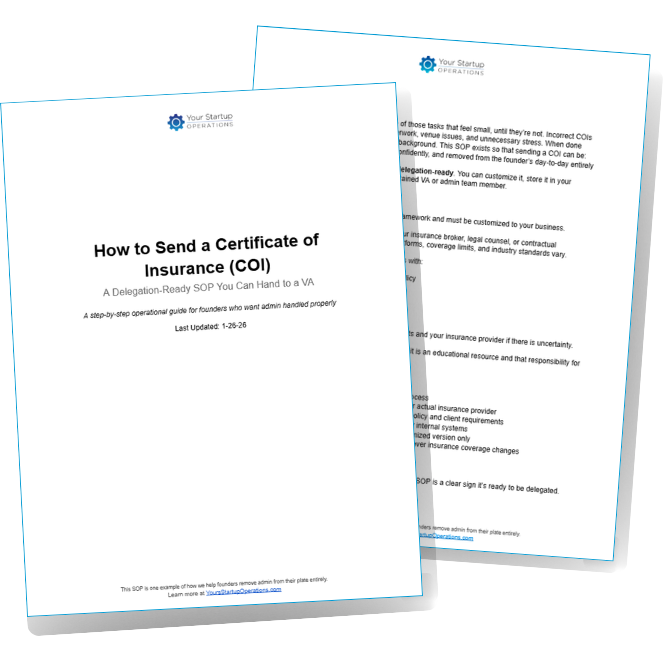
How to Send a Certificate of Insurance (COI)
Submitting a Certificate of Insurance doesn't have to be complicated.
This SOP
provides a clear, step-by-step process to help you submit accurate COIs, avoid delays, and keep approvals moving forward.