%20(1).png)

The Complete Event Planning Checklist: From First Client Call to Post-Event Wrap

Updated: Sep 11

A working event planning checklist isn't one long list. It's five separate checklists stitched together: one for the RFP and discovery call, one for the signed contract, one for the planning window, one for event day execution, and one for the post-event wrap. Skip a task in any single stage and it turns into a scramble two stages later. This guide breaks the checklist down stage by stage and flags which of those tasks a virtual event assistant can take off a planner's desk, and which ones have to stay with the planner.
Key Takeaways
An event planning checklist holds up better as five linked checklists (RFP, contract, planning, execution, wrap) than as one master document.
The RFP and contract stages generate the most paperwork, and they're where deposit terms and scope details tend to go missing later in a project.
The planning stage is where a virtual event assistant frees up the most planner time: vendor confirmations, timeline drafts, and guest list updates are repeatable enough to hand off.
Execution day still needs the planner on-site or on call. A VA's role here is pre-event prep and real-time documentation, not live troubleshooting.
Post-event wrap (invoicing, vendor payouts, feedback requests) is the stage most planners skip, and it's the one most closely tied to repeat bookings.
What an Event Planning Checklist Covers
"Event checklist" and "event management checklist" get used interchangeably, but they aren't quite the same thing. An event checklist is the task list for one specific event. An event management checklist (sometimes searched as an event organization checklist outside the U.S.) is the repeatable system a planning business runs across every event it books. This guide is built as the second kind: a system that holds up whether you're planning a 40-person corporate dinner or a 300-guest wedding.
Demand for this kind of work keeps growing, too. The U.S. Bureau of Labor Statistics lists meeting, convention, and event planning among its faster-growing business and financial occupations (BLS Occupational Outlook Handbook), which is part of why more planners are looking for ways to run a leaner back office instead of adding full-time headcount. The Events Industry Council reaches a similar conclusion through APEX, its industry standard for event terminology and practices (eventscouncil.org): planning holds up better as a repeatable process than as a list rebuilt from scratch for every client.
Stage 1: RFP and Discovery Call

This is where most of the client relationship gets set, and where the most information gets lost if it isn't captured in writing right away.
Log the inquiry source, date, guest count, and initial budget range
Send a qualifying questionnaire before the discovery call, not after
Confirm venue status (booked, pending, or undecided)
Send a same-day recap email with next steps and a follow-up date
Add the lead to the CRM or pipeline tracker
A virtual event assistant typically owns the questionnaire, the CRM entry, and the recap email. The planner keeps the actual call and the pricing conversation, since that's where the relationship gets built.
Stage 2: Contract and Deposit

Send the contract and track signature status
Collect and log the deposit
Set calendar reminders for remaining payment milestones
File the signed contract and insurance certificate somewhere the whole team can find them
Add the confirmed event to the master production calendar
None of this requires the planner's judgment. It requires someone who checks the same five boxes every time a contract comes in, which is exactly the kind of task that slips when a planner is juggling six live events.
Stage 3: The Planning Phase

This stage covers the most ground: vendor confirmations, floor plans, run-of-show timelines, guest list management, permit and insurance follow-up, and rehearsal scheduling. It's also where a planning business either builds a real system or reinvents the wheel every time.
Stage | Decision the Planner Owns | Task a Virtual Event Assistant Can Own |
RFP & Discovery | Pricing and scope | Questionnaire, CRM entry, recap email |
Contract & Deposit | Contract terms | Signature tracking, deposit logging, payment reminders |
Planning | Vendor selection, design decisions | Vendor confirmations, timeline drafts, guest list updates |
Execution | On-site decisions, troubleshooting | Pre-event packet prep, run-of-show documentation |
Post-Event Wrap | Client relationship, next booking | Invoicing, vendor payouts, feedback survey send-out |
The pattern holds across every stage: the planner owns the decision, the VA owns the follow-through. That split is what keeps a planning business from being capped by how many hours one person has in a week.
Stage 4: Execution and Day-Of Coordination

Event day itself still needs the planner on-site, or on call for a fully virtual event. A VA supports this stage from the days before it, not during it: finalizing the pre-event packet, confirming vendor call times, and building the run-of-show document the whole team follows on the day. During the event, a remote VA can track incoming questions, log real-time notes for the post-event report, and handle last-minute vendor communication that doesn't require someone physically on-site.
Stage 5: Post-Event Wrap

This is the stage most planning businesses skip once the event ends and the next one is already demanding attention. It's also the one most tied to repeat business:
Send final invoices and reconcile vendor payments
Send a feedback survey within a few days, while the event is still fresh
Write a short debrief noting what worked and what to fix next time
Update the CRM with notes for a future rebooking
Send a personal thank you to the client
Skipping this stage doesn't cost a planner anything today. It costs them the referral and the repeat booking six months later.
How This Works in Practice: Supercool Creamery
Supercool Creamery is an experiential catering company in Los Angeles, run by owner Ben, serving close to 30 active clients across the events they cater. Before working with YSO, client communication and contract status lived across scattered email threads and spreadsheets, a familiar problem for event businesses once client volume outpaces the original system.
YSO placed a virtual assistant who consolidated that into one CRM. Within two months, the switch saved the business roughly $250 a month and gave Ben a single place to check contract and payment status instead of digging through his inbox.
Frequently Asked Questions
What is an event planning checklist?
An event planning checklist is a task list organized around the stages of an event, from the first client inquiry through the final invoice, rather than one flat list of to-dos. Breaking it into stages (RFP, contract, planning, execution, wrap) makes it easier to see which tasks repeat on every event and which ones need a fresh decision each time.
What's the difference between an event checklist and an event management checklist?
An event checklist usually covers one event from start to finish. An event management checklist is the broader system a planning business uses across every event it takes on, including the admin work that happens between events: CRM updates, contract tracking, and vendor payment schedules.
How far in advance should my event planning schedule start?
It depends on the size of the event, but most full-service weddings book vendors and lock logistics nine to twelve months out, based on planning timeline guidance from The Knot, while smaller corporate or social events typically run on a three to six month schedule. The RFP and contract stages should wrap up well before the planning-heavy middle stretch begins.
Can a virtual assistant really handle vendor contracts and logistics?
Yes, for the follow-through pieces: sending contracts, tracking signatures and deposits, confirming vendor details, and building timeline documents. The decisions that require judgment, like which vendor to book, how to handle a difficult client request, or what to do when a venue falls through, stay with the planner. A VA extends the planner's capacity; it doesn't replace their judgment.
Which checklist tasks should never be delegated?
Pricing decisions, vendor selection based on fit and quality, client-facing negotiations, and on-site troubleshooting during the event itself. Everything else on this checklist, the paperwork, the reminders, the CRM updates, and the confirmations, is fair game for a VA to own.
Ready to Hand Off the Repeatable Half of Your Checklist?
That's the value of building your event planning checklist around stages instead of one long list: it shows you exactly which tasks repeat on every event you book. A virtual event assistant from YSO can own the RFP paperwork, the contract tracking, and the post-event wrap, so the planner's time goes to the client relationships and the on-site decisions only they can make.
About Your Startup Operations
Your Startup Operations (YSO) is a Women-Owned Small Business (WOSB) certified, white-glove operations agency co-founded by Jenna Henao and Alexis Schomer. YSO helps event business owners and other service-based companies step out of daily operations by installing a dedicated Ops Assistant trained specifically for their business, typically helping owners reclaim 30–40 hours per week.
YSO has been featured in Forbes, Voyage LA, Authority Maximizer, EIN Presswire, and AP News.
Explore our event vendor ops services, see client outcomes on our case studies page, or get in touch to talk through what your business needs.
About the Author

Alexis Schomer is the Co-Founder and Marketing & Operations Expert at Your Startup Operations. She works with business owners to optimize operations, improve delegation, and build scalable systems that support sustainable business growth. Drawing on her experience in marketing, entrepreneurship, and business operations, Alexis believes effective delegation is about more than hiring a virtual assistant. It starts with selecting the right person, creating efficient workflows, establishing clear expectations, and providing the training and support needed for teams to succeed. This practical, systems-first philosophy guides every client partnership at YSO. Connect with Alexis on LinkedIn.
Reviewed by

Jenna Henao is the Co-Founder and Operations Expert at Your Startup Operations. She partners with business owners to streamline operations, strengthen workflows, and build reliable teams that drive long-term growth. With a background in entrepreneurship and business operations, Jenna has led initiatives across HR, finance, recruitment, operations, sales, marketing, and team leadership. She has helped businesses grow from six to seven figures by developing scalable systems, recruiting outstanding talent, and implementing processes that support lasting success. Connect with Jenna on LinkedIn.
Free Resources
Access practical tools, templates, and SOPs designed to simplify operations, improve delegation, and support business growth.

25 Tasks You Can Offload To Your VA Today
Your day fills up fast with follow-ups, inbox replies, scheduling, and admin.
This guide
shows exactly
what to hand
off first so
you can
stop doing it all yourself and
free up
real time.

The Ultimate Productivity Toolkit for Event Professionals
Managing clients, coordinating vendors, and handling daily administrative tasks can quickly fill your schedule. This toolkit shares five practical ways a virtual assistant can help streamline your workload so you can spend more time growing your business.
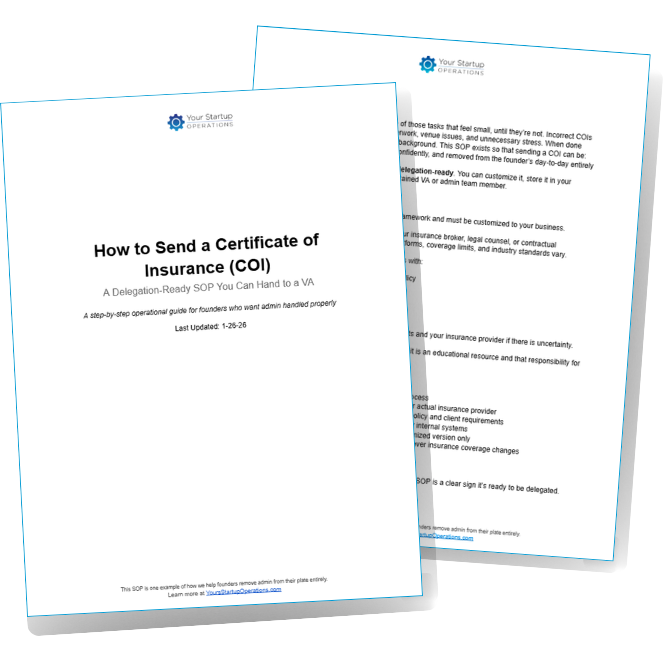
How to Send a Certificate of Insurance (COI)
Submitting a Certificate of Insurance doesn't have to be complicated.
This SOP
provides a clear, step-by-step process to help you submit accurate COIs, avoid delays, and keep approvals moving forward.


