%20(1).png)

Remote Event Assistant vs. On-Site Event Assistant: What You're Actually Buying

Updated: Jun 25

A lot of business owners walk into the event-assistant conversation already confused, and the confusion almost always starts in the same place. They've been told they need "an event assistant," and they don't realize the phrase covers two completely different jobs that solve completely different problems.
There's the remote event assistant (sometimes called an event virtual assistant or event VA) who builds and runs the operational backbone of your business, including CRM, vendor coordination, contracts, RSVPs, marketing execution, and post-event reporting. They never set foot in an event.
Choosing between a remote event assistant and an on-site isn't really a choice in the way most business owners frame it. They solve different problems. The actual decision is which one you need first, and the answer depends entirely on where your business is breaking. This guide walks through what each role actually does, where the comparison gets misleading, the cost math for both, and the order in which most event businesses should hire them. Every operational pain point covered below can be solved by hiring the right specialized event VA, but only if you match the role to the problem.
Key Takeaways
Remote event assistants and on-site event assistants aren't competing roles; they solve different problems, and many growing event businesses eventually need both.
A remote event assistant builds the operational backend: CRM, vendor coordination, contracts, RSVPs, marketing, and reporting. They show up Monday through Friday from a desk and never set foot at the event.
An on-site event assistant executes the event day: setup support, vendor wrangling, attendee management, and real-time problem-solving. They have no role in the backend that runs between events.
For most growing event businesses, the remote event assistant is the right first hire because the backend produces every event you've ever booked and breaks before the events themselves do.
The Core Distinction: Backend vs. Event-Day Execution
This is the framing that resolves the confusion.
Think of an event business as two distinct operational layers:
The backend — everything that happens before the event happens and after the event closes. Client onboarding, contracts, vendor coordination, RSVP collection, timeline drafting, payment collection, marketing, follow-ups, and reporting. This layer runs 50 weeks a year, regardless of how many events you have on the calendar.
The event day — everything that happens on the day itself. Set up, vendor management, attendee experience, real-time troubleshooting, and breakdown. This layer runs only on event days and disappears completely between them.
A remote event assistant handles the backend. An on-site event assistant handles the event day. They are not interchangeable; they are not in competition with each other, and the answer to "remote event assistant vs on-site" depends entirely on which layer is currently breaking.
What a Remote Event Assistant Actually Does
A remote event assistant, typically a trained virtual assistant specialized in event work, owns the operational machinery of the business. Their job is to make sure every event runs cleanly without the business owner having to personally manage every workflow.
The full scope typically includes:
Inbox triage and client communication. First response to every new inquiry within hours, not days. Routing client questions to the right team member or owner.
CRM and pipeline management. Logging every lead, tagging by source, moving deals through stages, triggering automated nurture sequences.
Vendor coordination. Outreach, contract collection, confirmation tracking, payment scheduling, and last-mile follow-ups before an event.
Contract and document workflow. Routing for signature, version control, and archive maintenance.
RSVP and attendee management. Building forms, tracking responses, sending reminders, and producing final headcounts.
Marketing execution. Social media scheduling, email newsletter sends, blog formatting, and review requests.
Post-event work. Thank-you emails, review requests, referral asks, and sponsor reports for corporate events.
Reporting and dashboards. Weekly snapshot of bookings, monthly review of lead sources and conversion, quarterly performance comparison.
If you've ever wondered why even small event businesses need full-time operational support, the answer is in the length of that list. The backend is bigger than most business owners realize until they try to map it out.
What an On-Site Event Assistant Actually Does
An on-site event assistant, also called an event-day coordinator or floor assistant, physically supports the execution of a single event. Their job is for four to twelve hours of the event itself, plus typically a few hours of setup and breakdown.
Their typical scope:
Pre-event setup. Arriving early, helping coordinate vendor arrival, confirming room layout, and checking signage.
Real-time vendor management. Pointing the caterer to the kitchen, troubleshooting AV issues, and helping the florist find the freight elevator.
Attendee experience. Welcoming guests, managing check-in lines, answering questions, and directing flow.
Owner support during the event. Being the second pair of hands, the lead planner or vendor needs.
Breakdown. Helping pack up, returning rentals, and confirming venue close-out.
The on-site event assistant typically works per event on a contract basis. They show up, do the job, get paid, and have no involvement in your business until you book them again.
For weddings, galas, corporate summits, and large private events, on-site assistance is essential. The day itself cannot be run remotely. But on-site assistance does nothing for the backend that produced the booking, runs the contract, and follows up afterward.
Side-by-Side: Remote Event Assistant vs On-Site Event Assistant
Dimension | Remote Event Assistant | On-Site Event Assistant |
Primary job | Build and operate the backend | Execute on event day |
When they work | Monday–Friday, 9–5 (typically) | Event hours only (often weekends/evenings) |
Where they work | Anywhere — fully remote | At the venue |
Engagement model | Monthly retainer | Per-event contract |
Continuity between events | Yes — same VA all year | No — different assistant per event |
Builds long-term systems | Yes (SOPs, CRM, dashboards) | No |
Owns marketing and post-event work | Yes | No |
Owns on-site execution | No | Yes |
Typical hours per week | 15–40 | 6–14 per event |
Best first hire when… | Backend is breaking | Event-day execution is breaking |
The pattern: remote support is continuity; on-site support is execution.
When You Need One, the Other, or Both
Most event businesses go through a predictable progression.
Early-stage solo operator (under 10 events/year). You don't need on-site help, yet you handle execution personally. You also probably don't need a remote event assistant yet, even if your backend volume is genuinely low. Save the spending until the backend pain is real.
Growth-stage event vendor (10–30 events/year). This is where most businesses hit the first inflection point. The backend is breaking before event-day execution. You're missing inquiries, sending late contracts, and forgetting follow-ups. A remote event assistant is the right first hire. On-site help can still be sourced ad hoc per event.
Established event business (30–80 events/year). You're running real volume now. The remote event assistant should be full-time and own the operational backbone. You're likely also booking enough events that you need consistent on-site help, typically a regular bench of 2–4 freelance assistants you call for specific event types.
Multi-event production company (80+ events/year). Both layers are now mature operations. The remote layer has likely grown into a pod of specialists (operations VA, marketing VA, bookkeeping VA). The on-site layer has likely grown into a managed roster with a lead coordinator. This is also the stage when most businesses outgrow their first virtual assistant and need to formalize both layers.
For more on sizing the team properly at each stage, see how many event assistants does your business actually need.
Client proof — Saphineia: Saphineia's co-founders Craig and Elliot were running a fast-growing manufacturing consultancy and doing everything themselves onboarding employees, running payroll, managing IT, updating financial trackers seven days a week. A YSO remote virtual assistant absorbed the operational layer entirely. The result: they scaled from 13 to 34 team members (161% growth) and eliminated the 7-day workweek. "Before we brought in a VA, my co-founder and I were doing everything ourselves, seven days a week. It wasn't sustainable." — Craig & Elliot, Co-Founders, Saphineia. The principle translates directly to event businesses: remote support handles the volume and continuity. Putting more bodies on event days does not solve a backend that's breaking.
Common Decision Mistakes
Mistake 1: Hiring on-site help to fix a backend problem.
This is the most common pattern. A business owner feels overwhelmed and books on-site assistants for the next three events. The events run fine. Then they get back to the inbox on Monday, and nothing has changed because on-site help can't fix the inbox. The fix for backend pain is remote support.
Mistake 2: Hiring a remote event assistant to handle the event day.
Less common, but it happens. A business owner hires a virtual assistant and is then disappointed when the VA can't be at the venue. The VA was never going to be at the venue. That's not the job.
Mistake 3: Treating "event assistant" as one role.
When you see job postings or service offerings labeled simply "event assistant," ask specifically what they cover. The good ones make the distinction clear. The ones that don't are usually trying to be everything to everyone.
Mistake 4: Hiring on-site help first when the backend is what's broken.
Business owners often default to on-site hiring because event-day stress is visible and dramatic, while backend stress is chronic and invisible. The dramatic version isn't always the urgent version. Audit which layer is actually costing you the most.
For warning signs that the backend is your real problem, see 7 signs your business needs virtual and in-person event support right now.
Frequently Asked Questions
Can one person do both remote and on-site work?
In rare cases, yes, usually a freelance event coordinator who works on-site events and also handles light admin between them. But this hybrid is hard to scale. The skill sets are different (operational systems thinking vs. real-time crisis management), the schedule is different (weekday business hours vs. evenings and weekends), and the cost structure is different (monthly retainer vs. per-event). For most event businesses, separating the two roles produces better results in both.
Which one do I hire first?
For 90% of growing event businesses, the answer is the remote event assistant. The backend produces every event you book and breaks before the events themselves do. Once the backend is stable, on-site help can be added per event without overhauling your operations. The reverse is harder: on-site help can't fix a backend that's quietly losing you bookings.
Can a remote event assistant manage on-site assistants for me?
Yes, and this is one of the highest-leverage moves at the Stage 3 transition. Your remote event assistant builds the on-site assistant roster, manages contracts and schedules, handles invoicing, runs pre-event briefings, and collects post-event debriefs. You stop managing on-site staff personally and start delegating that management upstream.
Do remote event assistants work weekends?
Most don't, by default. Standard remote event assistant retainers cover business hours, Monday through Friday. Many YSO clients arrange a Friday handoff and pre-approved templates for weekend coverage, so urgent inquiries get answered during peak booking season without requiring full weekend coverage. If your event mix requires consistent weekend backend coverage, that's a scoping conversation worth having during onboarding.
Can on-site assistants be sourced through a virtual assistant agency?
Some agencies place on-site contractors in addition to their remote roster, but the two services are usually managed separately. YSO specializes in managed remote Event Assistants. For on-site execution support, most clients use local freelance coordinators or event-day staffing agencies and have their YSO Event Assistant manage the roster and contracts remotely.
Will I ever need an on-site event assistant if my remote system is great?
Possibly not, if you only run small, intimate events, you can manage personally. But for weddings, galas, conferences, fundraisers, and corporate summits with 75+ attendees, on-site assistance is almost always worth the investment. The remote layer makes the backend efficient; the on-site layer makes the event day calm.
Ready to Match the Role to the Problem?
If you've read this far, you probably already know which layer is breaking, but you might not be sure whether to start with a remote event assistant, an on-site assistant, or both. A 30-minute scoping conversation usually resolves it.
YSO matches event businesses with managed remote Event Assistants and helps clients build the operational backbone that makes event-day execution dramatically less stressful. Every engagement starts with a backend audit, a stage assessment, and a clear recommendation about which role to hire first and when to add the second.
Book a free discovery call — 30 minutes, no pressure. You'll leave with a clear recommendation regardless of whether you sign with us.
Author Bio

Jenna Henao, Co-Founder and Operations Expert at Your Startup Operations, helps business owners turn messy operations into clear systems, stronger workflows, and teams that know how to execute. Her experience across HR, finance, operations, recruitment, management, sales, and marketing has helped multiple startups build the structure needed to grow from six figures to seven figures.
Reviewer Bio

Alexis Schomer, Co-Founder and Marketing and Operations Expert at Your Startup Operations, helps business owners step out of the daily details by improving efficiency, strengthening delegation, and building the right operational support around them.
About Your Startup Operations
Your Startup Operations is a certified women-owned agency founded by Jenna Henao and Alexis Schomer. The team provides operations and virtual assistant support for growing businesses and has been featured in Forbes, Voyage LA, Authority Maximizer, and DC News.
Free Resources
Practical tools, templates, and SOPs designed to help you hand off day-to-day operations and grow with more structure.
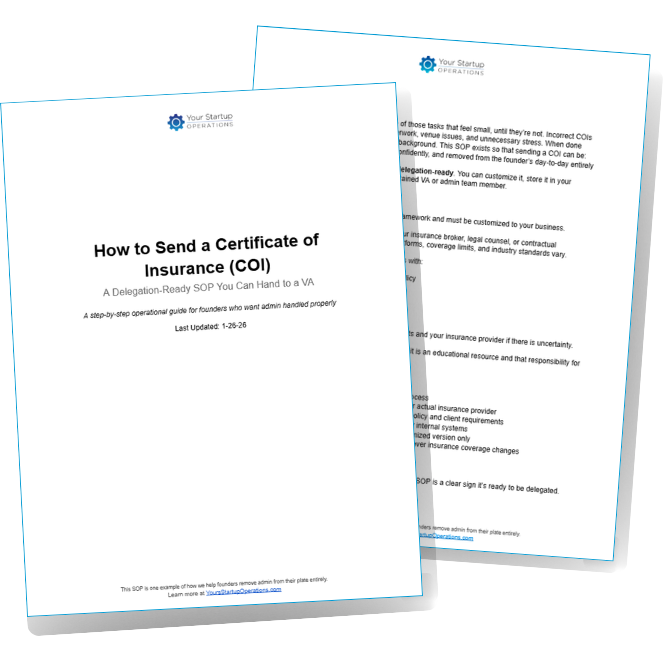
How to Send a Certificate of Insurance (COI)
Sending a COI can seem straightforward, but even a small mistake can delay approval. This SOP breaks down each step so you can submit the right information, avoid unnecessary back-and-forth, and keep the process moving.
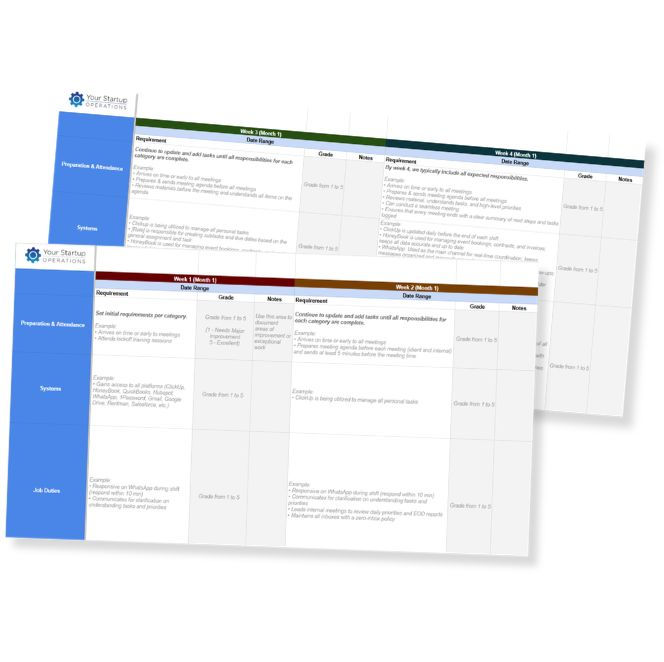
90-Day
Onboarding
Template
A new hire
should make
your workload
lighter, not
add to it.
This template
helps you
set clear expectations, assign responsibilities, and track progress from day one.

VA
Interview
Questions
Hiring the right virtual assistant starts with asking better questions. This guide helps you evaluate their skills, communication style, and ability to take ownership, so you can find support that fits the way your business works.


