%20(1).png)

Home Service Customer Retention: The Follow-Up System a VA Should Build


Home service businesses live and die on retention. The math is that unsentimental customer acquisition costs in the home services space (HVAC, plumbing, electrical, landscaping, cleaning, pest control, roofing) run high enough that the first job with a new customer often barely breaks even after ad spend, sales time, and service delivery. The profit lives in the second, third, fourth job that same customer books over the following years.
The problem is that most home service businesses aren't structured to earn those repeat jobs. The first service happens, the technician does great work, the customer pays, and then nothing. No follow-up. No seasonal reminder. No review request. No maintenance plan pitch. The customer forgets who did the work, and 14 months later when they need service again, they're back on Google searching for someone new.
That gap is where a home service customer retention VA does the most valuable work. Not by making sales calls or replacing the technician's craft, but by building and running the systematic follow-up that turns one-time customers into repeat clients. This guide walks through what that follow-up system actually includes, which specific workflows a VA should build, and how the whole thing produces measurable revenue over 6–12 months.
Key Takeaways
Home service customer retention is fundamentally a follow-up systems problem, not a service quality problem. Most home service businesses deliver good work but don't follow up systematically, which is where retention leaks.
The 6 workflows a home service VA should build first: post-service follow-up, seasonal reminders, membership and plan renewal outreach, review requests, referral program management, and nurture sequences for quotes that didn't convert.
Repeat customers typically cost dramatically less to acquire than new ones, so even modest gains in retention produce outsized revenue impact over a 12-month horizon.
The VA doesn't replace the sales or technical work. They build the systematic outreach that turns completed jobs into ongoing customer relationships.
Most home service businesses see measurable retention improvement within 90–120 days of turning on structured follow-up, with compounding growth in year two as the system matures.
Why Home Service Retention Is Different
Retention isn't universal across industries. Home service retention has a specific shape that makes it different from ecommerce, subscription, or professional services retention.
Long between-service intervals. A homeowner might need HVAC service once a year for a tune-up, or unpredictably when something breaks. Landscaping runs on seasonal cycles. Pest control might be quarterly or annually. Unlike consumer subscription businesses where retention is measured month-over-month, home service retention plays out over 6–24 month intervals long enough that customers genuinely forget who did their last job unless the business stays in touch.
High acquisition costs. Home services is a competitive local search market. Ad spend on Google, Yelp, Nextdoor, Angi, and HomeAdvisor adds up fast. The U.S. Small Business Administration's guidance on customer retention and marketing reinforces the underlying principle for small businesses in competitive local markets: retention economics almost always outperform acquisition economics.
Repeat customers refer more, book more, and complain less. The compounding value of retained customers is well-documented across industries. The foundational research in Frederick Reichheld's Harvard Business Review work on customer loyalty established decades ago that loyal customers refer new customers, tolerate premium pricing, and require less service overhead than newly acquired ones. That research holds up especially well in home services, where trust and history matter more than in most other industries.
Reviews and referrals drive local search visibility. Google Business Profile rankings, Nextdoor recommendations, and industry-specific directory rankings all weight review volume, freshness, and quality heavily. Home service businesses without a review generation system quietly lose local search ground to competitors who have one.
What a Retention Follow-Up System Actually Includes
A functional home service follow-up system has six workflows that a VA can own end-to-end. Each has a defined trigger, a defined sequence, and a defined output, meaning once the VA is trained on the system, they run it without daily owner input.
1. Post-Service Follow-Up Workflow
Trigger: A completed service job (usually flagged in your CRM or field service management platform).
What it includes:
Thank-you communication within 24–48 hours of service completion, using your defined template.
Satisfaction check-in 3–5 days after service, either via email or a brief survey.
Google, Nextdoor, or Yelp review request 7–10 days after service (allowing time for the customer to have used or lived with the service before asking).
Any follow-up documentation the customer needs: warranty info, maintenance recommendations, receipts.
Why it matters: This is the workflow most home service businesses don't have running. Every service that ends without follow-up is a customer who's slightly less likely to remember you next time. Even a two-touch follow-up (thank-you plus review request) meaningfully changes the relationship.
Expected volume: Equal to your monthly service volume for most home service businesses; that's 30–200+ instances per month depending on scale.
2. Seasonal Reminder Workflow
Trigger: Time-based, tied to your service categories.
What it includes:
Fall HVAC tune-up reminders (September–October) to customers who had spring service or previous fall service.
Spring HVAC and landscaping outreach (March–April).
Pre-summer AC service reminders (April–May).
Fall gutter cleaning outreach (October–November).
Whatever seasonal cycle applies to your specific home service category.
What it produces: Bookings your business would not otherwise have gotten. Customers know they should schedule fall maintenance; most just don't because nobody reminded them. The reminder is the booking trigger.
Expected volume: Batches of outreach 3–6 times per year, each touching your relevant customer base for that season.
3. Membership and Plan Renewal Outreach
Trigger: A service plan or membership approaching renewal date (usually 60 and 30 days out).
What it includes:
60-day pre-renewal notification with the renewal terms and any updates.
30-day reminder with a call to action.
7-day final notice.
Post-lapse re-engagement outreach within 14 days if the customer didn't renew.
Why it matters: Membership and service plan revenue is some of the most predictable revenue a home service business has. Losing memberships due to failed renewal outreach rather than customer choice is pure preventable revenue leakage.
Expected volume: Depends on your membership base, but ongoing throughout the year.
4. Review Request Workflow
Trigger: Job completion (integrated with the post-service workflow above, but worth calling out separately because of how much it matters).
What it includes:
Direct link to your primary review platform (Google Business Profile is usually the highest-priority).
Follow-up review request 21 days after the first if no review is received.
Response management: every review, positive or negative, gets a professional response from the VA using your defined tone.
Escalation of negative reviews or complaints to the owner for personal response.
Why it matters: Google Business Profile rankings, Nextdoor visibility, and Yelp positioning all correlate strongly with review volume and freshness. Businesses with 200+ reviews outperform businesses with 40 reviews on the same platforms even when the underlying service quality is comparable.
Expected volume: Equal to service volume for initial requests. Response management adds a few hours per week depending on review inflow.
5. Referral Program Management
Trigger: A completed job (often layered on top of the post-service workflow) or a new customer arriving via referral.
What it includes:
Referral ask at the right moment, usually after the customer has expressed satisfaction, either through the survey response or the review.
Tracking of who refers whom, in a shared CRM field or spreadsheet.
Reward fulfillment when referrals materialize, whatever your referral incentive structure is (discount, gift card, service credit).
Thank-you outreach to the referrer when their referral results in a booked job.
Periodic reactivation outreach to past referrers who haven't sent one in 6+ months.
Why it matters: Referral leads in home services convert at meaningfully higher rates than cold leads and cost virtually nothing to acquire. The businesses that systematically ask, track, and reward referrals build a pipeline that operates independently of ad spend. See YSO's post on why hiring through an operations agency gets you a better virtual assistant for related context on how structured outreach workflows outperform ad-hoc efforts.
6. Nurture Sequence for Lost Quotes
Trigger: A quote sent but not signed within 14 days.
What it includes:
Follow-up email at day 14 checking in on decision status.
Follow-up at day 30 with any relevant updates.
Move to long-term nurture (quarterly touch) at day 60.
Reactivation attempt at 6 months and 12 months.
Why it matters: Home service quotes that don't convert immediately often convert later when the customer's original vendor didn't work out, when the season changes, or when the underlying need becomes urgent. The businesses that keep unconverted quotes in a nurture flow book a meaningful percentage of them later; the businesses that let them drop don't.
Expected volume: Depends on quote volume and conversion rate.
What This System Actually Costs
The rough economics for adding a retention-focused VA to a home service business:
Part-time VA (20–30 hours per week): typically $1,500–$3,500 per month.
Full-time VA (40+ hours per week): typically $3,000–$6,000+ per month for equivalent-quality talent when W-2 employment costs are included.
Compared to the acquisition cost of the customers the retention system saves, the math almost always works. If the retention system prevents 2–4 memberships from lapsing per month and generates 8–15 additional service bookings per month from seasonal reminders and re-engagement, the VA typically pays for itself in the first quarter.
For related reading on how these hiring decisions work, see YSO's post on why hiring through an operations agency gets you a better virtual assistant.
Case Study: What Structured Follow-Up Actually Produces
One of YSO's clearest documented examples of what structured operational infrastructure produces in a home service business is Laguna Electric, an engagement that partnered with YSO to build operational systems and freed up 40 hours per week for the founder.
The engagement, documented in YSO's case studies library, covers exactly the pattern this article walks through: instead of the founder personally handling post-service outreach, follow-up communication, and customer relationship maintenance, YSO placed a trained VA who could own those workflows end-to-end. Forty hours per week returned to the founder isn't the result of the VA working harder; it's the result of building the retention system that turns individual jobs into ongoing customer relationships without founder time on every touchpoint.
The Harvard Business Review article on delegation by Jesse Sostrin captures the underlying principle: real delegation requires transferring the entire workflow, not just the individual tasks inside it. That's what happened in the Laguna Electric engagement and what happens across most successful home service VA placements.
Common Mistakes With Home Service Retention
Sending review requests too early. Immediate post-service review requests often produce lukewarm reviews because customers haven't had time to fully experience the work. Wait 7–10 days for most service categories.
Treating retention outreach as generic. "Hope you're doing well!" emails are worse than no email. Every touchpoint should reference the specific service the customer had, the timing since, and a specific reason for the contact.
Not responding to reviews. Every review, positive or negative, should get a professional response. Businesses that respond to reviews rank higher and retain better than businesses that ignore them.
Trying to run all six workflows immediately. Start with post-service follow-up and reviews. Add seasonal reminders once those two are running cleanly. Add memberships, referrals, and lost-quote nurture progressively over 90 days.
Never updating the customer database. Retention outreach fails if the customer contact information is stale. CRM hygiene is part of the retention system, not separate from it.
What to Keep Off the VA's Plate
Not everything about home service retention belongs with the VA. A few things stay with the owner:
Complex complaint resolution. Any escalation with legal risk, refund questions, or emotional weight stays with you.
Custom pricing negotiations. Retention offers within your standard structure are fine. Custom deals owner decision.
Warranty and insurance discussions. These involve technical and legal judgment that stays with you or your senior team.
Design decisions on the retention offers themselves. The VA executes the offers; you design them.
The Harvard Business Review foundational research by Frederick Reichheld makes clear that the strategic decisions about which customers to invest most in retaining aren't executional; they're business strategy. Delegate the execution; keep the strategy.
How to Actually Start Building This System
The build sequence for most home service businesses:
Month 1: Post-service follow-up and review request workflows only. Document current customer database. Build the email templates. Get the VA running these two workflows consistently.
Month 2: Add seasonal reminder workflow. Backfill any recent customers who should have received seasonal outreach but didn't.
Month 3: Add referral tracking and referral thank-you workflow. Add membership/plan renewal workflow if applicable.
Months 4–6: Add lost-quote nurture workflow. Refine templates based on what's produced results and what hasn't. Start measuring retention metrics month-over-month.
Months 7–12: Compounding impact. Reviews accumulate. Referrals build. Membership retention stabilizes. Seasonal outreach produces predictable bookings.
For related reading on how VA-supported operational systems get built and maintained, see YSO's posts on why process mapping and SOPs come first and evaluating the performance of virtual assistants.
How YSO Places VAs With Home Service Businesses
YSO places trained virtual assistants specifically with home service businesses, including HVAC, plumbing, electrical, landscaping, cleaning, pest control, and roofing companies. The VAs we place come in with experience running follow-up systems, review management workflows, and customer database hygiene, meaning your first month doesn't start from scratch on how to structure the work.
If you want to talk through what a retention follow-up system could look like in your specific home service business, book a free consultation.
Frequently Asked Questions
What does a home service customer retention VA actually do?
A retention-focused VA owns the systematic follow-up work that turns one-time customers into repeat clients post-service outreach, seasonal reminders, review requests and response management, referral program administration, membership renewal outreach, and nurture sequences for quotes that didn't convert. They don't replace sales or technical staff; they build and run the customer relationship layer that most home service businesses leave undone.
How much does a home service retention VA cost?
Part-time (20–30 hours per week) VAs typically run $1,500–$3,500 per month depending on experience and market. Full-time (40+ hours per week) runs $3,000–$6,000+ per month with equivalent-quality talent. Agency-placed VAs typically cost more per hour but include hiring, training, and replacement management overhead.
How quickly should a retention system produce results?
Review counts start improving within 30–60 days of turning on structured requests. Seasonal reminder bookings hit within the first applicable season (usually 3–6 months). Membership retention stabilizes over 90–120 days. Full compounding impact, the point where the retention system is meaningfully changing the business's revenue mix, usually shows up between months 6 and 12.
Do I need a CRM for a retention system to work?
Yes, in some form. Field service management platforms (ServiceTitan, Housecall Pro, Jobber) or general CRMs (HubSpot, Zoho, event-industry CRMs) all work. The retention system needs to know who your customers are, what service they had, when, and what their contact information is. Retention without customer data doesn't function.
Can a VA handle review responses on my behalf?
Yes, using your defined tone and templates for standard positive responses. Negative reviews or complex complaints should escalate to the owner for personal response. Most VAs handle 90%+ of review response volume; the owner handles the 10% that requires personal engagement.
How does home service retention differ from other industries?
Longer between-service intervals (customers might need service only once or twice a year), higher relative acquisition costs, more dependence on local search and reviews, and more structural fit for membership and service plan models. The follow-up sequences are also longer because the natural rhythm of home service means quarterly or semi-annual touches make sense in ways they wouldn't for higher-frequency service categories.
What if I already have some retention outreach happening?
Most home service businesses have some form of retention outreach, but usually not systematic. A retention VA doesn't replace whatever you already have; they structure it, close the gaps, and add the workflows that aren't running yet. The audit is often the first month of the engagement.
How is a retention VA different from a marketing VA?
Marketing VAs run acquisition-focused work: ads, social media, content, lead generation. Retention VAs focus on the customer relationship layer after the sale: follow-up, reviews, referrals, memberships, nurture. Some VAs handle both; larger businesses often separate them. For home service businesses under a certain scale, retention work usually produces more measurable ROI per hour than acquisition work.
About YSO
Your Startup Operations (YSO) is a Women-Owned Small Business (WOSB)-certified virtual assistant and operations agency founded by Jenna Henao and Alexis Schomer. The agency helps event vendors, home service businesses, and bookkeeping firms improve day-to-day operations by matching them with trained virtual assistants. Featured in Forbes, Authority Maximizer, and Voyage LA, YSO has also published 14 client case studies demonstrating measurable operational improvements and tangible business outcomes.
About the Author

Jenna Henao is the Co-Founder and Operations Expert at Your Startup Operations. She partners with business owners to improve operations, refine internal workflows, and build dependable teams that support sustainable growth. Drawing on her experience in entrepreneurship and operations leadership, Jenna has worked across HR, finance, recruitment, operations, sales, marketing, and team management. She has helped businesses scale from six figures to seven figures by developing efficient systems, recruiting exceptional talent, and implementing processes that create a strong operational foundation for long-term success. Connect with Jenna on LinkedIn.
Reviewed by

Alexis Schomer is the Co-Founder and Marketing & Operations Expert at Your Startup Operations. She partners with business owners to streamline operations, strengthen delegation, and build scalable systems that support long-term business growth. With experience in marketing, entrepreneurship, and business operations, Alexis believes effective delegation goes beyond hiring a virtual assistant. It starts with selecting the right person, designing efficient workflows, establishing clear expectations, and providing the training and support teams need to perform successfully. This practical, systems-driven philosophy is at the core of every client partnership at YSO. Connect with Alexis on LinkedIn.
Free Resources
Browse practical tools, templates, and SOPs that make it easier to delegate tasks, streamline your operations, and build a business that scales with confidence.

25 Tasks You Can Offload to Your VA Today
Between managing your inbox, scheduling meetings, following up with clients, and handling day-to-day admin, it's easy to spend your time on tasks that don't drive growth. This guide outlines 25 responsibilities you can confidently delegate to a virtual assistant, giving you more time to focus on the work that matters most.
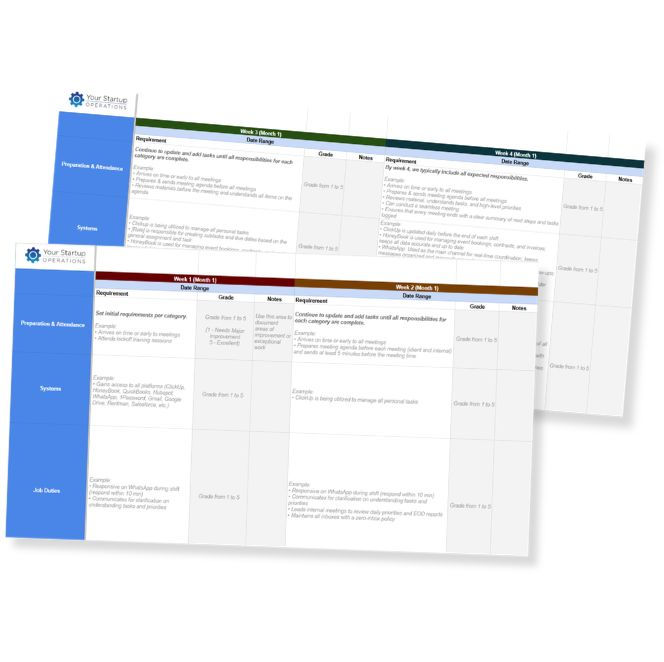
90-Day Onboarding Template
The right onboarding process should help new hires succeed without creating extra work for you. This template helps you set clear expectations, assign responsibilities, and monitor progress throughout the first 90 days so every new team member gets off to a strong start.

Hire Your First VA Guide
Bringing on your first virtual assistant is an important step, but it can be difficult to know where to begin. This free guide walks you through the hiring process, helping you make informed decisions, avoid common pitfalls, and confidently find the right support for your business.


