%20(1).png)

What a Construction Virtual Assistant Does for Contractors


A construction virtual assistant handles the paperwork and follow-up that keeps a job site moving, without needing a desk in the office. Bid follow-ups, subcontractor confirmations, permit tracking, and client updates pile up fast on an active project, and most general contractors end up trying to handle all of it between site visits rather than during dedicated office hours.
Construction management is also a growing field, not a shrinking one. The median annual wage for construction managers was $114,990 in May 2025, and the U.S. Bureau of Labor Statistics projects 9 percent employment growth from 2025 to 2035, well above the average for all occupations, with about 49,700 openings projected each year. That growth is exactly why the admin load behind each project matters more, not less, as a business scales.
Key Takeaways
A construction virtual assistant handles job-specific admin work: subcontractor coordination, permit tracking, and client updates, beyond general office tasks.
The role works inside the scheduling and project management software a contractor already uses, rather than requiring a new system.
YSO trains every construction placement on trade-specific tasks and software before they ever reach a client.
A trained virtual assistant typically costs less than a full-time in-house coordinator while covering the same ground.
What Contractors Are Really Buying When They Hire a Virtual Assistant
The real question is not whether to hire help. It is what that help covers once the contract is signed. A construction virtual assistant is not a generic admin hire applying office skills to a job site for the first time. The role is trained specifically around how a construction business runs: bid cycles, subcontractor relationships, permit timelines, and the steady stream of client questions that come with an active build.
That distinction matters because construction has its own rhythm. A missed subcontractor confirmation or a permit that falls through the cracks does not stay contained to paperwork. It pushes back a schedule that every other trade on the job is depending on.
The Daily Operational Load a Construction Virtual Assistant Handles
The work breaks down into a few consistent categories on most active projects:
Bid and estimate follow-up. Chasing down responses on submitted bids and keeping the pipeline of potential jobs moving forward.
Subcontractor scheduling and confirmations. Confirming arrival times, coordinating around weather delays, and following up when a sub goes quiet.
Permit and inspection tracking. Keeping tabs on application status, scheduling inspections, and flagging anything that is at risk of holding up the next phase of work.
Change order documentation. Recording scope changes and cost adjustments as they happen, rather than trying to reconstruct them later.
Client project updates. Sending progress updates, photos, and answers to the questions every homeowner or property manager asks mid-project.
Every VA YSO places into a construction role trains on this exact task list before the placement starts. A contractor is not the one running the ramp-up period.
Permit timelines alone show how much this can vary and how easily it can slip through the cracks. In a market like Los Angeles, a standard residential remodel permit typically takes 6 to 10 weeks, while an ADU permit can run 8 to 16 weeks or longer, according to a 2025 permit timeline guide from JDJ Consulting.
Tracking status across several permits at different stages, across several active projects, is exactly the kind of ongoing follow-up that benefits from a dedicated owner rather than whoever has a free hour that week.
Keeping a Project Schedule From Slipping
Construction schedules are built on dependencies. One missed subcontractor confirmation or one inspection that gets scheduled late does not stay contained to that single task. It moves the whole project back, and everyone downstream feels it.
A construction virtual assistant's real value shows up here: following up before something becomes a problem rather than after. That means confirming a subcontractor's arrival two days out, instead of finding out the morning of that they never got the message. It means tracking permit and inspection status closely enough that a delay gets flagged while there is still time to adjust around it.
Integrating With Buildertrend, CoConstruct, and Procore
A construction virtual assistant is only useful if the work lands inside the systems a contractor already runs on. YSO trains placements on the specific platform a client uses, whether that is Buildertrend, CoConstruct, Procore, or another project management tool, so updates, schedules, and client communication happen in one place rather than in a separate spreadsheet no one else checks.
This is a screening point worth applying to any candidate, not only an agency placement. A general admin background does not automatically include experience in construction-specific software, and the ramp-up cost of learning an unfamiliar platform from scratch falls on whoever hires without checking for this first.
Construction Virtual Assistant vs In-House Project Coordinator
An in-house project coordinator brings full-time availability and physical presence, which some contractors genuinely need. The tradeoff is cost: salary, benefits, and a single set of working hours that does not flex with how unevenly construction admin work arrives. Bid follow-up might be light one week and heavy the next, and a full-time hire gets paid the same either way.
A construction virtual assistant scales with the actual workload instead. Coverage extends to whatever the bid cycle or active project count requires that month, without carrying the fixed cost of a full-time salary through the slower stretches.
What This Costs Compared to a Full-Time Hire
Pricing for a construction virtual assistant varies by scope and hours, but the comparison worth running is the fully loaded cost of an in-house coordinator, salary, benefits, payroll taxes, and paid time off, against the hours needed once bid follow-up, subcontractor coordination, and client updates are handled by someone working inside the software already in place.
Call handling is a related but separate piece of this puzzle. If subcontractor and client calls are piling up alongside the written coordination work, our guide to virtual receptionist options for home services businesses covers that side of the operation specifically.
Frequently Asked Questions
What tasks does a construction virtual assistant handle?
Bid and estimate follow-up, subcontractor scheduling and confirmations, permit and inspection tracking, change order documentation, and client project updates are the core of the role.
Can a virtual assistant really manage subcontractor coordination remotely?
Yes. Confirmations, scheduling, and follow-up do not require being on-site. They require access to the project schedule and a clear process for flagging anything that needs in-person attention.
How much does a construction virtual assistant cost compared to hiring in-house?
Pricing varies by scope and hours, but most contractors find it runs well below the fully loaded cost of a full-time coordinator once salary, benefits, and slower-season downtime are factored in.
Ready to see whether a construction virtual assistant would keep your next project on schedule?
About Your Startup Operations
Your Startup Operations (YSO) is a Women-Owned Small Business (WOSB) certified, white-glove operations agency co-founded by Jenna Henao and Alexis Schomer. YSO helps event business owners and other service-based companies step out of daily operations by installing a dedicated Ops Assistant trained specifically for their business, typically helping owners reclaim 30–40 hours per week.
YSO has been featured in Forbes, Voyage LA, Authority Maximizer, EIN Presswire, and AP News.
Explore our event vendor ops services, see client outcomes on our case studies page, or get in touch to talk through what your business needs.
About the Author

Alexis Schomer is the Co-Founder and Marketing & Operations Expert at Your Startup Operations. She works with business owners to optimize operations, improve delegation, and build scalable systems that support sustainable business growth. Drawing on her experience in marketing, entrepreneurship, and business operations, Alexis believes effective delegation is about more than hiring a virtual assistant. It starts with selecting the right person, creating efficient workflows, establishing clear expectations, and providing the training and support needed for teams to succeed. This practical, systems-first philosophy guides every client partnership at YSO. Connect with Alexis on LinkedIn.
Reviewed by

Jenna Henao is the Co-Founder and Operations Expert at Your Startup Operations. She partners with business owners to streamline operations, strengthen workflows, and build reliable teams that drive long-term growth. With a background in entrepreneurship and business operations, Jenna has led initiatives across HR, finance, recruitment, operations, sales, marketing, and team leadership. She has helped businesses grow from six to seven figures by developing scalable systems, recruiting outstanding talent, and implementing processes that support lasting success. Connect with Jenna on LinkedIn.
Free Resources
Access practical tools, templates, and SOPs designed to simplify operations, improve delegation, and support business growth.

25 Tasks You Can Offload To Your VA Today
Your day fills up fast with follow-ups, inbox replies, scheduling, and admin.
This guide
shows exactly
what to hand
off first so
you can
stop doing it all yourself and
free up
real time.

The Ultimate Productivity Toolkit for Event Professionals
Managing clients, coordinating vendors, and handling daily administrative tasks can quickly fill your schedule. This toolkit shares five practical ways a virtual assistant can help streamline your workload so you can spend more time growing your business.
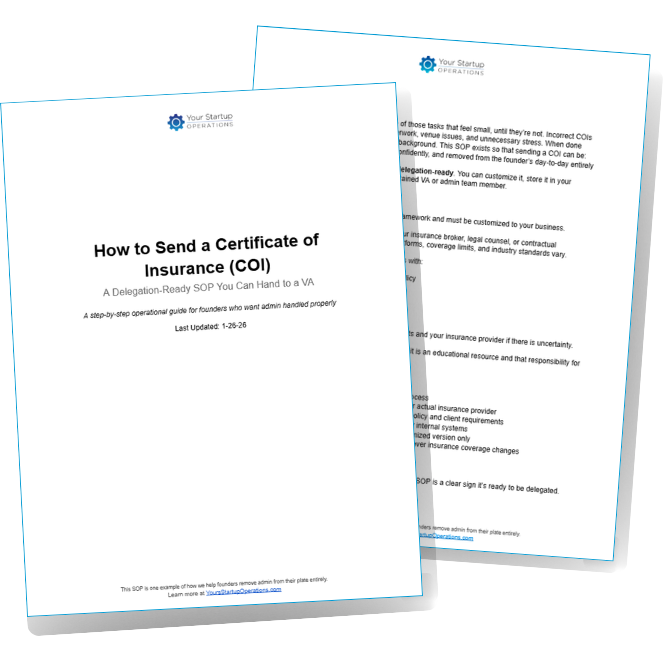
How to Send a Certificate of Insurance (COI)
Submitting a Certificate of Insurance doesn't have to be complicated.
This SOP
provides a clear, step-by-step process to help you submit accurate COIs, avoid delays, and keep approvals moving forward.
