

Event Coordinator Job Description for Small Event Businesses and Which Duties Can Go Remote


An event coordinator job description should state what the person will own, which events they will work, the hours and physical demands, the qualifications you require, and the pay. For a small event business, the harder part is scoping the role. "Event coordinator" means different things at a venue, an agency, and a five-person company, and a description borrowed from a large employer attracts the wrong applicants.
This guide gives you a copy-ready event coordinator job description template, the event coordinator duties and responsibilities to include by phase and by event type, the qualifications and working conditions to spell out, and a duty-by-duty look at which tasks need someone in the room and which can go remote.
Key Takeaways
State the scope first. A venue coordinator, an agency coordinator, and a coordinator at a small event company do different work, and the description should say which one you are hiring.
List duties by phase, from planning through follow-up, so applicants can see the whole job.
Add what changes by event type. Wedding, corporate, social, and conference work each pull a coordinator in a different direction.
Spell out the schedule and physical demands, and put the pay range in the posting. Some states and cities require it, and applicants expect it.
Many duties can be done remotely, while setup, vendor direction, and guest handling need someone on site. Splitting the role this way can widen your options.
Use the template below, then cut anything you do not need. A short, specific description attracts better applicants than a long generic one.
What an Event Coordinator Does
A useful event coordinator role description starts with purpose: the coordinator keeps each event organized from signed contract to wrap-up and is the person vendors, venues, and clients rely on for answers. Titles vary. At a venue, the coordinator manages bookings inside the space. At an agency or a small event business, the role covers the event itself, across vendors and clients. BLS projects employment of meeting, convention, and event planners to grow 6 percent from 2025 to 2035, faster than the average for all occupations.
For how the coordinator role differs from an operations manager, see our event operations manager vs. event coordinator guide. This guide stays on writing the description.
Event Coordinator Duties and Responsibilities by Phase
The core event coordinator responsibilities fall into six areas. Use them as headings in your posting and keep only the duties your business needs.
Area | Typical duties |
Planning and logistics | Builds and maintains the event timeline and run-of-show, confirms space, rentals, and equipment needs, and tracks venue requirements |
Vendor and venue coordination | Requests quotes, confirms bookings and arrival times, sends vendors the final schedule, and acts as their point of contact before and during the event |
Client communication | Answers client questions, shares updates, collects approvals, runs planning meetings, and escalates decisions to the owner or lead planner |
Budget and administration | Tracks costs against the event budget, collects and files contracts and insurance certificates, and follows up on vendor invoices and payments |
Event day | Directs setup and breakdown, manages vendors on site, keeps the schedule on track, and resolves problems as they arise |
Follow-up | Sends thank-yous, collects feedback, reconciles final costs, and records what to change next time |
How the Role Changes by Event Type
The same title covers very different weeks. Name the event types you run, because experience with one does not always carry over to another.
Event type | Where the coordinator spends extra time | Worth adding to the description |
Weddings | Many vendors, a personal client, a tight ceremony and reception timeline, and evening and weekend hours | Weekend availability, client-facing tact, and experience with ceremony timelines. For the day itself, see our day-of wedding coordinator guide |
Corporate events | Approval chains, brand standards, attendee logistics, and budget reporting | Experience with corporate clients and with managing several stakeholders at once |
Social and private events | Smaller budgets, fast turnarounds, and hands-on setup | Flexibility and comfort with physical, hands-on work |
Conferences and trade shows | Speakers, sponsors, exhibitors, registration, and several rooms running at once | Experience with registration and multi-session schedules |
Qualifications, Skills, and Working Conditions
State what you need, not what sounds impressive. A small business often attracts better applicants by asking for relevant event or hospitality experience and the skills below than by listing a long string of years and degrees.
Skills: Organization and attention to detail, clear writing and phone communication, vendor and client communication, budget tracking, comfort with event or project tools, and calm problem solving under time pressure.
Education: BLS lists a bachelor's degree as the typical entry-level education for event planners, with no related work experience required. You decide what your role needs, so say whether you require a degree or will accept equivalent experience.
Optional credential: The Events Industry Council's Certified Meeting Professional (CMP) designation is a common one in the industry. Treat it as a plus, not a requirement, unless your clients expect it.
Hours and travel: Say plainly if the role includes evenings, weekends, and travel to venues.
Physical demands: Event days often involve long periods of standing, walking, and lifting. List the demands that are truly part of the job, and leave off the ones that are not. The EEOC's guidance on job advertisements covers wording to avoid.
Pay: Put the pay range in the posting. The U.S. Bureau of Labor Statistics Occupational Outlook Handbook reports 2025 median pay of $61,160 per year ($29.41 per hour) for meeting, convention, and event planners, the closest BLS category to an event coordinator. Use it as a reference point, then adjust for your location, the event types you run, and the scope of the role. Local postings show what applicants in your area expect.
Event Coordinator Job Description Template
Copy this template, replace the bracketed items, and delete anything that does not apply.
Job Title: Event Coordinator
Company: [Company name], a [wedding / corporate / social] event business based in [city or region]
Work arrangement: [On-site / hybrid / remote with on-site event days]
Schedule: [Weekdays, with evening and weekend hours during event season]
Pay: [Pay range] per [hour / year]
About the role [Company name] is hiring an event coordinator to support [event types]. You will keep each event organized from signed contract to wrap-up, coordinate vendors and venues, and serve as the main on-site contact for clients, vendors, and guests on event day.
What you will do
Build and maintain the event timeline and run-of-show
Request quotes, confirm bookings and arrival times, and send final schedules to vendors
Update clients, collect approvals, and escalate decisions to [owner or lead planner]
Track costs against the event budget and follow up on contracts, insurance certificates, and invoices
Direct setup and breakdown, manage vendors on site, and keep the event on schedule
Resolve problems as they arise and keep [owner or lead planner] informed
Collect feedback, reconcile final costs, and document what to improve next time
What you bring
[Years or level] of event, hospitality, or related experience, or equivalent skills
Strong organization, writing, and phone communication
Comfort with budgets and with [CRM or project tool]
Calm, practical problem solving under time pressure
Availability for evenings and weekends, including about [number] events per [month / season]
Optional: Certified Meeting Professional (CMP) or a similar credential
Physical and working requirements [For example: standing for extended periods, lifting up to X pounds, travel within the region, valid driver's license. Remove anything that is not essential to the job.]
How to apply Send [resume and a short note about an event you coordinated] to [email] by [date].
Which Duties Can Go Remote
Splitting the role by location can widen your hiring options. Here is how the duties above divide.
Duty | Where it happens | Notes |
Vendor quotes, confirmations, and schedule distribution | Remote | Phone and email work |
Contract, insurance certificate, and invoice tracking | Remote | Needs a shared system the whole team uses |
Client updates and planning meetings | Remote or on site | Video calls handle most check-ins |
Budget tracking and reconciliation | Remote | |
Guest list and RSVP tracking | Remote | |
Post-event thank-yous, feedback, and reporting | Remote | |
Site visits and walk-throughs | On site | |
Setup, vendor direction, and breakdown | On site | |
Guest handling and problem solving on event day | On site |
Most planning-side duties can be done remotely, and the event-day duties need someone in the room. Some small businesses split the job accordingly, with an on-site coordinator for event days and a remote assistant for the planning-side work. Our guides to event planning assistance and how to hire an event specialist cover the remote side in depth.
Hire a Coordinator, Add a Remote Assistant, or Use a Contractor?
Option | Best when | Watch out for |
Part-time or full-time coordinator | You run enough events to keep one person busy and need someone on site | Payroll costs and a hiring pool limited to your area |
Remote event assistant or specialist | Planning-side work is piling up and you or a lead still cover event days | Needs documented processes and clear handoffs, and does not replace on-site presence |
Independent contractor | Seasonal peaks or one-off events | Whether someone is a contractor or an employee depends on the facts of the working relationship, and the IRS explains the tests |
If you are unsure which fits, write the description first. The duties that cannot be assigned remotely tell you what must be handled on site.
Frequently Asked Questions
What are the main event coordinator duties?
Event coordinator duties cover six areas: planning and logistics, vendor and venue coordination, client communication, budget and administration, event-day execution, and post-event follow-up. The mix varies by business, so include the ones your events need.
What should an event coordinator job description include?
A job title and scope, the event types you run, duties by phase, required and preferred qualifications, the schedule, physical and working requirements, the tools used, and a pay range. The template above covers each one.
What is the difference between an event coordinator and an event planner?
A planner usually shapes the event, from concept and design to major decisions such as venue and vendors. A coordinator keeps the plan on track, handling logistics, vendors, timelines, and event-day execution. At small businesses one person often does both, so define the scope in the description instead of relying on the title.
Can an event coordinator work remotely?
Parts of the job can. Vendor communication, tracking, budgets, guest lists, and follow-up can be done from anywhere. Setup, vendor direction, and event-day problem solving need someone on site. The table above shows which duties fall where.
How much should I pay an event coordinator?
Pay varies by location, event type, and experience. BLS reports 2025 median pay of $61,160 per year for meeting, convention, and event planners, which is a useful reference point. Benchmark against local postings, and include the range in your posting, since some states and cities require it.
Find Out Which Coordinator Duties You Can Hand Off
Writing an event coordinator job description is easier once you know which duties need someone in the room and which do not. A time audit shows how many hours go to vendor chasing, tracking, and event admin, and which of those an events virtual assistant could take over first.
About Your Startup Operations
Your Startup Operations (YSO) is a Women-Owned Small Business (WOSB) certified, white-glove operations agency co-founded by Jenna Henao and Alexis Schomer. YSO helps event business owners and other service-based companies step out of daily operations by installing a dedicated Ops Assistant trained specifically for their business, typically helping owners reclaim 30–40 hours per week.
YSO has been featured in Forbes, Voyage LA, Authority Maximizer, EIN Presswire, and AP News.
Explore our event vendor ops services, see client outcomes on our case studies page, or get in touch to talk through what your business needs.
About the Author

Jenna Henao is the Co-Founder and Operations Expert at Your Startup Operations. She partners with business owners to streamline operations, strengthen workflows, and build reliable teams that drive long-term growth. With a background in entrepreneurship and business operations, Jenna has led initiatives across HR, finance, recruitment, operations, sales, marketing, and team leadership. She has helped businesses grow from six to seven figures by developing scalable systems, recruiting outstanding talent, and implementing processes that support lasting success. Connect with Jenna on LinkedIn.
Reviewed by

Alexis Schomer is the Co-Founder and Marketing & Operations Expert at Your Startup Operations. She works with business owners to optimize operations, improve delegation, and build scalable systems that support sustainable business growth. Drawing on her experience in marketing, entrepreneurship, and business operations, Alexis believes effective delegation is about more than hiring a virtual assistant. It starts with selecting the right person, creating efficient workflows, establishing clear expectations, and providing the training and support needed for teams to succeed. This practical, systems-first philosophy guides every client partnership at YSO. Connect with Alexis on LinkedIn.
Free Resources
Access practical tools, templates, and SOPs designed to simplify operations, improve delegation, and support business growth.

25 Tasks You Can Offload To Your VA Today
Your day fills up fast with follow-ups, inbox replies, scheduling, and admin.
This guide
shows exactly
what to hand
off first so
you can
stop doing it all yourself and
free up
real time.

The Ultimate Productivity Toolkit for Event Professionals
Managing clients, coordinating vendors, and handling daily administrative tasks can quickly fill your schedule. This toolkit shares five practical ways a virtual assistant can help streamline your workload so you can spend more time growing your business.
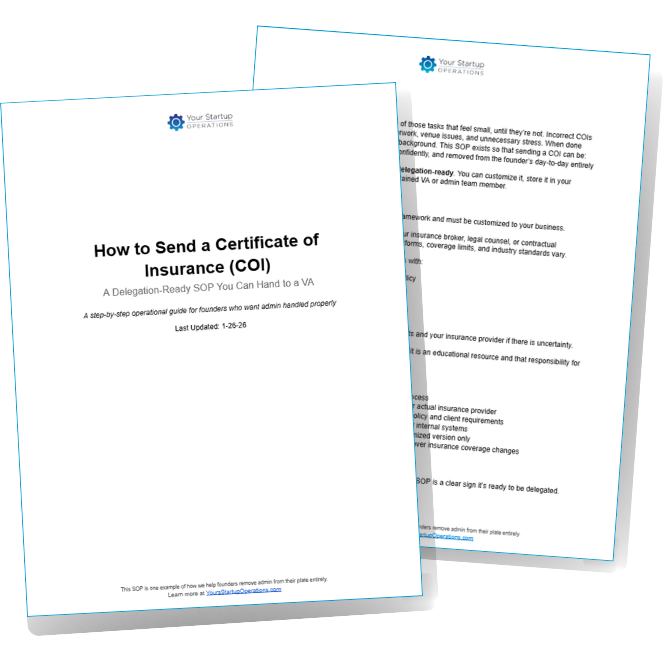
How to Send a Certificate of Insurance (COI)
Submitting a Certificate of Insurance doesn't have to be complicated.
This SOP
provides a clear, step-by-step process to help you submit accurate COIs, avoid delays, and keep approvals moving forward.


