%20(1).png)

How to Hire an Event Specialist Who Doesn't Need You to Train Them


A corporate activities company owner once handed us an event plan his last ops hire had marked up. Next to the beverage line, the hire had written one word: "juice." No pickup time, no cooling plan, no serving instructions. As the owner put it, "you can't just write juice." That's the difference between a general assistant and an event specialist.
Event work runs on details nobody has to ask about twice, and a general assistant will not think to ask about most of them.
Key Takeaways
An event specialist owns the operational details between a signed contract and event day: vendor logistics, timelines, and the small specifics a general assistant won't think to capture.
Four signs point to needing a specialist rather than another generalist hire: cycling through hires repeatedly, SOPs scattered across tools, a phone that never stops, and contractors with nobody managing them internally.
Most owners go wrong by hiring through volume staffing channels or hiring before there's any system for a new person to step into.
A paid trial built from real work, not a generic test, is the most reliable way to vet an event specialist before they touch a client.
Escalation rules, end-of-day reports, and 90-day goals are what let a specialist operate without the owner checking in on every decision.
What an Event Specialist Does (and Why It's Not a General VA)
An event specialist owns the operational details between the sale and event day: vendor confirmations, timeline builds, guest and logistics tracking, and the follow-through that keeps a signed contract from turning into a scramble two weeks out. That's a different job than general administrative support, and the difference shows up fast when the wrong hire is in the role.
One event company owner put it well when evaluating a support option, asking whether the person was event-based or only generally administrative. The distinction matters because an event operations coordinator has to think in the specific rhythm of event work, vendor timelines, day-of contingencies, client-facing tone under pressure, rather than applying general task management to a job that requires industry-specific judgment.
The Bureau of Labor Statistics tracks meeting, convention, and event planners as their own distinct occupational category, with its own pay ranges and required skill set, which reflects how specialized this work is compared to general administrative roles.
4 Signs You Need an Event Specialist, Not Another Assistant
You Keep Cycling Through Hires
One owner kept a general assistant for a full year before realizing a task that should take 90 minutes was taking three weeks to get done. That's not a motivation problem. It's a mismatch between the role's demands and the hire's actual skill set, and it repeats itself with every new generalist hire until the role itself changes.
Your SOPs Are Scattered Across Tools
For that same owner, whatever process documentation existed was spread across Google Drive, Notion, and Loom recordings, left behind piecemeal by each previous hire. Nobody could find a complete picture of how the business ran, which meant every new hire started from scratch instead of building on what came before.
Your Phone Never Stops
A wedding planner with 22 years in the business described her WhatsApp and texts as something that simply does not stop, even on production weekends when she should be focused on the event in front of her. That volume of inbound communication is exactly the kind of load a specialist is built to absorb, and exactly the kind that burns out an owner trying to handle it personally.
You Have Contractors but No Back Office
Another owner runs roughly 50 rotating contractors with nobody managing that relationship internally: no one tracking availability, confirming bookings, or handling the administrative side of a large freelance roster. A back office to manage that volume isn't optional once a contractor list reaches that size.
Where Most Owners Go Wrong Hiring One
The most common mistake is sourcing through volume channels, posting on Facebook Marketplace, or working with a staffing agency built for broad, high-volume placement rather than a specific fit. One owner described a staffing agency sending 30 candidates, none of whom matched what he'd asked for.
The second common mistake is hiring before there's any system for a new person to step into. Bringing on an event specialist without documented processes to train against sets the new hire up to repeat the same trial-and-error every predecessor went through. For more on why that pattern shows up so often in virtual assistant hires specifically, see our guide on why VA hires fail.
The Society for Human Resource Management tracks cost-per-hire and the broader cost of a bad hire across industries, and the pattern holds here too: a hire that doesn't work out costs more than the search itself. It costs the output lost while the business waits to notice the mismatch, then costs the search all over again. Gallup has found that replacing an employee typically runs a significant multiple of their salary once training time, ramp-up, and lost productivity are factored in, a cost that compounds every time an owner cycles through another generalist hire instead of finding the right fit the first time.
What to Look For in an Event Specialist
Event-type match. Corporate and wedding experience aren't interchangeable. A multicultural wedding planner whose events pack five separate ceremonies and receptions into a day and a half needs someone who has worked at that pace before, not someone learning it on the job.
Detail-first thinking. Call it the juice test: does a candidate ask the follow-up questions nobody told them to ask, or do they take an instruction at face value and move on?
Multitasking across functions. Invoicing, vendor coordination, and client communication often need to happen in the same hour, and a candidate needs to demonstrate comfort switching between them without losing track of any one thread.
Writing ability. Can they document what they learn in a way someone else could follow later? That skill is what turns one person's knowledge into a process the business can rely on beyond that one hire.
The Professional Convention Management Association sets a similar bar in its resources for event professionals: technical event knowledge matters, but the ability to document and communicate that knowledge clearly is what makes it transferable across a team.
How to Vet an Event Specialist Before They Touch Your Clients
A paid trial built from real work in the business, not a generic skills test, is the most reliable way to see how a candidate performs. Real vendor emails, a real timeline, a real client scenario reveal far more than a hypothetical case study ever will.
One useful exercise: have finalists write an SOP based on a recorded call. It shows two things at once, how clearly they think through a process, and how well they can put that thinking into words someone else could follow. A candidate who struggles with this exercise will likely struggle with the documentation side of the job itself.
YSO's own process reflects this directly. Roughly 1,000 candidates come through the top of the funnel for every event specialist role, narrowed through screenings and skills assessments, then tested through a 20 to 40 hour paid trial before a placement is ever made. That volume of screening exists because the cost of a wrong hire, in wasted time, lost client trust, and a repeated search, is far higher than the cost of a thorough vetting process upfront.
How to Onboard Them So They Don't Need You
Escalation rules. Define specifically what a specialist can decide alone, for example, anything under a set dollar threshold, and when something needs to come back to the owner, such as only after a defined number of unanswered attempts to reach a client (a few texts, a couple of calls, a couple of emails). Clear rules prevent both extremes: a specialist afraid to make any decision, and one making calls that should have stayed with the owner.
End-of-day reports. A short daily summary, what got done, what needs the owner's attention, and what's coming next, keeps visibility high without requiring constant check-ins throughout the day.
90-day goals, set up front. Clear goals for the first three months, paired with weekly check-ins, give both the specialist and the owner a shared understanding of what "working out" looks like, rather than a vague sense of things going fine or not.
This is also where documenting your processes first pays off directly: escalation rules and reporting structures are far easier to build, and to train someone into, once the underlying process is already written down.
Frequently Asked Questions
What does an event specialist do?
An event specialist owns the operational details of running an event between the signed contract and event day: vendor confirmations, timelines, logistics tracking, and client communication, freeing the business owner to focus on sales, relationships, and on-site judgment calls.
Event specialist vs. event coordinator vs. event planner: what's the difference?
The titles overlap heavily in practice. An event planner is often involved earliest, shaping vendor selection and design. An event coordinator or event specialist typically owns execution and the administrative detail behind it, though exact scope varies by the business using the title.
Can an event specialist work remotely?
Yes, for most of the role. A remote event coordinator can handle vendor communication, timeline building, invoicing, and client follow-up without being on-site, though day-of execution still typically needs someone physically present.
How long does it take to train an event specialist?
It depends heavily on whether documented processes already exist. A specialist trained against a written SOP tends to ramp up faster than one learning a business's workflow from scratch, which is part of why documenting your process before hiring makes such a measurable difference.
What should an event specialist job description include?
A clear scope of owned tasks (vendor confirmations, timeline management, client communication), the tools the role requires familiarity with, escalation expectations, and the event types the business handles, since corporate and wedding experience aren't interchangeable.
Ready to Find Out What an Event Specialist Would Take Off Your Plate?
A quick time audit shows exactly which tasks are eating into an owner's week, and which of them a trained event specialist could own instead. Book a call with YSO to walk through what that audit would surface for your business.
About Your Startup Operations
Your Startup Operations (YSO) is a Women-Owned Small Business (WOSB) certified, white-glove operations agency co-founded by Jenna Henao and Alexis Schomer. YSO helps event business owners and other service-based companies step out of daily operations by installing a dedicated Ops Assistant trained specifically for their business, typically helping owners reclaim 30–40 hours per week.
YSO has been featured in Forbes, Voyage LA, Authority Maximizer, EIN Presswire, and AP News.
Explore our event vendor ops services, see client outcomes on our case studies page, or get in touch to talk through what your business needs.
About the Author

Jenna Henao is the Co-Founder and Operations Expert at Your Startup Operations. She partners with business owners to streamline operations, strengthen workflows, and build reliable teams that drive long-term growth. With a background in entrepreneurship and business operations, Jenna has led initiatives across HR, finance, recruitment, operations, sales, marketing, and team leadership. She has helped businesses grow from six to seven figures by developing scalable systems, recruiting outstanding talent, and implementing processes that support lasting success. Connect with Jenna on LinkedIn.
Reviewed by

Alexis Schomer is the Co-Founder and Marketing & Operations Expert at Your Startup Operations. She works with business owners to optimize operations, improve delegation, and build scalable systems that support sustainable business growth. Drawing on her experience in marketing, entrepreneurship, and business operations, Alexis believes effective delegation is about more than hiring a virtual assistant. It starts with selecting the right person, creating efficient workflows, establishing clear expectations, and providing the training and support needed for teams to succeed. This practical, systems-first philosophy guides every client partnership at YSO. Connect with Alexis on LinkedIn.
Free Resources
Access practical tools, templates, and SOPs designed to simplify operations, improve delegation, and support business growth.

25 Tasks You Can Offload To Your VA Today
Your day fills up fast with follow-ups, inbox replies, scheduling, and admin.
This guide
shows exactly
what to hand
off first so
you can
stop doing it all yourself and
free up
real time.

The Ultimate Productivity Toolkit for Event Professionals
Managing clients, coordinating vendors, and handling daily administrative tasks can quickly fill your schedule. This toolkit shares five practical ways a virtual assistant can help streamline your workload so you can spend more time growing your business.
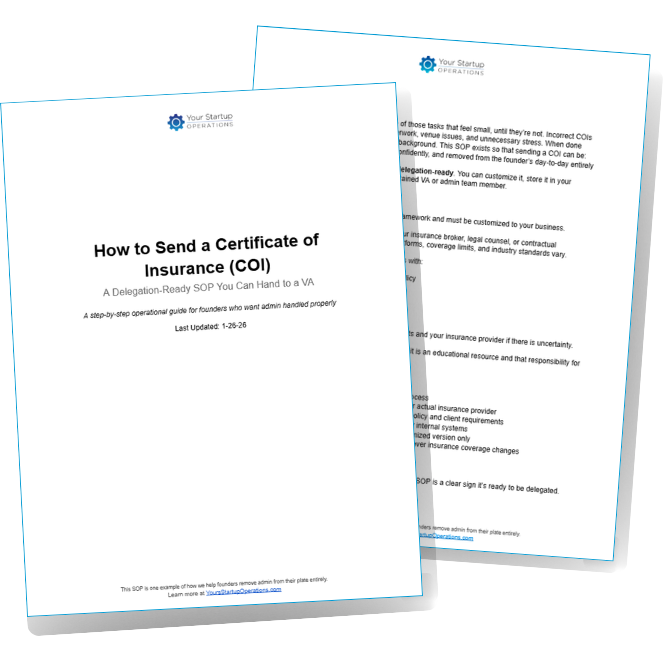
How to Send a Certificate of Insurance (COI)
Submitting a Certificate of Insurance doesn't have to be complicated.
This SOP
provides a clear, step-by-step process to help you submit accurate COIs, avoid delays, and keep approvals moving forward.