%20(1).png)

Virtual Event Planning and the Vetting Process Behind Our Event VAs


Virtual event planning support only works if the person behind it is good at the job, and "good at event work" isn't the same skill set as general admin support. A VA who can manage an inbox well isn't automatically ready to confirm a vendor's day-of arrival window or notice that a timeline has quietly drifted out of sync with reality.
This is what our vetting process for event VAs is built to catch before a client ever meets the person we place with them.
Key Takeaways
Virtual event planning support depends on more than general administrative skill. Event-specific judgment (vendor communication, timeline accuracy, client-facing tone) is what separates a good fit from a poor one.
YSO's vetting process for event VAs includes event-industry experience screening, a scenario-based skills assessment, a background check, and a trial period before a full placement begins.
Every placement is trained on the specific tools and workflow a client already uses, rather than asking the client to adapt to a new system.
Vetting doesn't end at placement. Ongoing check-ins catch drift in quality before it becomes a client-facing problem.
For what virtual event planning support covers day to day, and the models businesses use to structure it, our event planning assistance guide and virtual event support guide cover that ground directly.
What Virtual Event Planning Support Covers
Virtual event planning support is a remote team member handling the administrative and coordination work behind an event: vendor communication, timeline documents, guest list tracking, contract and invoice follow-up, and similar tasks that don't require an on-site presence. This piece isn't about that scope in detail, since our event planning assistance guide and virtual event support guide already cover what the work includes and how the day-to-day relationship functions. This piece is about the step before any of that: how the person doing the work gets selected in the first place.
How YSO Vets Event VAs Before Placement
Vetting starts before a resume ever gets reviewed for general VA skills. A candidate for event work goes through a process built specifically around what the role demands:
Event-industry experience screening. General administrative experience isn't the bar. We look for direct exposure to event workflows: vendor coordination, client-facing communication under time pressure, and familiarity with how a timeline gets used on the ground.
A scenario-based skills assessment. Candidates work through realistic situations, drafting a vendor confirmation email, prioritizing a list of conflicting day-of requests, rather than answering questions in the abstract. This surfaces judgment that a resume alone doesn't.
A background check. Standard for any placement handling client communication, contracts, and scheduling on a business's behalf.
A trial period. Before a full placement, a candidate works through real (or realistic) tasks under supervision, which catches a mismatch before a client ever experiences it.
Training on Your Specific Tools and Workflow
Vetting confirms the person is capable. Training makes sure that capability transfers to how a specific business works. YSO trains every placement on the client's existing tools, whether that's HoneyBook, Dubsado, a spreadsheet-based system, or something else entirely, rather than asking the business to adapt to whatever the VA happens to already know. That distinction matters: a highly skilled VA who has to learn a business's systems from scratch after placement is a slower start than one who was trained on those systems before day one.
Ongoing Quality Checks After Placement
Vetting well and then walking away isn't enough. A placement that looked strong in training can still drift once the work gets busy, deadlines shift, or account is managing more clients at once, so regular check-ins matter as much as the initial screening. The Society for Human Resource Management points to a similar pattern in its research on hiring and onboarding more broadly: the quality of a placement is shaped as much by what happens in the weeks after hiring as by the interview process itself. YSO's ongoing check-ins are built around that same idea, catching a quality gap early rather than after a client raises it.
Why Vetting Matters More for Event Work Specifically
An event VA's mistakes tend to be more visible, and more costly, than a general admin error. A missed vendor confirmation shows up as a no-show on the day of an event, not as a delayed internal report. A poorly worded client email during a stressful planning window can affect a relationship the business depends on for referrals.
The Professional Convention Management Association reflects this same standard in its resources for event professionals: the margin for error in client-facing, time-sensitive event work is smaller than in most other administrative functions, which is exactly why the vetting bar needs to be higher going in.
How This Works in Practice: Flair Project
Ivo, who runs Flair Project, a cocktail catering business, went through this same transition from solo operator to structured company. Before bringing on support, running the business meant constant daily firefighting, logistics and bookings left little room for anything else.
After hiring an assistant, Ivo saw revenue increase 15 to 18 percent while operational costs dropped 7 percent, a shift he attributes directly to finally having the bandwidth to focus on growing the business instead of only keeping it running day to day. It's the same principle behind vetting an event VA well in the first place: the right support doesn't only take tasks off a plate, it frees up the judgment and attention an owner needs to grow the business.
Frequently Asked Questions
What is virtual event planning?
Virtual event planning is remote support for the administrative and coordination side of running events: vendor communication, timeline documents, guest list tracking, and contract or invoice follow-up, handled by someone working outside the office or event site.
How are YSO's event VAs vetted before placement?
Through event-industry experience screening, a scenario-based skills assessment, a background check, and a trial period before a full placement begins. The process is built specifically around the judgment event work requires, not only general administrative competence.
What happens if a placed VA isn't the right fit?
Ongoing check-ins are designed to catch a mismatch early, before it becomes a client-facing problem. If a placement isn't working, addressing it quickly matters more than treating the original vetting as final and unchangeable.
Do vetted event VAs need training on our specific tools, or do they already know them?
Both. Vetting confirms the underlying skill and judgment. Training is still required on the specific platform and workflow a business already uses, since even a highly capable VA benefits from being trained on the actual systems rather than guessing at how a business runs.
How long does the vetting and onboarding process take before a VA starts working?
Vetting itself (screening, assessment, background check) typically happens before a candidate is presented as a fit for a specific client. Onboarding onto a client's specific tools and workflow after that generally takes a few weeks before the VA is operating independently, similar to onboarding any new team member.
Ready to Work With a Vetted Event VA?
Virtual event planning support is only as good as the vetting behind it. YSO's event VAs go through event-specific screening, a scenario-based assessment, a background check, and training on your actual tools before they ever touch client-facing work.
About Your Startup Operations
Your Startup Operations (YSO) is a Women-Owned Small Business (WOSB) certified, white-glove operations agency co-founded by Jenna Henao and Alexis Schomer. YSO helps event business owners and other service-based companies step out of daily operations by installing a dedicated Ops Assistant trained specifically for their business, typically helping owners reclaim 30–40 hours per week.
YSO has been featured in Forbes, Voyage LA, Authority Maximizer, EIN Presswire, and AP News.
Explore our event vendor ops services, see client outcomes on our case studies page, or get in touch to talk through what your business needs.
About the Author

Alexis Schomer is the Co-Founder and Marketing & Operations Expert at Your Startup Operations. She works with business owners to optimize operations, improve delegation, and build scalable systems that support sustainable business growth. Drawing on her experience in marketing, entrepreneurship, and business operations, Alexis believes effective delegation is about more than hiring a virtual assistant. It starts with selecting the right person, creating efficient workflows, establishing clear expectations, and providing the training and support needed for teams to succeed. This practical, systems-first philosophy guides every client partnership at YSO. Connect with Alexis on LinkedIn.
Reviewed by

Jenna Henao is the Co-Founder and Operations Expert at Your Startup Operations. She partners with business owners to streamline operations, strengthen workflows, and build reliable teams that drive long-term growth. With a background in entrepreneurship and business operations, Jenna has led initiatives across HR, finance, recruitment, operations, sales, marketing, and team leadership. She has helped businesses grow from six to seven figures by developing scalable systems, recruiting outstanding talent, and implementing processes that support lasting success. Connect with Jenna on LinkedIn.
Free Resources
Access practical tools, templates, and SOPs designed to simplify operations, improve delegation, and support business growth.

25 Tasks You Can Offload To Your VA Today
Your day fills up fast with follow-ups, inbox replies, scheduling, and admin.
This guide
shows exactly
what to hand
off first so
you can
stop doing it all yourself and
free up
real time.

The Ultimate Productivity Toolkit for Event Professionals
Managing clients, coordinating vendors, and handling daily administrative tasks can quickly fill your schedule. This toolkit shares five practical ways a virtual assistant can help streamline your workload so you can spend more time growing your business.
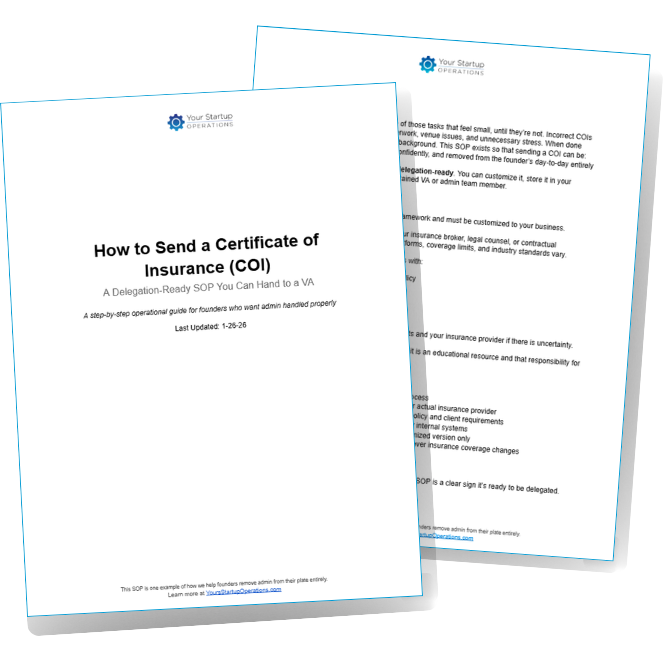
How to Send a Certificate of Insurance (COI)
Submitting a Certificate of Insurance doesn't have to be complicated.
This SOP
provides a clear, step-by-step process to help you submit accurate COIs, avoid delays, and keep approvals moving forward.


