

Running a Mobile Bartending Business: What to Hand Off Once You're Fully Booked


Once your mobile bartending business is fully booked, hand off the admin first: inquiries and quotes, contracts and deposits, permit and insurance paperwork, bartender scheduling, and invoices and reviews. Keep the menu, the client relationship and the bar itself with you.
This guide is for owners past the start-up stage: you have a trailer or a portable bar, a team of bartenders and more weekend requests than you can answer quickly. Weddings, corporate happy hours, milestone birthdays and brand activations all come with the same paperwork, and at some point it starts costing you bookings.
The owner of a cocktail catering business we work with put it this way before he brought in an ops assistant: "you wear a lot of hats… you are not efficient in any of them." He handed off 17 to 20 hours a week of admin and social media so he could get back to the part of the business that grows it.
Key Takeaways
If inquiries wait more than a day or you're building quotes after midnight, the admin is already costing you bookings.
Hand off in this order: inquiries and quotes, contracts and deposits, event paperwork, staffing, then invoices and reviews.
Every event needs the same details confirmed: venue rules, permits or authorizations, insurance, headcount, menu and bartender count.
Keep pricing, menu design, client relationships and on-site service with you.
Set targets you can measure, like quotes sent within 24 hours and staff confirmed one week out.
How do you know it's time to hand off the admin?
Most mobile bar owners notice it in the same places:
Inquiries from Friday get answered on Monday, and some of those couples have already booked someone else.
Quotes take an evening each because you rebuild them from scratch.
You've been the one confirming bartenders, chasing deposits and answering "can we add a signature cocktail?" emails from the event.
Venue paperwork, like certificates of insurance or proof of a permit, gets sent the day before.
Final invoices for added hours or extra guests never go out.
If two or more of those sound familiar, the next booking you lose probably won't be about your drinks.
What should a mobile bartending business hand off first?
Hand these off in order. Each one frees up time for the next.
1. Inquiries and quotes
The first reply wins a lot of mobile bar bookings. Your assistant can answer inquiries the same day, ask the questions you always ask (date, venue, guest count, hours, bar style, who's supplying the alcohol), and build a quote from your packages. You approve anything outside your standard pricing.
2. Contracts and deposits
A date isn't booked until the contract is signed and the deposit is paid. Tools like HoneyBook can bundle both into one booking document; HoneyBook describes its smart files as letting clients sign a contract, schedule a call and pay all at once. Your assistant sends them, follows up by email and phone until they're done, and only then marks the date as booked. For the full process, see our guide to client onboarding for event vendors.
3. Event paperwork: permits, insurance and venue rules
Mobile bars run into more paperwork than most event vendors, and the rules depend on your state and the venue. In California, for example, caterers with the right license need to get authorization from the state ABC for each catered event. Venues often ask for a certificate of insurance before load-in. Your assistant can track what each event needs, start applications on time, send your COI in the format the venue asks for (here's how to send a COI) and keep copies on file. You and your licensing advisor decide what your business is allowed to do.
4. Bartender scheduling and the event-day plan
Your assistant can assign bartenders and barbacks, confirm them a week out, send each one the run sheet (arrival time, venue contact, menu, parking, dress code) and find a replacement when someone drops.
5. Invoices, gratuity and reviews
After the event: final invoices for added hours or guests, a thank-you note and a review request. Be clear in your contract about gratuity. The IRS says a payment is a tip only if the customer voluntarily decides to pay it and sets the amount, so a required gratuity on the invoice is treated as a service charge. Ask your accountant how to handle it for your team.
Mobile bar event checklist
Copy this into your booking software or a shared spreadsheet and run every event through it.
Stage | Task | Done |
Inquiry | Same-day reply with packages and availability | ☐ |
Quote | Quote sent with bartender count, hours, bar setup and add-ons | ☐ |
Booking | Contract signed and deposit paid; date marked booked | ☐ |
Details | Menu, signature cocktails and who supplies the alcohol confirmed | ☐ |
Venue | Venue rules, load-in time, power and water access confirmed | ☐ |
Paperwork | Permits or authorizations filed; COI sent | ☐ |
Staffing | Bartenders assigned and confirmed one week out; run sheet sent | ☐ |
Event week | Final headcount, timeline and balance invoice | ☐ |
After | Extra hours invoiced; thank-you and review request sent | ☐ |
What should you keep doing yourself?
Menu design and signature cocktails
Pricing and anything outside your packages
Licensing and legal decisions about what you can serve and where
Hiring and training bartenders
The client relationship on big events, and the bar itself
What does a well-run mobile bar business look like?
Suggested targets to measure your own process against:
Step | Suggested target |
Inquiry reply | Same business day |
Quote sent | Within 24 hours |
Contract and deposit | Within 7 days of the quote being accepted |
Paperwork and COI | Sent at least 2 weeks before the event |
Bartenders confirmed | 7 days before the event |
Final invoice and review request | Within 3 days after the event |
How can a virtual assistant help a mobile bartending business?
At YSO, we place full-time event vendor virtual assistants (we call them ops assistants) who work only for your business, inside the tools you already use, like HoneyBook, Dubsado or Google Workspace. Before they start, we map how you run bookings today and turn it into SOPs you own, because you cannot hand off what's never been written down. Then we stay involved for 90 days.
If you also cater food, our list of what to delegate first in a catering business covers the kitchen side.
Frequently Asked Questions
How do you run a mobile bartending business efficiently?
Run every event through the same steps: same-day inquiry replies, quotes from set packages, contract and deposit before the date is held, paperwork and staffing confirmed early, and invoices and review requests right after. Write those steps down and decide who owns each one.
How many bartenders do you need for 100 guests?
It depends on the bar style, the length of the event and how complex the menu is. A beer and wine bar moves faster than a full cocktail menu, and a cocktail hour rush needs more hands than a slow reception. Set your own ratio for each package, put it in your quotes and adjust it for venue layout.
Do mobile bartenders need a liquor license?
It depends on your state and on who is buying and serving the alcohol. Some states require a license or event authorization for each catered event; others allow bartending services when the host supplies the alcohol. Check with your state's alcohol beverage control agency before you quote.
What insurance does a mobile bartending business need?
Talk to an insurance broker about general liability and liquor liability coverage for your state. Many venues ask for a certificate of insurance listing them before your team can set up.
Can a virtual assistant answer calls for my mobile bar?
YSO ops assistants don't answer your business line or take live inbound calls. They reply to inquiries by email and text, call leads and clients back, and handle vendor calls with venues and suppliers.
Spend your weekends behind the bar, not behind the inbox
YSO maps how your business runs, writes the SOPs and places a trained ops assistant who knows event work, with 90 days of support. See how it works for event vendors.
About Your Startup Operations
Your Startup Operations (YSO) is a Women-Owned Small Business (WOSB) certified, white-glove operations agency co-founded by Jenna Henao and Alexis Schomer. YSO helps event business owners and other service-based companies step out of daily operations by installing a dedicated Ops Assistant trained specifically for their business, typically helping owners reclaim 30–40 hours per week.
YSO has been featured in Forbes, Voyage LA, Authority Maximizer, EIN Presswire, and AP News.
Explore our event vendor ops services, see client outcomes on our case studies page, or get in touch to talk through what your business needs.
About the Author

Jenna Henao is the Co-Founder and Operations Expert at Your Startup Operations. She partners with business owners to streamline operations, strengthen workflows, and build reliable teams that drive long-term growth. With a background in entrepreneurship and business operations, Jenna has led initiatives across HR, finance, recruitment, operations, sales, marketing, and team leadership. She has helped businesses grow from six to seven figures by developing scalable systems, recruiting outstanding talent, and implementing processes that support lasting success. Connect with Jenna on LinkedIn.
Reviewed by

Alexis Schomer is the Co-Founder and Marketing & Operations Expert at Your Startup Operations. She works with business owners to optimize operations, improve delegation, and build scalable systems that support sustainable business growth. Drawing on her experience in marketing, entrepreneurship, and business operations, Alexis believes effective delegation is about more than hiring a virtual assistant. It starts with selecting the right person, creating efficient workflows, establishing clear expectations, and providing the training and support needed for teams to succeed. This practical, systems-first philosophy guides every client partnership at YSO. Connect with Alexis on LinkedIn.
Free Resources
Access practical tools, templates, and SOPs designed to simplify operations, improve delegation, and support business growth.

25 Tasks You Can Offload To Your VA Today
Your day fills up fast with follow-ups, inbox replies, scheduling, and admin.
This guide
shows exactly
what to hand
off first so
you can
stop doing it all yourself and
free up
real time.

The Ultimate Productivity Toolkit for Event Professionals
Managing clients, coordinating vendors, and handling daily administrative tasks can quickly fill your schedule. This toolkit shares five practical ways a virtual assistant can help streamline your workload so you can spend more time growing your business.
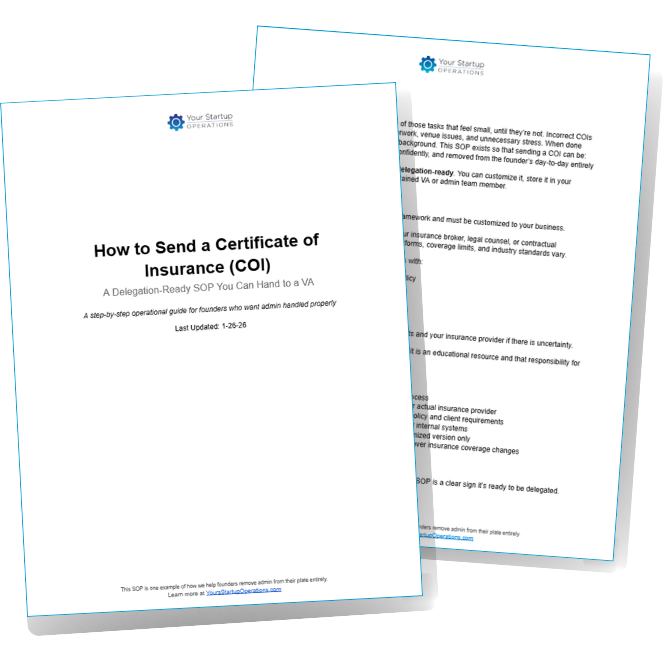
How to Send a Certificate of Insurance (COI)
Submitting a Certificate of Insurance doesn't have to be complicated.
This SOP
provides a clear, step-by-step process to help you submit accurate COIs, avoid delays, and keep approvals moving forward.


