%20(1).png)

How to Take a Real Vacation as a Home Service Business Owner


Most home service business owners haven't taken a real vacation in years. Not a weekend where they answered emails from the beach. Not a "vacation" where they checked in with dispatch three times a day and answered emergency calls. A real vacation where the business ran without them, no calls, no emails, no putting out fires from a hotel bathroom.
It's not because they don't want one. It's because home service ownership has structurally trained them out of believing it's possible. The on-call culture. The customer relationships that go through the owner. The systems that live in the owner's head. The tech team that "can't handle" complex jobs without the owner's input. All of it adds up to a business where the owner leaving, even for five days, feels like leaving a burning building unattended.
This guide is about how to actually take a real home service owner vacation without the business falling apart. It covers the business case for why you should, what a graduated approach looks like, what to prepare in advance, and where a virtual assistant fits into making the whole thing possible. It's written for home service business owners HVAC, plumbing, electrical, landscaping, cleaning, pest control, roofing who've told themselves for years that "next year will be different."
Key Takeaways
The reason most home service owners don't take real vacations isn't lack of desire. It's that structural customer trust is concentrated in the owner, on-call responsibility falls on them, and business systems live mostly in their head.
The cost of never taking a vacation is real and compounds: owner burnout, team development stalling, business valuation dropping (because a business that can't run without its owner is worth less), and cultural norms that repel good hires.
Taking a real vacation requires operational preparation, documented escalation paths, cross-trained on-call coverage, delegated decision authority, and customer expectations set in advance.
A virtual assistant plays a central role by absorbing customer communication, triaging what actually needs owner attention (usually less than owners think), and running the standard operational workflows without interruption.
A graduated approach works best: start with a long weekend, then a full week, then a real 10–14-day vacation. Each round proves out and refines the systems.
Why Home Service Owners Struggle to Take Real Vacations
The structural reasons are worth naming honestly because most of them are fixable but not by pushing through willpower alone.
On-call culture. Home service businesses often operate on emergency-response models. Broken furnace on a cold night, burst pipe on a holiday, roof damage after a storm. The owner is usually the ultimate escalation point, and even if the on-call rotation includes technicians, the customer often expects to reach the owner directly when things go wrong.
Customer trust is concentrated in the owner. Long-standing customers know the owner personally. They ask for the owner by name. They don't want to work with "whoever's available"; they want the person they've known for eight years. When the owner is gone, some customers just wait, others get anxious, and a few call competitors.
Systems that live in the owner's head. The pricing rules for unusual jobs. The service history of long-term customers. The vendor relationships. The scheduling logic during peak season. All of it is undocumented tribal knowledge usable when the owner is present, invisible when the owner isn't.
Team dependence on owner decisions. Technicians know the routine work but escalate anything unusual. Office staff can handle the everyday but need the owner for judgment calls. The default management style ends up creating a team that runs well under supervision and struggles without it.
Owner guilt. Even when the systems could support a vacation, many owners feel guilty about leaving the team to cover. This is real but rarely helpful; the guilt reinforces the pattern that made vacation impossible in the first place.
The World Health Organization's 2019 classification of burnout as an occupational phenomenon formally recognized what home service owners have known experientially for years: chronic workplace stress without recovery produces measurable health consequences over time. The WHO framework identifies exhaustion, mental distance from work, and reduced professional efficacy as the core symptoms. Home service ownership without adequate time off produces all three.
What Not Taking a Vacation Actually Costs the Business
The cost isn't just personal. It shows up in the business itself:
Owner burnout translates to worse decisions. A burned-out owner makes short-term-oriented decisions, misses strategic patterns, and reacts to daily crises rather than working on the business. This shows up as growth stalling, margins slipping, and hires that don't work out.
Team development stalls. If the owner never leaves, the team never gets to lead. Technicians never learn to make judgment calls on complex jobs. Office staff never learn to handle escalations. Managers never get to actually manage. The team stays at their current skill level indefinitely.
Business valuation drops. A business that requires the owner's daily presence to function has almost no exit value. A business that runs without the owner for two weeks at a time has real transferable value. Owners who eventually want to sell or even just take extended time off for a family situation often discover this too late.
Cultural norms repel good hires. Ambitious employees don't want to work at a business where the owner is chronically overwhelmed. Word gets around. The businesses that struggle most to hire quality staff are often the ones where the owner never leaves.
Missed strategic thinking. Almost every business owner will admit that their best strategic ideas come during periods of rest, not periods of work. The Harvard Business Review's work on delegation by Jesse Sostrin makes the underlying point directly: leaders who can't step back from operational work don't develop the strategic muscles the business needs to keep growing.
The Business Case for Owner Vacation
The counter-case reasons a real vacation is a business investment, not a cost:
Systems get stress-tested. Whatever breaks while you're gone was already broken; you were just personally holding it together. Discovering the actual gaps is more valuable than the vacation itself.
Team development accelerates. Two weeks of the team running without the owner produces more skill growth than six months of the owner supervising.
Decisions improve on return. The first week back from a real vacation is usually the sharpest strategic thinking of the year.
Customer relationships get resilience-tested. The customers who genuinely require the owner personally are a small minority. The rest can be served just as well by trained staff; the owner just needs to prove this to themselves and to the customers.
Business valuation improves. Every vacation the business survives cleanly is evidence that the business is more transferable, which matters even if you have no intention of selling. Optionality is valuable.
Owner health. The U.S. Small Business Administration's guidance on business continuity planning touches on this: a business that depends entirely on one person's continuous presence isn't just fragile; it's actively risky. Vacation isn't just personal wellness; it's operational risk mitigation.
The Prep Work: How to Actually Take One
A real vacation requires operational preparation, ideally 4–8 weeks in advance. The prep list:
Document escalation paths. Who handles what kind of call. What decisions can be made by which team member. What actually needs to escalate to the owner via phone (should be a very short list). What can wait until you return.
Cross-train on-call coverage. If the on-call rotation depends on the owner, that's the biggest single vacation blocker. Train enough team members to cover the on-call responsibility during your absence. The Harvard Business Review analysis by James Oldroyd on response time touches on why this matters: response quality during your absence directly affects customer relationships, so the coverage needs to be real, not just hypothetical.
Communicate with customers in advance. For your top 15–20 customers, a personal email a week before ("I'll be out from X to Y, but the team is fully prepared to handle anything that comes up") prevents most of the anxiety-based escalations that would otherwise reach you.
Set up customer expectations for new inquiries. Autoresponders that give a realistic timeline for owner-required conversations while making clear the team can handle standard bookings and service requests.
Automate what you can. Confirmation emails, review requests, seasonal reminders anything that runs on triggers rather than owner decisions. Anything you can automate before you leave is one less thing that has to be manually done in your absence.
Delegate specific decision authority. For decisions between $X and $Y, the office manager can decide. For quotes under $Z, sales staff can decide. Above those thresholds, the answer is "we'll get back to you when the owner returns," which is fine.
Create the "call the owner" list. A very short list of what genuinely requires you personally. Usually 3–5 categories: major emergencies with legal or financial exposure, VIP customer complaints that risk churn, decisions above defined thresholds, urgent staff issues, and things that could damage the business's reputation. Everything else waits.
The VA's Role in Making Vacation Possible
For home service businesses that have a virtual assistant, the VA is central to making vacation actually work.
During the prep window (4–8 weeks out):
The VA documents workflows the owner runs personally, so team members have written procedures rather than relying on informal handoffs. Communicates with customers about the upcoming window. Sets up the automated follow-up systems described above.
During the vacation:
The VA handles customer communication inquiries, responses, follow-up, scheduling, and review responses. Triages what needs immediate attention from the team versus what can wait for the owner's return. Manages the CRM to keep everything current. Escalates only the "call the owner" list items.
After the vacation:
The VA prepares a synthesized summary of what happened while you were gone: what worked, what didn't, what needed attention, what patterns showed up. This is where the systems get refined for the next time.
For related workflow context, see YSO's post on why process mapping and SOPs come first and evaluating the performance of virtual assistants.
The Graduated Approach: Weekend → Week → Real Vacation
Trying to take a two-week vacation as the first attempt is usually how vacation attempts fail. The graduated approach works better.
Round 1: The Long Weekend (3–4 days off).
Purpose: prove to yourself and the team that you can be unavailable for a small stretch. Set realistic escalation rules; most things wait; only genuine emergencies get through. Come back and honestly assess what actually happened, what the team handled well, what they struggled with.
Round 2: The Full Week.
Purpose: identify the gaps that a long weekend didn't surface. A week is long enough that most operational patterns will play out a payroll cycle, an emergency service call, a new inquiry, a quote request, a review response needed. Come back and refine the systems based on what did and didn't work.
Round 3: The Real Vacation (10–14 days).
Purpose: the actual thing. If the first two rounds went reasonably well and you refined the systems in between, the real vacation should feel manageable not stress-free, but not disastrous either. Come back and do the final refinement.
The whole graduated sequence typically takes 6–12 months. Not fast, but sustainable and dramatically higher-success than trying to jump straight to a long vacation as the first attempt.
Case Study: What Operational Systems That Enable Owner Time Off Produce
One of YSO's clearest documented examples of building operational systems that free owner time is Wright Time Financial, a bookkeeping practice that partnered with YSO to build operational infrastructure and freed 30 hours per week for the founder.
The engagement, documented in YSO's case studies library, reflects the same principle that makes real owner vacations possible in home service businesses: the operational work has to be systematized and delegated before the owner can meaningfully step back from it. Thirty hours per week freed isn't just about efficiency; it's about the operational scaffolding that also makes it possible to take a real vacation without the business falling apart.
To be transparent: Wright Time Financial is a bookkeeping firm, not a home service business. But the pattern is identical. Across YSO's published case studies, including the home services engagement with Laguna Electric that freed up 40 hours per week for the founder, the same principle repeats: businesses that build operational systems first can then afford the owner time off that builds resilience for the long run.
Common Failure Modes When Trying to Take a Vacation
Announcing the vacation but not doing the prep. Blocking the calendar without documenting escalation paths, cross-training on-call, or communicating with customers. Predictable outcome: constant interruption.
Being "reachable for emergencies" without defining what counts as an emergency. Everything ends up feeling like an emergency to the team, and the owner spends the vacation on the phone.
Trying to do it without an on-call cross-training investment. If you're the only person who can handle emergency calls, no amount of documentation makes the vacation work. Cross-training has to happen in advance.
Not telling customers. Long-term customers who reach out during your absence and get bounced without warning often escalate their frustration. A brief heads-up email prevents most of this.
Coming back and blaming the team for what broke. Whatever broke was probably a systems gap, not a team failure. Blaming the team makes the next vacation harder because they won't want to cover.
Taking the vacation but not refining the systems afterward. The value of the first vacation isn't the vacation itself; it's the operational gaps it surfaces. Skipping the debrief means the second vacation goes just as roughly.
What to Keep the Owner in the Loop On (Even While Away)
Some information does need to reach you during a real vacation, but the list should be short:
Genuine emergencies with legal, financial, or safety exposure (structural damage, injury, major dispute)
VIP customer complaints that risk churn of a major account
Decisions above the delegated authority thresholds you defined
Urgent staff issues (someone quitting, someone injured, harassment allegation)
Anything that could damage the business's reputation publicly
Everything else: new inquiries, standard complaints, minor scheduling issues, routine questions waits or gets handled without you. The daily "just checking in" call to the office is the pattern that undermines most vacation attempts. Cut it.
How YSO Supports Home Service Business Owners Taking Time Off
YSO places trained virtual assistants specifically with home service businesses, including HVAC, plumbing, electrical, landscaping, cleaning, pest control, and roofing companies. The VAs we place come in with experience running the customer communication, follow-up, and CRM management workflows that make owner vacations operationally possible, meaning your vacation prep doesn't start from scratch.
If you want to talk through what a vacation-ready operation could look like in your specific home service business, book a free consultation.
Frequently Asked Questions
Can a home service business owner really take a two-week vacation?
Yes, but not without preparation. Operational systems, cross-trained on-call coverage, delegated decision authority, and clear customer communication all have to be in place. The businesses where the owner can take real vacations are the ones that invested in building this infrastructure. The businesses where the owner "can't leave" are usually the ones that haven't.
How far in advance should I plan my first real vacation?
Realistically, 8–12 weeks of preparation for a first real attempt. Half of that is systems and documentation work, half is training the team and communicating with customers. Trying to prepare in less than 6 weeks usually produces a vacation that gets interrupted.
Who handles emergency calls when I'm gone?
Cross-trained team members, ideally on a rotation. If your business currently has no cross-trained on-call coverage, that's the first thing to fix before attempting a real vacation. Emergency coverage that depends entirely on the owner is the single biggest vacation blocker in home service businesses.
What if a customer insists on speaking with me personally?
For a small number of VIP customers, an advance heads-up email usually solves this. For the rest, the team handles it. Some customers will push. Very few will actually cancel because the owner is briefly unavailable; most understand that owners take vacations, especially when the team handles the situation professionally.
How do I stop myself from checking work while on vacation?
The single most reliable method is not having the tools to check with you. Delete the work email app from your phone for the duration. Set up the autoresponder. Give one team member the emergency contact number and instruct them to only use it for actual emergencies. Structural blocks work better than willpower.
What if I really can't afford to lose two weeks of revenue?
Two weeks of a vacation almost never costs two weeks of revenue for a home service business. Standard bookings still happen. Repeat customers still book. Emergency service still runs through the team. What you lose in personal revenue-generating activity, you gain in sustainability, team development, and long-term business value. The math works even in the first year.
Should I hire a VA specifically to enable vacations?
Most home service businesses would benefit from a VA regardless of vacation plans; the retention, review, and follow-up work described in adjacent YSO content produces measurable ROI on its own. Enabling owner vacations is a secondary benefit of having a VA already running those workflows. Hire the VA for the primary business case; vacations become possible as a downstream effect.
How do I know the systems are ready for a real vacation?
A long weekend that went cleanly is the first signal. A full week that went reasonably well is the second. If both worked, a 10–14 day vacation is likely to work. If the long weekend was a disaster, don't skip ahead; refine the systems first.
About YSO
Your Startup Operations (YSO)is a Women-Owned Small Business (WOSB)-certified virtual assistant and operations agency founded by Jenna Henao and Alexis Schomer. YSO partners with event vendors, home service businesses, and bookkeeping firms by providing trained virtual assistants who help streamline operations and improve efficiency. The agency has been featured in Forbes, Authority Maximizer, and Voyage LA, and has published 14 client case studies showcasing measurable operational improvements and proven business results.
About the Author

Jenna Henao is the Co-Founder and Operations Expert at Your Startup Operations. She works with business owners to streamline operations, strengthen workflows, and build reliable teams that support long-term growth. With a background in entrepreneurship and operations leadership, Jenna has experience across HR, finance, recruitment, operations, sales, marketing, and team management. She has helped businesses grow from six figures to seven figures by building scalable systems, recruiting outstanding talent, and implementing processes that lay the foundation for sustainable success. Connect with Jenna on LinkedIn.
Reviewed by

Alexis Schomer is the Co-Founder and Marketing & Operations Expert at Your Startup Operations. She helps business owners improve efficiency, delegate with confidence, and build scalable systems that support lasting growth. With a background in marketing, entrepreneurship, and business operations, Alexis knows that successful delegation involves much more than hiring a virtual assistant. It requires finding the right fit, building efficient workflows, setting clear expectations, and providing the guidance and training teams need to succeed. This practical, operations-focused approach shapes every client partnership at YSO. Connect with Alexis on LinkedIn.
Free Resources
Access practical tools, templates, and SOPs that help you simplify your operations, delegate with confidence, and build systems that support long-term growth.

Best Practices for Creating an SOP
When key processes exist only in your head, your team has to rely on you to keep work moving. This guide shows you how to document clear, repeatable SOPs that improve consistency, simplify delegation, and help your team work more independently.
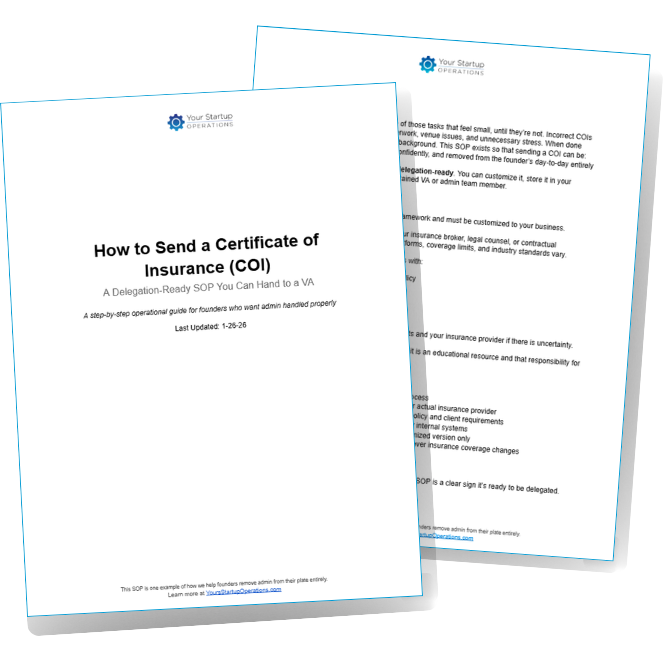
How to Send a Certificate of Insurance (COI)
Submitting a Certificate of Insurance can quickly become a hassle if details are missing or incorrect. This step-by-step SOP walks you through the process, helping you avoid common mistakes, speed up approvals, and minimize unnecessary back-and-forth.

The Ultimate Productivity Toolkit for Event Professionals
Managing an event business means balancing clients, vendors, schedules, and constant follow-ups. This toolkit explores five practical ways a virtual assistant can take routine tasks off your plate, helping you spend less time on administration and more time growing your business.


