%20(1).png)

Wedding Virtual Assistant Cost and What You Get at Each Price Point


"What does a wedding virtual assistant cost?" is one of the most common questions wedding professionals ask, and one of the hardest to answer with a single number. Pricing varies widely based on experience, scope, specialization, location, and whether you hire a freelancer directly or work through an agency. A generalist offshore VA and a trained, US-based wedding specialist backed by an agency can differ by several times over on rate, and they deliver very different things.
So the useful answer isn't a single figure. It's understanding how wedding VA pricing works: the models, the ranges, and what you really get at each price point. This article breaks down wedding virtual assistant cost across the pricing structures you'll encounter, what's included as you move up the tiers, and how the cost compares to hiring in-house, so you can decide what's worth paying for based on your needs rather than chasing the lowest rate.
Key Takeaways
Wedding virtual assistant cost varies widely by experience, scope, specialization, location, and freelance-versus-agency, so any single number is misleading without context.
The three main pricing models are hourly, monthly retainer, and per-package, each suited to a different kind of need.
Higher price points generally buy specialization, vetting, training, management, and continuity, not simply more hours.
The cheapest option is rarely the best value; a slightly higher rate for a wedding-fluent VA often costs less in the end than a cheap generalist who needs constant oversight.
Compared to a full-time in-house hire, a wedding VA is structurally cheaper, which is where the average $40,800 annual savings versus a full-time employee comes from.
Typical Rate Ranges
Before the numbers, the essential caveat: the ranges below are general market approximations, not quotes. Wedding virtual assistant rates depend on so many factors that the only accurate number for your situation is a quote for your specific scope. Treat these as a way to understand the landscape, not a price list.
With that said, wedding VA rates generally fall along a spectrum driven mainly by specialization and location:
Entry-level and generalist VAs sit at the lower end. These are often less specialized or offshore assistants who can handle basic administrative tasks. The rate is attractive, but they typically lack wedding-industry fluency and need more direction.
Specialized wedding VAs occupy the middle of the range. These assistants bring genuine event and wedding fluency (CRM knowledge, workflow understanding, the judgment the work requires) and command a higher rate because that specialization is worth paying for.
Senior, agency-backed, or full-service support sits at the upper end. Here the rate reflects not only the assistant's skill but the vetting, training, management, and continuity an agency provides, so you're buying a managed service rather than an individual's raw hours.
The most important thing to understand about these ranges is what moves you up them: specialization and support, not simply hours. A higher wedding virtual assistant cost usually reflects that you're getting a more skilled, more reliable, better-supported assistant, which for the high-stakes, detail-heavy nature of wedding work is often exactly what's worth paying for.
Hourly vs Monthly Retainer vs Package Pricing
Beyond the rate itself, wedding VA pricing comes in three main structures, and the right one depends on how you work.
Hourly pricing means you pay for the time used, usually best for variable or unpredictable workloads, or for testing a working relationship before committing. The upside is flexibility; the downside is less predictability in your monthly cost and, sometimes, a hesitation to hand off small tasks because the meter is running.
Monthly retainer pricing means you pay a set monthly fee for an agreed block of hours or scope, often at a better effective rate than pure hourly. This suits wedding businesses with a steady, ongoing need, because it gives you predictable costs, a committed block of the assistant's time, and no hesitation about using the support you're paying for. It's the most common structure for an ongoing wedding VA relationship.
Package or per-project pricing means a fixed price for a defined scope, for example, a set of deliverables or support for a specific number of weddings. This works when the need is well-defined and bounded, giving you cost certainty for a known deliverable. It's less common for ongoing operational support and more common for discrete projects like a CRM setup or a season's worth of a specific workflow.
Most ongoing wedding VA relationships land on an hourly or monthly retainer model, with the retainer becoming more attractive as the relationship stabilizes and the workload becomes predictable.
What's Included at Each Wedding Virtual Assistant Cost Tier
As wedding virtual assistant cost rises, what changes isn't only the hourly figure, it's the depth, reliability, and scope of what you get. Here's what tends to be included as you move up the price points.
At the lower tier, you generally get basic administrative support: inbox monitoring, simple scheduling, data entry, and straightforward task execution. What you often don't get is deep wedding-industry fluency, proactivity, or the judgment to handle the constant changes wedding work produces. You'll spend more of your own time directing the work, which is a hidden cost that offsets the low rate.
At the mid tier, you get a wedding-fluent VA who can own workflows rather than only execute tasks: managing the CRM, building and sending proposals, running inquiry response and follow-up, coordinating vendors remotely, and handling invoicing. This is where a VA starts genuinely removing operational load rather than adding management overhead, and for most wedding businesses it's the tier where the value becomes clear.
At the upper tier, whether through a senior specialist or an agency, you get a managed, reliable service: a vetted and trained assistant, oversight and quality control, continuity if your assistant is unavailable, and often an account manager coordinating the relationship. You're paying for the assurance that the work gets done well and consistently without you having to manage the person, which for a busy owner is frequently worth the premium.
The pattern across tiers is consistent: you're paying for specialization, reliability, and reduced management burden as you move up. The right tier depends on how much of your own time you can afford to spend directing the work, and how high the stakes are if something slips. For a fuller picture of what the role covers regardless of tier, our breakdown of what a wedding virtual assistant does lays it out.
Wedding VA vs In-House Coordinator Cost
A common comparison is between a wedding VA and hiring in-house, and here the structural difference matters more than the raw rate. An in-house employee's cost is not only their salary. It includes payroll taxes, benefits, paid time off, equipment, and workspace, and it's a fixed cost you carry year-round regardless of season. The employer obligations behind those added costs are laid out in the U.S. Small Business Administration's guidance on hiring and managing staff, and once counted, the true cost of an employee runs well above the base salary.
A wedding VA, as a contractor, carries none of that overhead in the same way, and the hours flex to your seasonal demand rather than sitting fixed through the off-season. That structural difference is why a VA typically costs meaningfully less in total than an in-house hire delivering comparable operational output. At YSO, clients save an average of roughly $40,800 per year compared to a full-time hire, which reflects exactly this gap between a flexible contractor cost and a fixed employment cost.
It's worth being clear about what an in-house hire buys that a VA does not: physical presence and on-site availability. If your need genuinely requires someone in the room, that's worth paying for. But if your need is operational and administrative, which for most wedding businesses it is, the VA model delivers it at a lower total cost. We work through this decision in detail in our wedding planner assistant vs virtual assistant comparison.
Frequently Asked Questions
How much does a wedding virtual assistant cost?
It varies widely based on experience, scope, specialization, location, and whether you hire a freelancer or work through an agency. Rather than a single figure, think in terms of tiers: generalist VAs sit at the lower end, wedding-specialized VAs in the middle, and senior or agency-backed support at the upper end. The only accurate number for your situation is a quote for your specific scope, because how much a wedding assistant costs depends entirely on what you need them to do.
What's the difference between hourly, retainer, and package pricing?
Hourly means you pay for time used, best for variable workloads or testing a relationship. A monthly retainer means a set fee for an agreed block of hours or scope, best for steady ongoing needs, and often a better effective rate. Package pricing means a fixed price for a defined scope, best for bounded projects. Most ongoing wedding VA relationships use hourly or retainer pricing.
Why do wedding VA rates vary so much?
Because you're not paying only for hours, you're paying for specialization, reliability, and support. A generalist offshore VA and a trained, agency-backed wedding specialist deliver very different things. Higher rates generally reflect wedding-industry fluency, vetting, training, management, and continuity, which reduce your own oversight burden and the risk of something slipping.
Is a cheaper wedding VA a better value?
Not usually. The lowest rate often comes with less specialization and more need for direction, which costs you time and risk. A slightly higher rate for a wedding-fluent VA who can own workflows independently frequently costs less in the end than a cheap generalist you have to manage constantly. Value is about output and reliability relative to cost, not the rate alone.
Does a wedding VA cost less than hiring in-house?
Structurally, yes, for comparable operational work. An in-house employee carries salary plus payroll taxes, benefits, paid time off, equipment, and workspace, as a fixed year-round cost. A wedding VA, as a flexible contractor, carries none of that overhead and scales with your season. At YSO, clients save an average of roughly $40,800 per year versus a full-time hire. What an in-house hire adds that a VA cannot is physical, on-site presence.
How do I get an accurate quote for a wedding VA?
Define your scope first, the specific tasks you want handled, so a provider can price against real requirements rather than a vague ask. The clearer you are about what you need (inquiry response, CRM management, proposals, follow-up, and how many hours or weddings), the more accurate the quote. Our guide on how to hire a wedding virtual assistant walks through scoping the role.
About Your Startup Operations
Your Startup Operations (YSO) is a Women-Owned Small Business (WOSB) certified, white-glove operations agency co-founded by Jenna Henao and Alexis Schomer. YSO helps event business owners and other service-based companies step out of daily operations by installing a dedicated Ops Assistant trained specifically for their business, typically helping owners reclaim 30–40 hours per week.
YSO has been featured in Forbes, Voyage LA, Authority Maximizer, EIN Presswire, and AP News.
Explore our event vendor ops services, see client outcomes on our case studies page, or get in touch to talk through what your business needs.
About the Author

Jenna Henao is the Co-Founder and Operations Expert at Your Startup Operations. She partners with business owners to streamline operations, strengthen workflows, and build reliable teams that drive long-term growth. With a background in entrepreneurship and business operations, Jenna has led initiatives across HR, finance, recruitment, operations, sales, marketing, and team leadership. She has helped businesses grow from six to seven figures by developing scalable systems, recruiting outstanding talent, and implementing processes that support lasting success. Connect with Jenna on LinkedIn.
Reviewed by

Alexis Schomer is the Co-Founder and Marketing & Operations Expert at Your Startup Operations. She works with business owners to optimize operations, improve delegation, and build scalable systems that support sustainable business growth. Drawing on her experience in marketing, entrepreneurship, and business operations, Alexis believes effective delegation is about more than hiring a virtual assistant. It starts with selecting the right person, creating efficient workflows, establishing clear expectations, and providing the training and support needed for teams to succeed. This practical, systems-first philosophy guides every client partnership at YSO. Connect with Alexis on LinkedIn.
Free Resources
Access practical tools, templates, and SOPs designed to simplify operations, improve delegation, and support business growth.

25 Tasks You Can Offload To Your VA Today
Your day fills up fast with follow-ups, inbox replies, scheduling, and admin.
This guide
shows exactly
what to hand
off first so
you can
stop doing it all yourself and
free up
real time.

The Ultimate Productivity Toolkit for Event Professionals
Managing clients, coordinating vendors, and handling daily administrative tasks can quickly fill your schedule. This toolkit shares five practical ways a virtual assistant can help streamline your workload so you can spend more time growing your business.
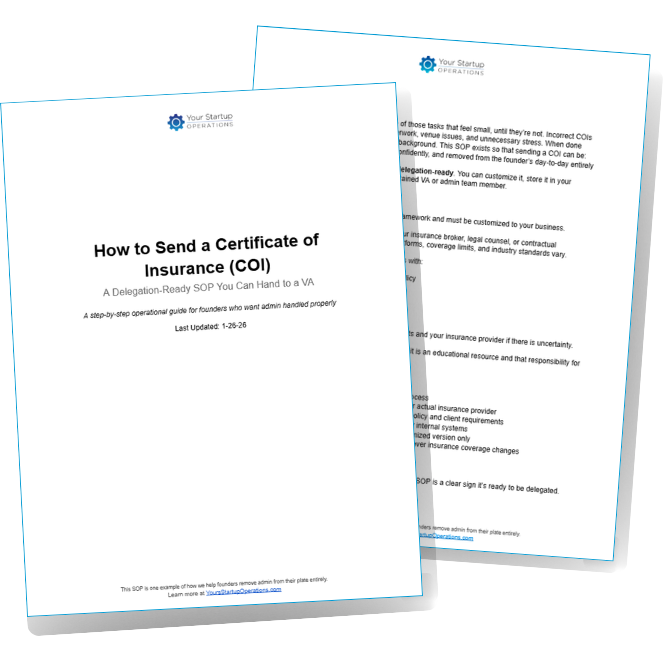
How to Send a Certificate of Insurance (COI)
Submitting a Certificate of Insurance doesn't have to be complicated.
This SOP
provides a clear, step-by-step process to help you submit accurate COIs, avoid delays, and keep approvals moving forward.
Pay for Value, Not the Lowest Rate
The right way to think about wedding virtual assistant cost isn't "what's the cheapest option," it's "what do I need, and what's it worth to have it handled well." A wedding-fluent VA who owns workflows independently is worth more than a generalist who needs constant direction, and an agency-backed service is worth more than a bare freelance rate when reliability and continuity matter. Understand the models, know what each tier includes, and match the price point to your actual need, and the cost becomes an investment in getting your time back rather than an expense to minimize.
For a quote based on your specific scope, we'd be glad to talk it through.


