%20(1).png)

How a Virtual Assistant for Home Security Installers Handles Job Intake and Scheduling

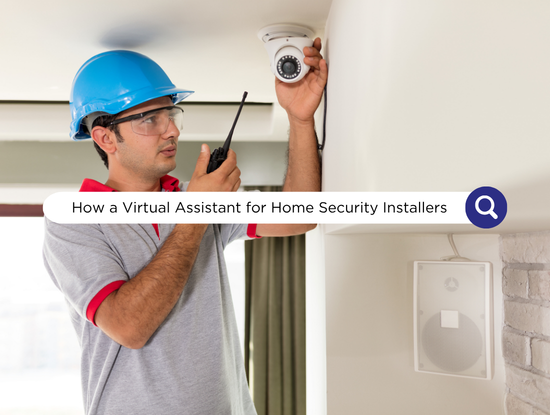
For a home security installation business, the work happens in the field, but the business runs on the office. A missed call is a missed install. A disorganized schedule means technicians drive across town between jobs instead of working efficiently. A permit that wasn't pulled delays a job. A monitoring contract that wasn't followed up on is recurring revenue that quietly walks away. Yet the owner of a small install business is usually on-site running installs, exactly when those calls come in and that coordination needs to happen.
A virtual assistant for home security installers closes that gap. It's a remote professional who handles the job intake, scheduling, permit coordination, and recurring-revenue admin that keep an install business running, so the calls get answered, the schedule stays efficient, and the paperwork gets handled, without the owner or a technician having to stop working. This article walks through the daily operational load a home security VA carries, how they support peak install season and route efficiency, how they work inside your platforms, and how the role compares to hiring an in-house office manager.
Key Takeaways
A virtual assistant for home security installers handles job intake, scheduling, permit coordination, monitoring contract admin, and warranty follow-up, so the phone is answered and the install calendar stays full.
What owners are really buying is captured jobs, an efficient schedule, and protected recurring revenue, not simply administrative help.
The role supports peak install season by absorbing the surge in intake and helping optimize routing so technicians complete more installs per day.
A capable home security VA works inside platforms like Alarm.com and dealer tools, alongside field service software.
Monitoring contracts are the recurring-revenue backbone of a security business, and a VA helps protect and grow that revenue through diligent admin.
What Home Security Installers Are Really Buying When They Hire a VA
When a security installer hires a virtual assistant, the visible part is the task list, answering calls, scheduling installs, handling paperwork. But that's not really what they're buying. They're buying the outcomes a reliable person handling those tasks produces.
They're buying captured jobs. Every inquiry answered promptly is an install that didn't go to a competitor because the call hit voicemail. In an industry where a homeowner concerned about security wants a fast response, answered calls convert directly into booked installs and revenue that would otherwise walk.
They're buying an efficient install schedule. A VA who keeps the calendar organized and the routing sensible means technicians spend their day installing rather than driving and backtracking, which lifts the number of jobs the same crew can complete.
They're buying protected recurring revenue. Monitoring contracts are the financial backbone of a security business, and diligent admin, setting them up correctly, following up on renewals, catching lapses, directly protects and grows the monthly recurring revenue that makes the business valuable.
And they're buying their own time back. The owner stops doing office work at night, stops fielding calls from a job site, and gets to focus on running installs and growing the business. That relief is often what an owner values most, even though it never appears on a task list.
Understood this way, a virtual assistant for security system installers isn't an administrative expense, it's an investment in capturing more jobs, running more efficiently, and protecting the recurring revenue the business is built on.
The Daily Operational Load a Virtual Assistant for Home Security Installers Handles
Here's what the role covers day to day. The operational load a home security business virtual assistant carries falls into several continuous streams, with job intake and scheduling at the center.
Job intake. The foundational task. As inquiries come in by phone, web form, or email, the VA responds promptly, captures the customer and job details, and books the install or the assessment visit. This means the phone is covered whether the owner is on a job, driving, or off the clock, so no lead goes to voicemail and no job slips to a competitor who answered first.
Scheduling and dispatch coordination. The VA manages the install calendar, booking jobs against your rules, coordinating technician assignments, and handling the reschedules and adjustments that come up constantly. Keeping the schedule tight and organized is where a lot of an install business's efficiency lives.
Permit coordination. Many jurisdictions require permits for alarm and low-voltage installation work, and coordinating those, submitting applications, tracking approvals, and making sure a permit is in place before a job, is procedural, time-consuming work that a VA can own so installs aren't delayed by paperwork.
Monitoring contract administration. Setting up monitoring contracts correctly, tracking them, and managing renewals is central to the recurring revenue of the business, and a VA handles this admin diligently so nothing falls through the cracks.
Warranty and follow-up. Registering warranties, following up with customers after installation to confirm satisfaction, and running the post-install follow-up that generates reviews and referrals, all handled consistently rather than whenever someone remembers.
Invoicing and administrative flow. Generating and sending invoices, following up on outstanding balances, keeping customer records current, and handling the administrative flow around every job, so the back office stays organized and cash flow stays healthy.
Together these streams make up the operational spine of the business, handled remotely so the owner and technicians can focus on the installation work. This security installer admin support is what turns a chaotic, owner-dependent office into a smooth operation, and it's the core of what a home security virtual assistant provides. The pattern is similar to what a remote assistant provides in adjacent home services trades, which our guide on what an HVAC virtual assistant does covers in detail.
Peak Install Season Coordination and Route Optimization Support
Home security installation has busier and slower stretches, and a virtual assistant helps most when the volume surges. During peak periods, whether driven by moving season, new-construction cycles, or seasonal security concerns, install volume spikes, and the coordination load intensifies along with it.
A VA absorbs that surge on the intake and scheduling side, keeping every inquiry answered and every job booked efficiently during exactly the window when capturing demand matters most. But the support goes beyond simply handling more volume. A VA can also help optimize the install schedule for efficiency, sequencing jobs geographically so technicians spend less time driving between installs and more time installing.
Route optimization is a meaningful lever in an install business, because drive time is unbillable time. When jobs are scheduled thoughtfully, clustering installs in the same area on the same day, minimizing backtracking across the service territory, the same crew can complete more installs in a day, which directly lifts revenue capacity. A VA coordinating the schedule with routing efficiency in mind turns a scattered day of long drives into a tight, productive one. During peak season, that efficiency is the difference between capturing the surge and losing jobs because the schedule couldn't absorb them.
Integrating a Virtual Assistant With Alarm.com, SimpliSafe Pro, and Field Service Platforms
A virtual assistant for security system installers works inside the platforms your business already runs on. Home security businesses typically operate across a few types of software: security and monitoring platforms like Alarm.com and the professional dealer tools offered by providers such as SimpliSafe, along with field service platforms that handle scheduling, dispatch, and customer records.
In practice, a capable VA operates within these systems, managing customer accounts and provisioning in the security platform, booking and coordinating installs in the field service software, keeping customer records and job histories current, and handling the administrative flow across the tools. Whether your business runs primarily on Alarm.com's dealer platform, a provider's professional installer tools, or a separate field service system, the VA works within your existing setup rather than requiring you to change how you operate.
A strong home security VA is either already familiar with these platforms or able to learn your specific stack quickly, since operating in that software is central to the role. When evaluating a virtual assistant, confirming platform fluency, or a demonstrated ability to ramp fast, is one of the most important things to check, because a VA who can't work confidently in your systems can't run your daily operations. The goal is for the VA to integrate into the tools your team already uses so the handoff of daily operations is smooth from the start.
Handling Monitoring Contracts and Recurring Revenue Admin
Monitoring contracts deserve their own attention, because they're what makes a security business valuable, and the admin around them is exactly the kind of diligent, procedural work a VA excels at.
Unlike a one-time install, a monitoring contract generates monthly recurring revenue for as long as the customer stays subscribed. That recurring revenue is the financial engine of a security business and a major driver of its overall value, which means the admin that protects and grows it is high-leverage work. A virtual assistant for alarm companies can own this entire administrative layer: setting up new monitoring contracts correctly at the point of install, tracking active contracts, managing renewals before they lapse, following up on cancellations or payment failures to retain revenue, and coordinating the billing around recurring accounts.
The value here is direct and measurable. Recurring revenue that lapses because no one followed up on a renewal or a failed payment is revenue lost for no reason, and in a subscription-based business, small improvements in retention compound significantly over time. A VA who diligently manages the monitoring contract admin protects revenue the business has already earned and helps grow the recurring base that makes the business more valuable. For an owner focused on running installs, having someone own this recurring-revenue admin is one of the highest-value parts of the role.
Virtual Assistant vs In-House Office Manager for Small Install Teams
As a security install business grows, many owners consider hiring an in-house office manager to handle the operational load. It's worth comparing that path to a virtual assistant, especially for a small team, because the cost and structure differ significantly.
An in-house office manager is a W-2 employee who handles the office side, often with the ability to manage in-person, on-site tasks. The advantage is a dedicated, embedded team member. The tradeoffs are cost and commitment: you carry the full expense of an employee, salary, payroll taxes, benefits, equipment, and workspace, as a fixed cost year-round, and you handle the hiring, training, and management. For a small install team, that's a significant commitment, and an awkward fit if the workload isn't steady enough to justify a full-time salary. The employer obligations behind a full-time hire are laid out in the U.S. Small Business Administration's guidance on hiring and managing staff.
A virtual assistant covers the same job intake, scheduling, and administrative work remotely, as a flexible arrangement rather than a fixed hire. The advantages are a lower total cost, hours that scale with your workload, and, through an agency, vetting and training handled for you. The tradeoff is that a remote VA can't handle physical, in-office tasks that genuinely require someone present. At YSO, clients save an average of roughly $40,800 per year compared to a full-time hire, which reflects the gap between a flexible contractor cost and a fixed employment cost.
For most small install teams, the operational load, job intake, scheduling, permits, monitoring admin, is remote-friendly, which is why a virtual assistant often delivers the coverage a small team needs at a fraction of the cost of a full-time office manager. If your need genuinely requires an in-person office presence, an in-house hire fills that specific gap, but the core operational work usually doesn't require it.
Frequently Asked Questions
What does a virtual assistant for home security installers do?
A virtual assistant for home security installers handles the operational and administrative side of an install business remotely: job intake and scheduling, permit coordination, monitoring contract administration, warranty and customer follow-up, invoicing, and CRM management. They keep the phone answered, the install schedule efficient, and the paperwork and recurring-revenue admin handled, so the owner and technicians can focus on the installation work.
How does a virtual assistant handle job intake and scheduling?
The VA answers incoming inquiries promptly, captures the customer and job details, and books the install or assessment into your calendar following your scheduling rules. They coordinate technician assignments, handle reschedules, and keep the schedule organized and efficient, often with an eye to routing so technicians spend less time driving between jobs. This means no lead goes to voicemail and the install calendar stays full and efficient.
Can a virtual assistant coordinate permits for security installations?
Yes. Many jurisdictions require permits for alarm and low-voltage installation work, and a VA can own the permit coordination, submitting applications, tracking approvals, and confirming a permit is in place before a job so installs aren't delayed. It's procedural, detail-oriented work that fits the role well and removes a common source of scheduling headaches.
How does a virtual assistant help with monitoring contracts and recurring revenue?
A VA owns the monitoring contract admin: setting up new contracts correctly at install, tracking active contracts, managing renewals before they lapse, following up on cancellations or failed payments to retain revenue, and coordinating recurring billing. Because monitoring contracts are the recurring-revenue backbone of a security business, this diligent admin protects and grows revenue the business has already earned.
Can a virtual assistant use Alarm.com and field service software?
Yes. A capable home security VA works inside the platforms your business runs on, including security and monitoring platforms like Alarm.com, professional dealer tools, and field service software for scheduling and dispatch. A strong VA is either familiar with these systems or able to learn your specific stack quickly, since operating in that software is central to the role.
Is a virtual assistant better than hiring an in-house office manager?
For a small install team, a VA often delivers the operational coverage at a lower, more flexible cost than a full-time office manager, who carries salary, taxes, benefits, and workspace as a fixed year-round expense. A VA handles the remote-friendly work, job intake, scheduling, permits, monitoring admin, while an office manager can add in-person presence. For most small teams, the operational load is remote-friendly, so a VA is frequently the more cost-effective choice.
About Your Startup Operations
Your Startup Operations (YSO) is a Women-Owned Small Business (WOSB) certified, white-glove operations agency co-founded by Jenna Henao and Alexis Schomer. YSO helps event business owners and other service-based companies step out of daily operations by installing a dedicated Ops Assistant trained specifically for their business, typically helping owners reclaim 30–40 hours per week.
YSO has been featured in Forbes, Voyage LA, Authority Maximizer, EIN Presswire, and AP News.
Explore our event vendor ops services, see client outcomes on our case studies page, or get in touch to talk through what your business needs.
About the Author

Jenna Henao is the Co-Founder and Operations Expert at Your Startup Operations. She partners with business owners to streamline operations, strengthen workflows, and build reliable teams that drive long-term growth. With a background in entrepreneurship and business operations, Jenna has led initiatives across HR, finance, recruitment, operations, sales, marketing, and team leadership. She has helped businesses grow from six to seven figures by developing scalable systems, recruiting outstanding talent, and implementing processes that support lasting success. Connect with Jenna on LinkedIn.
Reviewed by

Alexis Schomer is the Co-Founder and Marketing & Operations Expert at Your Startup Operations. She works with business owners to optimize operations, improve delegation, and build scalable systems that support sustainable business growth. Drawing on her experience in marketing, entrepreneurship, and business operations, Alexis believes effective delegation is about more than hiring a virtual assistant. It starts with selecting the right person, creating efficient workflows, establishing clear expectations, and providing the training and support needed for teams to succeed. This practical, systems-first philosophy guides every client partnership at YSO. Connect with Alexis on LinkedIn.
Free Resources
Access practical tools, templates, and SOPs designed to simplify operations, improve delegation, and support business growth.

25 Tasks You Can Offload To Your VA Today
Your day fills up fast with follow-ups, inbox replies, scheduling, and admin.
This guide
shows exactly
what to hand
off first so
you can
stop doing it all yourself and
free up
real time.

The Ultimate Productivity Toolkit for Event Professionals
Managing clients, coordinating vendors, and handling daily administrative tasks can quickly fill your schedule. This toolkit shares five practical ways a virtual assistant can help streamline your workload so you can spend more time growing your business.

How to Send a Certificate of Insurance (COI)
Submitting a Certificate of Insurance doesn't have to be complicated.
This SOP
provides a clear, step-by-step process to help you submit accurate COIs, avoid delays, and keep approvals moving forward.
Keep the Schedule Full and the Revenue Protected
For a home security installer, the office work isn't optional, but it doesn't have to be yours. A virtual assistant for home security installers answers the calls you can't get to in the field, keeps the install schedule tight and efficient, coordinates the permits, and protects the monitoring revenue that makes your business valuable, at a fraction of the cost of a full-time hire.
The installation work is yours and your technicians' to do. The job intake, the scheduling, the permits, and the recurring-revenue admin can belong to someone whose entire focus is making sure none of it slips. If missed calls, scheduling chaos, and lapsed monitoring contracts are capping what your business can do, that's exactly the load we help home security installers hand off.


